
Saudi Arabia Shipping Container Market: Trade Expansion, Port Modernization & Growth Outlook
How expanding international trade, rising investments in ports and logistics infrastructure under Vision 2030, and increasing demand for efficient cargo transportation and storage solutions are driving innovation, container fleet expansion, and smart tracking technologies across the Saudi Arabia Shipping Container Market.

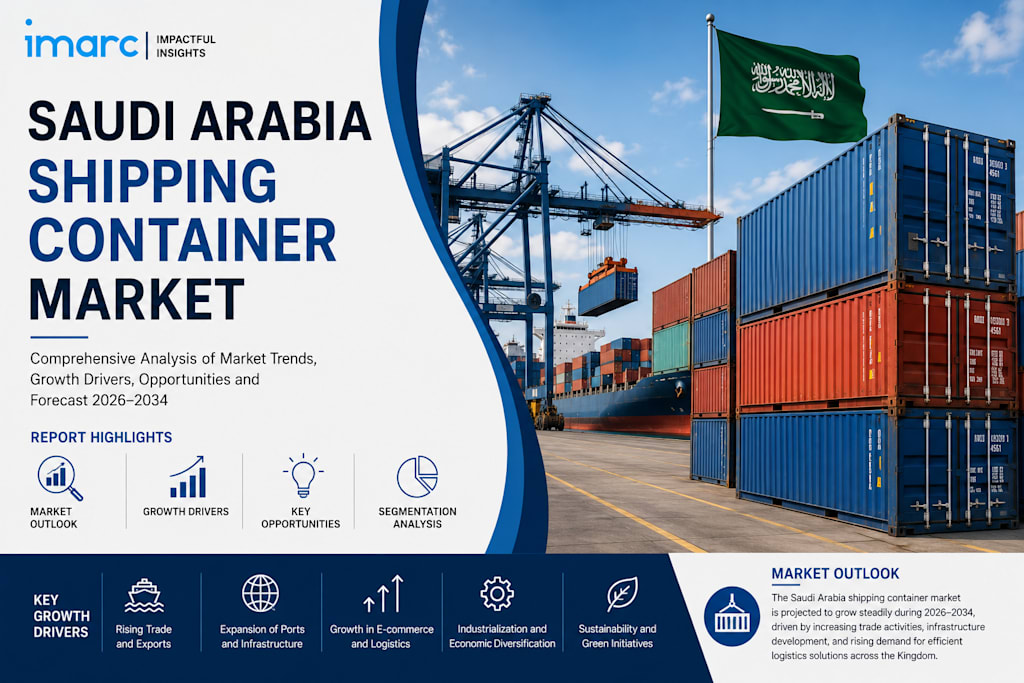
Saudi Arabia’s shipping container market sits at the intersection of two powerful forces: the Kingdom’s push to diversify its economy beyond oil and a massive government-led investment in port and logistics infrastructure. As non-oil exports grow, new energy projects multiply, and e-commerce volumes climb, the demand for reliable, standardized containerized shipping solutions is rising steadily across multiple sectors. According to IMARC Group’s latest data, The Saudi Arabia shipping container market size reached USD 117.9 Million in 2025. Looking forward, IMARC Group expects the market to reach USD 206.5 Million by 2034, exhibiting a growth rate (CAGR) of 6.23% during 2026-2034.
The market is not a single-product story it spans a broad range of container types and end-use applications that reflect Saudi Arabia’s evolving trade mix. Saudi Arabia’s total exports reached USD 25.1 billion in December 2024 alone, encompassing oil, petrochemicals, industrial equipment, and agricultural products, all of which require dependable shipping solutions. Key product segments include dry storage containers, flat rack containers, refrigerated containers, special purpose containers, and others. Container sizes range from small 20-foot units and large 40-foot units to high cube containers. Applications stretch across food and beverages, consumer goods, healthcare, industrial products, vehicle transport, and others, covering four regions: Northern and Central, Western, Eastern, and Southern Saudi Arabia.
Saudi Arabia Shipping Container Market Growth Drivers:
- Surging Export Activities and Non-Oil Trade Diversification
Saudi Arabia’s push to build an export economy beyond hydrocarbons is generating consistent demand for containerized shipping. Total exports reached USD 25.1 billion in December 2024, covering oil, petrochemicals, industrial equipment, and agricultural products. As international trade agreements expand and Vision 2030 incentivizes non-oil manufacturers, companies need secure, durable containers in larger numbers. Ports like Jeddah, Dammam, and King Abdullah Port are handling significantly higher cargo volumes to match this growth. The e-commerce surge is also playing a role driving demand for refrigerated and high-capacity units while container tracking technologies are helping businesses improve shipment security and efficiency.
- Oil, Gas, and Petrochemical Project Expansions Driving Specialized Container Demand
Large-scale energy projects are one of the most reliable demand engines for shipping containers in Saudi Arabia. In April 2025, Saudi Aramco awarded the main engineering, procurement, and construction (EPC) contract for the third expansion phase of its Jafurah unconventional gas project a landmark step in boosting the Kingdom’s gas production. Projects like these require moving heavy machinery, pipelines, and hazardous chemicals across domestic and international routes. Ports like Ras Tanura and Jubail are handling rising containerized shipments tied directly to energy exports. Specialized containers for temperature-sensitive cargo and hazardous materials are particularly in demand as the energy sector scales.
- Vision 2030 Port Modernization and Smart Logistics Investment
Government investment in port infrastructure and logistics modernization is both improving container handling capacity and making Saudi Arabia a more attractive transit hub. The National Transport and Logistics Strategy targets a top-10 position in the Global Logistics Performance Index by 2030, with the development of smart ports, free trade zones, and logistics corridors across the Kingdom. Saudi Ports Authority (Mawani) reported a 12.19% rise in container throughput to 709,393 TEU in October 2025, with transshipment volumes surging 38.68% year-on-year concrete evidence that infrastructure investment is already translating into measurably higher container volumes at major Saudi gateways.
Saudi Arabia Shipping Container Market Trends:
- Smart Port Upgrades Expanding Ultra-Large Container Handling Capacity
Saudi Arabia’s ports are being upgraded to handle the next generation of ultra-large container vessels and the scale of investment is substantial. In March 2025, DP World opened its upgraded South Container Terminal at Jeddah Islamic Port, featuring a 2,150-meter quay length with an 18-meter deep-water berth capable of hosting up to five ultra-large container ships simultaneously. Jeddah was also selected as a regional hub for the Gemini partnership, linking three Saudi ports to international terminals. These upgrades directly expand the volume of containerized cargo the Kingdom can process, attract more shipping line calls, and reduce turnaround times for exporters relying on prompt container availability.
- Feeder and Short-Sea Services Improving Regional Container Connectivity
Regional feeder shipping is emerging as a fast-growing segment within the Saudi container market. A newly established feeder and short-sea container shipping firm was launched in Saudi Arabia to connect the Kingdom with key Red Sea ports. It operates two services: a pair of 2,500 TEU feeders linking Yanbu, Jeddah, and NEOM to Ain Sokhna in Egypt weekly, and a smaller 700 TEU container vessel serving Sudan fortnightly. This connectivity expansion reduces dependence on mainline vessels for shorter regional hauls, lowers per-unit shipping costs, and opens the door to more frequent, flexible cargo cycles for Saudi exporters targeting neighboring markets.
- Digital Tracking and Container Technology Raising Operational Standards
Technology is reshaping how containers are managed throughout the Saudi logistics chain. IoT-enabled container tracking systems give shippers real-time visibility into location, temperature, and security status particularly valuable for refrigerated and hazardous cargo moving between energy project sites and export terminals. The Petroleum Products Movement Monitoring Platform already provides live digital map tracking for truck-based cargo across the Kingdom. Saudi Arabia’s AI spending is projected at USD 1.9 billion by 2027, with logistics identified as a priority sector. As digital adoption deepens, container operations are becoming faster, more transparent, and better equipped to handle the growing complexity of Saudi Arabia’s diversified trade flows.
Recent News and Developments in Saudi Arabia Shipping Container Market
- March 2025: DP World opened its upgraded South Container Terminal at Jeddah Islamic Port, featuring a 2,150-meter quay length and an 18-meter deep-water berth capable of simultaneously accommodating up to five ultra-large container vessels. Jeddah was designated as a regional hub for the Gemini shipping partnership, directly linking three Saudi ports to international terminals and reinforcing the Kingdom’s ambition to become a premier global container transshipment destination.
- April 2025: Saudi Aramco awarded the main engineering, procurement, and construction (EPC) contract for the third expansion phase of its Jafurah unconventional gas project. The milestone accelerates the Kingdom’s gas production capabilities and directly fuels demand for specialized shipping containers including flat rack, special purpose, and hazardous material units needed to transport heavy equipment, pipelines, and chemicals to and from project sites across domestic and export routes.
- October 2025: Saudi Ports Authority (Mawani) reported a 12.19% rise in container throughput to 709,393 TEU, with transshipment volumes surging 38.68% year-on-year. Total cargo tonnage across Mawani’s port network reached 21.8 million tons a direct reflection of the volume of freight feeding into and out of Saudi Arabia’s container ecosystem, and a clear signal of strengthening container demand across the Kingdom’s major gateways.
Note: If you require specific details, data, or insights that are not currently included in the scope of this report, we are happy to accommodate your request. As part of our customization service, we will gather and provide the additional information you need, tailored to your specific requirements. Please let us know your exact needs, and we will ensure the report is updated accordingly to meet your expectations.
About the Creator
Faisal Al-Harbi
Market research professional based in Saudi Arabia (KSA), focused on industry trends, market growth, and economic insights.
Writing data-driven articles on Saudi markets, business outlook, and Vision 2030–driven sectors.
Enjoyed the story? Support the Creator.
Subscribe for free to receive all their stories in your feed.
Comments
There are no comments for this story
Be the first to respond and start the conversation.