
Saudi Arabia Ship Repairing Market: Maritime Expansion, Port Infrastructure & Growth Outlook
How increasing maritime trade across the Red Sea, expansion of port infrastructure, and rising demand for vessel maintenance are driving capacity upgrades, technological adoption, and long-term growth across the Saudi Arabia Ship Repairing Market.

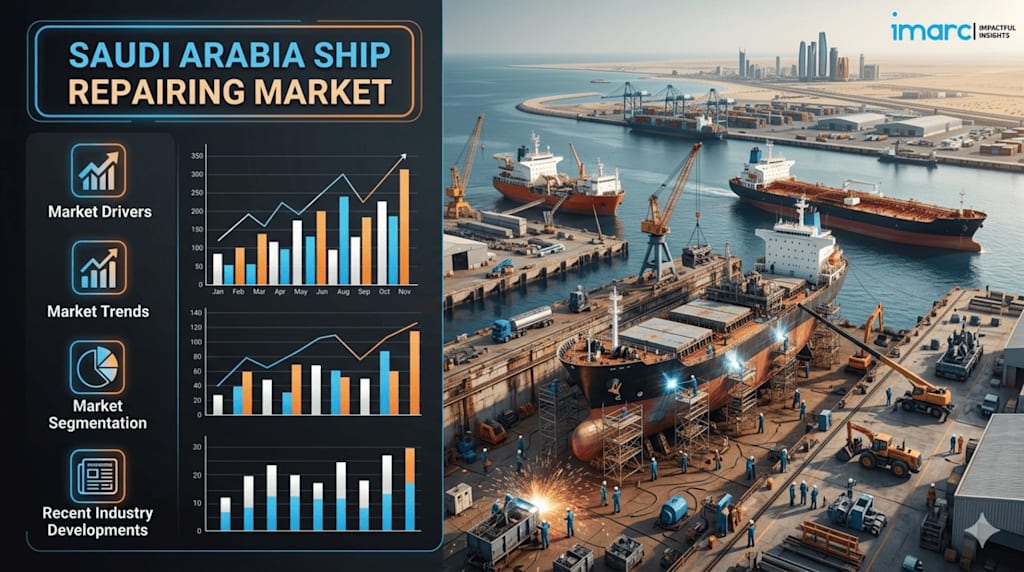
The growing maritime trade, expanding offshore energy sector, and strong government push toward localizing maritime services are reshaping Saudi Arabia's ship repair landscape. According to IMARC Group's latest data, the Saudi Arabia ship repairing market size reached USD 398.1 Million in 2025. Looking forward, IMARC Group expects the market to reach USD 840.2 Million by 2034, exhibiting a growth rate (CAGR) of 8.65% during 2026-2034. Strategic alliances, technology upgrades, and the localization agenda under Vision 2030 are the core forces driving the Saudi Arabia ship repairing market share.
Saudi Arabia's ship repair sector is growing well beyond routine maintenance. With over 500 offshore support vessels operating along the Kingdom's coast, demand for dry-docking, hull repair, engine overhaul, and electrical works is rising steadily. The King Salman International Complex for Maritime Industries and Services in Ras Al-Khair the largest maritime facility in the MENA region can service up to 250 vessels and 15 rigs annually when fully operational. About 6% of all global maritime trade passes through Saudi ports, making reliable, high-quality ship repair infrastructure not just a business opportunity but a national strategic asset.
Saudi Arabia Ship Repairing Market Growth Drivers:
- Vision 2030 Localization and Infrastructure Investment
Saudi Arabia is putting serious money into building a domestic maritime industry, not just maintaining a foreign-dependent one. The Ras Al-Khair Special Economic Zone alone is projected to contribute SAR 119 billion to exports and SAR 82 billion to GDP between 2021 and 2030, while creating over 80,000 jobs. The government's $10 billion guaranteed offtake agreement with IMI backstops private investment with real revenue certainty. Vision 2030 targets localizing 50% of military spending, which directly expands demand for naval vessel maintenance. When you back infrastructure with guaranteed contracts, the private sector follows and that's exactly what is happening here.
- Booming Offshore Energy and Fleet Demand
Saudi Arabia's offshore oil and gas expansion is generating consistent, large-scale demand for ship repair services. Over 500 offshore support vessels are currently operating off the Saudi coast, each requiring regular dry-docking, hull maintenance, and mechanical upkeep. In October 2025, Bahri placed an order for six new dry bulk carriers the Kingdom's first large-scale shipbuilding program which signals a growing fleet that will need ongoing repair and maintenance support. Saudi Arabia is also the seventh-largest defense spender globally, and naval fleet expansion under that budget is creating further demand for specialized military vessel repair and overhaul services.
- Strategic Location Along Critical Global Shipping Routes
Saudi Arabia sits at the intersection of the Red Sea and Arabian Gulf, two of the world's busiest maritime corridors. Red Sea vessel traffic is projected to climb from roughly 28,000 vessels to nearly 48,000 by 2040. Global shipping route disruptions have already redirected significant freight through Gulf ports like Dammam and Jubail. Saudi Arabia's customs clearance times dropped from 9 hours in 2021 to under two hours by 2025, and port handling capacity jumped 50% to 24.3 million standard containers. This kind of logistics efficiency makes Saudi ports natural service stops, translating directly into ship repair and maintenance business.
Saudi Arabia Ship Repairing Market Trends:
- Strategic Partnerships Expanding Local Repair Capabilities
The biggest shift in Saudi ship repair is not just money it is who is showing up to invest. In February 2023, International Maritime Industries signed agreements worth USD 350 million to expand ship repair, shipbuilding, and marine engineering at Ras Al-Khair. In January 2025, Italy's Fincantieri established Fincantieri Arabia for Naval Services specifically to transfer shipbuilding know-how and train Saudi nationals. These are not one-off deals. They represent a deliberate strategy of pairing global technical expertise with Saudi capital and scale, building a workforce pipeline alongside the physical infrastructure. The agreements align directly with Vision 2030's Saudization agenda.
- Advanced Technology and Smart MRO Services Taking Hold
Saudi shipyards are moving past manual repair into tech-driven maintenance, repair, and overhaul. In November 2024, Saudi Arabian Military Industries (SAMI) showcased AI-assisted diagnostics, advanced sensors, and automated systems at the Third Saudi International Maritime Forum. That same year, the American Bureau of Shipping opened a maritime technology center in Dammam to support certification and technical advisory services aligned with international standards. IMI's infrastructure already embeds AI and biometrics for operational efficiency. These technologies cut turnaround times, reduce costs, and allow shipyards to handle more complex repairs a direct competitive advantage as global fleets grow older and technical demands increase.
- Green Compliance and Emission Retrofitting Creating New Work
International Maritime Organization regulations on emissions are pushing shipping companies to retrofit existing vessels rather than replace entire fleets. For Saudi shipyards with the right capabilities, this is a significant new revenue stream. NEOM's collaboration with Candela in August 2024 to supply eight P-12 electric hydrofoil ships delivering through 2025 and 2026 shows how zero-emission vessel demand is already reshaping procurement decisions. Globally, emission retrofitting services are among the fastest-growing segments in ship repair right now. Saudi Arabia's shipyards, backed by government investment and international partnerships, are well-positioned to capture this work from both regional and transiting commercial fleets.
Recent News and Developments in Saudi Arabia Ship Repairing Market
- October 2025: Bahri placed an order for six dry bulk carriers, marking Saudi Arabia's first large-scale shipbuilding program. The move signals significant fleet expansion and creates sustained demand for ongoing maintenance, repair, and overhaul services across Saudi shipyards.
- November 2024: Saudi Arabian Military Industries (SAMI) participated as a strategic partner at the Third Saudi International Maritime Forum, presenting advanced maintenance, repair, and overhaul solutions featuring AI-driven diagnostics, automated systems, and smart sensor technology for precision ship servicing.
- October 2024: The American Bureau of Shipping (ABS) opened a maritime technology center in Dammam, Saudi Arabia, to provide certification support and technical expertise for ship repair services aligned with international maritime safety standards.
- January 2025: Italian shipbuilder Fincantieri established Fincantieri Arabia for Naval Services as a dedicated Saudi subsidiary, signing multiple MoUs to transfer offshore shipbuilding expertise and develop Saudi nationals for the maritime engineering workforce.
- February 2023: International Maritime Industries (IMI) signed agreements worth USD 350 million to expand its ship repair, shipbuilding, and marine engineering operations at the King Salman International Complex in Ras Al-Khair, the largest maritime facility in the MENA region.
Note: If you require specific details, data, or insights that are not currently included in the scope of this report, we are happy to accommodate your request. As part of our customization service, we will gather and provide the additional information you need, tailored to your specific requirements. Please let us know your exact needs, and we will ensure the report is updated accordingly to meet your expectations.
About the Creator
Shubham Sharma
Market research enthusiast sharing insights on global industries, emerging trends, growth opportunities, and data-driven analysis across diverse markets.
Enjoyed the story? Support the Creator.
Subscribe for free to receive all their stories in your feed.
Comments
There are no comments for this story
Be the first to respond and start the conversation.