
Saudi Arabia Semiconductor Market: Digital Transformation, Chip Demand & Growth Outlook
How rapid digital transformation under Vision 2030, growing investments in AI, IoT, and data center infrastructure, and increasing demand for advanced electronics and smart devices are driving innovation, local manufacturing initiatives, and technological advancement across the Saudi Arabia Semiconductor Market.

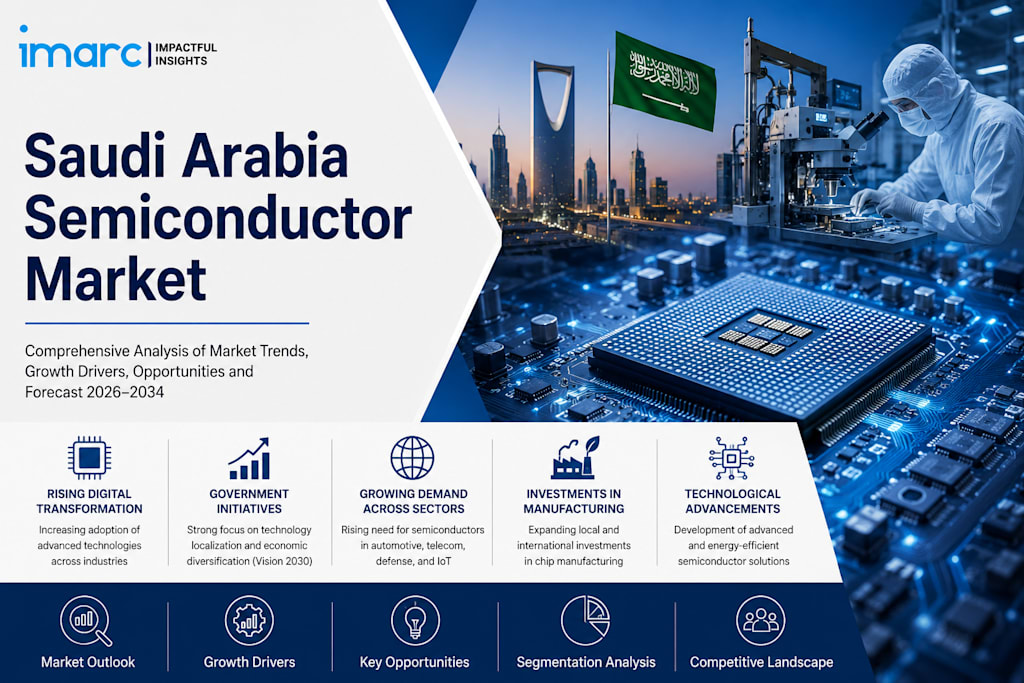
The Saudi Arabia semiconductor market size was valued at USD 6.6 Billion in 2025. Looking forward, IMARC Group estimates the market to reach USD 11.2 Billion by 2034, exhibiting a CAGR of 5.83% from 2026-2034. The Northern and Central region currently dominates the market, holding a significant market share of around 40.0%.
Saudi Arabia's semiconductor sector has moved well beyond just import dependency. Vision 2030 has turned it into a strategic build-out, with the country investing heavily in AI infrastructure, data centers, 5G networks, and smart city projects that all run on semiconductors. Major segments include memory devices, logic devices, analog ICs, microprocessors, discrete power devices, microcontrollers, and sensors, serving end markets from automotive and data centers to telecom and healthcare. Memory devices alone account for roughly 26.8% of the market, driven by explosive demand from cloud computing, big data, and AI. The region's hardware build-out is only getting started.
Saudi Arabia Semiconductor Market Growth Drivers:
- Vision 2030 and the National Semiconductor Hub
The Saudi government has put real money behind chip ambitions. The National Semiconductor Hub launched with a SAR 1 billion investment fund targeting 50 chip design firms, specifically for AI, EV, and drone applications. KACST researchers produced 25 advanced chips in July 2025, a concrete milestone in building domestic design capability. The government's strategy is not just about buying chips from abroad. It's about reducing import dependency by creating a local fabless design ecosystem, supported by cleanroom facilities, regulatory incentives, and structured funding. That combination is what separates this from past Gulf tech initiatives that stayed mostly on paper.
- AI and Data Center Buildout Creating Massive Chip Demand
Saudi Arabia's AI infrastructure push is generating semiconductor demand at a scale the country has never seen before. HUMAIN, a PIF subsidiary, secured initial delivery of 18,000 NVIDIA Blackwell GB300 GPUs in May 2025, with plans for up to 500 megawatts of data center capacity. AMD signed a USD 10 billion partnership to supply Instinct MI450 GPUs targeting 1 gigawatt of capacity by 2030, and Qualcomm is deploying 200 megawatts of its new AI200 and AI250 data center chips. AWS is also deploying 150,000 NVIDIA GPUs in a dedicated AI zone in Riyadh. This level of infrastructure investment translates directly into sustained, large-scale semiconductor procurement for years ahead.
- 5G, Smart Cities, and Automotive Electronics Expanding End-Use
Beyond data centers, semiconductor demand is spreading across multiple sectors simultaneously. Saudi Arabia's 5G rollout and projects like NEOM and King Abdullah Economic City require real-time data processing that relies on high-performance memory and logic chips. The automotive sector is adopting semiconductors for navigation, safety systems, and EV powertrains, adding a stable industrial demand layer. The green energy push is driving power semiconductor adoption in solar and wind systems. Saudi Arabia's green energy market alone was valued at over USD 1 billion and is on a steep growth path, each new solar installation requiring specialized semiconductor components for energy conversion and grid management.
Saudi Arabia Semiconductor Market Trends:
- Shift Toward Domestic Chip Design and Fabless Ecosystems
Saudi Arabia is moving from chip buyer to chip designer. The National Semiconductor Hub is pulling in fabless design companies with SAR 3.5 billion in funding commitments, focused on analog and mixed-signal ASICs, IoT chips, and automotive-grade components. In October 2025, startup SemChip launched to design ASICs and ROICs for healthcare, automotive, and consumer electronics, signaling the kind of specialized, sector-specific chip activity that sustains a long-term industry. AI is compressing chip design cycles from 18 months to 12 months while boosting power efficiency. That speed advantage matters when the market is moving as fast as it is right now in Saudi Arabia.
- Silicon Carbide and Advanced Materials Gaining Ground
The materials mix in Saudi semiconductors is shifting. Silicon carbide (SiC) is gaining traction driven by EV adoption and renewable energy applications, where its ability to handle higher voltages and temperatures makes it a better fit than traditional silicon. Other advanced materials like gallium manganese arsenide and copper indium gallium selenide are entering the picture for defense, photonics, and solar applications. As Saudi Arabia builds out both its EV ambitions and its clean energy infrastructure under Vision 2030, the demand profile for power semiconductors made from these advanced materials will only widen, creating a market segment that did not meaningfully exist here five years ago.
- US-Saudi Strategic AI Partnership Reshaping Chip Import Flows
In November 2025, the US Department of Commerce formally approved advanced semiconductor exports to HUMAIN under a new US-Saudi strategic AI partnership, clearing the way for up to 35,000 NVIDIA Blackwell chips per approved tranche. This is not routine procurement. It's a government-to-government technology alignment that gives Saudi Arabia preferential access to the world's most advanced AI chips at a time when export controls make such access genuinely competitive. AMD and Qualcomm followed with their own partnership agreements. The long-term implication is that Saudi Arabia has locked in supply relationships with the top three US chip companies, a position few countries in the region have managed to secure.
Recent News and Developments in Saudi Arabia Semiconductor Market
- May 2025: HUMAIN, a PIF subsidiary, signed a landmark partnership with NVIDIA at the Saudi-US Investment Forum in Riyadh. NVIDIA CEO Jensen Huang announced the delivery of 18,000 Blackwell GB300 GPUs for a 500-megawatt data center, with several hundred thousand more GPUs planned over five years.
- July 2025: KACST announced that Saudi researchers had designed and manufactured 25 advanced chips, marking a concrete milestone in domestic chip innovation. The chips target IoT and EV applications and were developed using cleanroom fabrication facilities within the Kingdom.
- October 2025: Saudi chip design startup SemChip launched, focused on analog and mixed-signal ASICs and ROICs for healthcare, automotive, and consumer electronics sectors. The launch signals a new wave of specialized domestic chip design activity within the Kingdom's growing fabless ecosystem.
- November 2025: The US Department of Commerce authorized advanced semiconductor exports to HUMAIN under a new US-Saudi strategic AI partnership. HUMAIN subsequently expanded its NVIDIA deal to cover up to 600,000 GPUs over three years, and signed a USD 10 billion agreement with AMD for Instinct MI450 GPU infrastructure targeting 1 gigawatt of capacity by 2030.
- December 2025: HUMAIN received its first physical shipment of NVIDIA's latest AI chips, accelerating construction timelines for data centers in Riyadh and Dammam. AWS also confirmed plans to deploy and manage up to 150,000 NVIDIA GPUs in a dedicated AI Zone in Riyadh under a separate infrastructure agreement.
Note: If you require specific details, data, or insights that are not currently included in the scope of this report, we are happy to accommodate your request. As part of our customization service, we will gather and provide the additional information you need, tailored to your specific requirements. Please let us know your exact needs, and we will ensure the report is updated accordingly to meet your expectations.
About the Creator
Faisal Al-Harbi
Market research professional based in Saudi Arabia (KSA), focused on industry trends, market growth, and economic insights.
Writing data-driven articles on Saudi markets, business outlook, and Vision 2030–driven sectors.
Enjoyed the story? Support the Creator.
Subscribe for free to receive all their stories in your feed.
Comments
There are no comments for this story
Be the first to respond and start the conversation.