
Saudi Arabia School Market to Reach USD 179.7 Billion by 2034, Growing at 11.91% CAGR
Saudi Arabia’s school market is expanding rapidly, driven by rising student population, education reforms, private sector growth, and digital learning adoption.

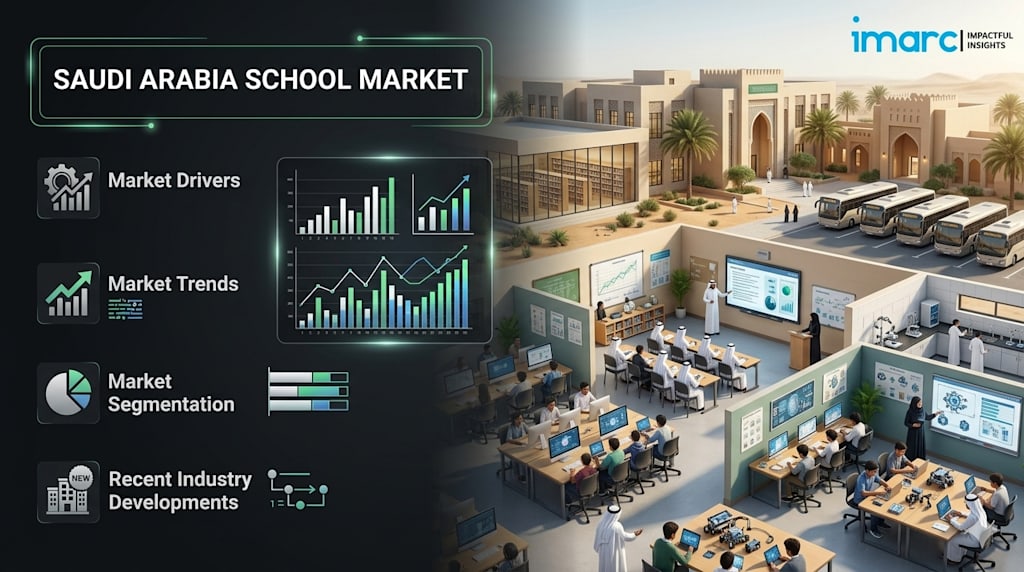
Expanding digital learning adoption, rising demand for internationally recognized curricula fueled by expatriate inflows and local aspirations, and regulatory reforms that improve transparency and streamline enrollment processes are driving the Saudi Arabia School Market, supported by Vision 2030 education mandates, growing private sector participation, and heightened parental engagement. According to IMARC Group's latest data, Saudi Arabia school market size reached USD 65.3 Billion in 2025. Looking forward, IMARC Group expects the market to reach USD 179.7 Billion by 2034, exhibiting a growth rate (CAGR) of 11.91% during 2026-2034. The market is segmented by level of education, ownership, board of affiliation, fee structure, and region, reflecting the breadth and complexity of the Kingdom's evolving education landscape.
The Saudi Arabia school market is undergoing rapid transformation as the Kingdom deepens its investment in human capital development under Vision 2030. Both government and private institutions are scaling digital infrastructure, adopting AI-powered tools, and integrating internationally benchmarked curricula to meet rising expectations from families across income brackets. Regulatory clarity around enrollment processes and school-family contracts is strengthening institutional trust and attracting new operators into the market.
Saudi Arabia School Market Growth Drivers:
- Growing Adoption of Digital Learning Tools
The acceleration of digital learning tools, both in classrooms and at home, is fundamentally reshaping expectations around school delivery formats. Schools are integrating digital platforms for homework, parent-teacher communication, lesson planning, and assessment, attracting families who value technology-enhanced education with greater visibility and personalized learning. The governing body is actively investing in digital infrastructure, making it easier for schools to adopt blended and remote learning capabilities. AI-powered tools, gamified content, and adaptive learning systems are increasingly influencing how institutions differentiate themselves and drive enrolment. In April 2025, Saudi Arabia launched an AI course for 12th-grade students, aiming to equip over 50,000 learners with essential digital skills through a dedicated digital platform blending theory with hands-on projects, as part of the Vision 2030 strategy to build a knowledge-based economy.
- Inflow of Expat Families and International Curricula Demand
The relaxation of residency and employment regulations is resulting in a consistent rise in expatriate families relocating to Saudi Arabia, particularly in major business hubs, directly driving demand for schools offering internationally recognized curricula. These families prioritize academic continuity, language familiarity, and cultural adaptability, fueling strong interest in international education options. Local families are equally drawn to these institutions, viewing them as pathways to improved international university placement and career opportunities. Authorities are proactively supporting the entry of foreign school operators and the expansion of international programs within the Kingdom. In 2024, International Schools Services (ISS) was announced as the first American-based International School Operator in Riyadh, with plans to open its first school in the city, contributing to Vision 2030's goal of enhancing education quality and aligning with the Royal Commission for Riyadh City's efforts to attract world-class institutions to the capital.
- Regulatory Reforms Enhancing Transparency and Access
Saudi Arabia's emphasis on regulatory reform is strengthening parental trust in the private education sector by establishing clearly defined enrollment processes and formalizing the rights and responsibilities of both schools and families. These reforms are reducing disputes, ensuring equitable treatment, and fostering a more stable relationship between institutions and parents. Standardized procedures are improving school operations and enrolment consistency, while promoting an inclusive and reliable educational environment aligned with Vision 2030's human capital objectives. In 2024, Saudi Arabia launched a unified electronic contract for student enrollment in private schools, clarifying the contractual relationship between schools and parents, protecting the rights of both parties, simplifying the enrollment process, and ensuring that students were not denied education due to financial difficulties.
Saudi Arabia School Market Trends:
- AI Integration and EdTech Expansion Across Institutions
The Saudi Arabia school market is experiencing strong growth momentum as institutions increasingly embed artificial intelligence and education technology into core learning experiences. Schools that demonstrate readiness for digital innovation are attracting higher enrolments and greater parent satisfaction, creating a competitive advantage in a rapidly evolving sector. In 2025, Saudi Arabia launched the Mustaqbalhum app, allowing over two million parents to access real-time performance data for more than 22,000 schools. The initiative improves educational quality, transparency, and accountability by offering insights into student performance including national test results, empowering families, and fostering healthier competition among schools. This type of government-backed digital initiative is accelerating technology adoption across both public and private institutions nationwide.
- Vision 2030 Driving Curriculum Modernization and National Identity
The Kingdom's national development agenda is actively shaping school curriculum standards, blending global academic benchmarks with a strong emphasis on cultural heritage and national identity. Government directives are ensuring that modernization does not come at the expense of Saudi values, creating a dual focus on international competitiveness and domestic pride. In January 2025, Saudi Arabia's Ministry of Education issued a directive requiring secondary school students in public and private schools to wear the national dress including the thobe and ghutra or shemagh, aiming to strengthen national identity and pride in Saudi heritage, supported by awareness programs for smooth implementation. This policy reflects the government's commitment to balancing educational modernization with cultural continuity across all levels of schooling.
- Private Sector Growth and International School Operator Entry
The Saudi Arabia school market is witnessing steady expansion in private sector participation as regulatory reforms reduce barriers to entry and international operators recognize the Kingdom's long-term education demand fundamentals. Private unaided and private aided schools are scaling capacity to serve diverse fee structure segments spanning low-income, medium-income, and high-income families, broadening access while sustaining quality. The entry of globally recognized school operators is raising the overall standard of education delivery, introducing best practices in curriculum design, teacher training, and institutional governance. This competitive environment is pushing existing institutions to upgrade facilities, adopt technology, and invest in staff development to retain and grow their student base.
Recent News and Developments in Saudi Arabia School Market
- March 2026: Private operators assume management of 60 public schools, enhancing efficiency and innovation through expanded public-private partnership models.
- February 2026: Nationwide AI curriculum expansion equips over 6 million students with progressive hands-on modules in algorithmic thinking and ethical AI use.
- February 2026: Al-Nobala Private Schools launches Kingdom’s first learning outcomes framework, linking every classroom activity to measurable competencies for future skills.
- January 2026: British Council KSA Schools Conference unites over 120 leaders to advance AI integration and leadership strategies for future-ready institutions.
- December 2025: New municipal standards permit on-campus student housing at private schools, expanding facilities and improving accessibility for larger enrollments.
Note: If you require specific details, data, or insights that are not currently included in the scope of this report, we are happy to accommodate your request. As part of our customization service, we will gather and provide the additional information you need, tailored to your specific requirements. Please let us know your exact needs, and we will ensure the report is updated accordingly to meet your expectations.
About the Creator
Kishan Kumar
My name is Kishan Roy and I am a market analyst having 5 years of experience and a skilled researcher with a keen eye for consumer trends and data-driven insights.
Enjoyed the story? Support the Creator.
Subscribe for free to receive all their stories in your feed.
Comments
There are no comments for this story
Be the first to respond and start the conversation.