
Saudi Arabia’s Smart Home Revolution: Why the Home Energy Management System Market Is Set to Triple by 2033
How Vision 2030, AI-Powered Homes, and Sustainability Goals Are Transforming Residential Energy Consumption Across the Kingdom

Introduction
Saudi Arabia is undergoing one of the most ambitious economic and technological transformations in its history. While mega-projects, renewable energy investments, and smart cities often dominate headlines, a quieter revolution is taking place inside homes across the Kingdom.
Residential consumers are increasingly embracing technologies that help them monitor, control, and optimize energy consumption. At the center of this transformation are Home Energy Management Systems (HEMS)—smart solutions that empower homeowners to reduce electricity bills, improve efficiency, and contribute to national sustainability goals.
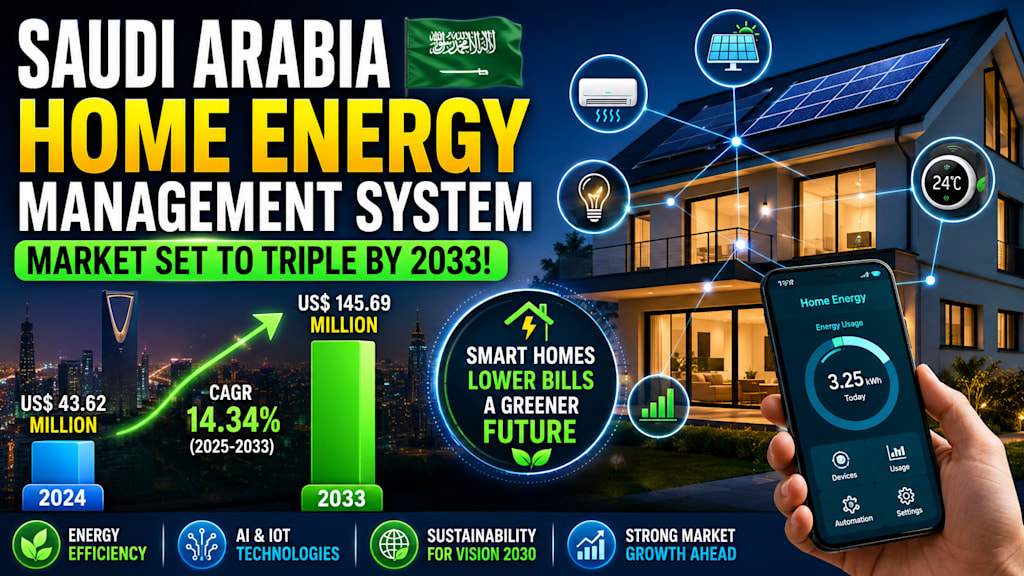
According to Renub Research, the Saudi Arabia Home Energy Management System Market was valued at US$ 43.62 Million in 2024 and is projected to reach US$ 145.69 Million by 2033, growing at a robust CAGR of 14.34% from 2025 to 2033. This impressive growth reflects rising consumer awareness, technological innovation, and strong government support for energy efficiency initiatives.
As Saudi Arabia advances toward its Vision 2030 objectives, HEMS technologies are becoming an essential component of modern living.
Understanding Home Energy Management Systems
A Home Energy Management System is a combination of hardware, software, and connected services designed to monitor and regulate household energy usage.
These systems allow homeowners to:
Track electricity consumption in real time
Control lighting and appliances remotely
Optimize HVAC operations
Schedule energy-intensive activities
Receive automated energy-saving recommendations
Integrate renewable energy sources and battery storage
Unlike traditional energy monitoring tools, modern HEMS platforms utilize artificial intelligence and Internet of Things (IoT) connectivity to continuously improve household energy efficiency.
The result is lower utility costs, enhanced convenience, and reduced environmental impact.
Market Forecast Signals Strong Growth
The market's expected growth from US$ 43.62 Million in 2024 to US$ 145.69 Million by 2033 demonstrates the increasing relevance of smart energy technologies within Saudi households.
Several factors contribute to this expansion:
Government energy efficiency initiatives
Rapid urbanization
Growing adoption of smart homes
Expansion of broadband and IoT infrastructure
Rising environmental awareness
Increased deployment of smart meters
As more Saudi consumers become digitally connected, demand for intelligent energy solutions is expected to accelerate significantly.
Vision 2030 Is Driving Smart Energy Adoption
Saudi Arabia's Vision 2030 strategy seeks to diversify the economy, reduce reliance on oil revenues, and build a sustainable future.
Energy efficiency forms a critical pillar of this transformation.
Government agencies have launched numerous initiatives aimed at:
Reducing energy waste
Modernizing infrastructure
Encouraging smart building development
Promoting digital transformation
Supporting sustainable lifestyles
Residential buildings represent a major opportunity for energy savings. By encouraging adoption of HEMS technologies, policymakers can significantly reduce national electricity demand while improving quality of life for citizens.
The alignment between Vision 2030 and smart home technologies creates a favorable environment for long-term market growth.
Artificial Intelligence Is Revolutionizing Energy Management
Artificial Intelligence is becoming one of the most influential technologies within the HEMS ecosystem.
Traditional systems simply report energy consumption. AI-powered systems go much further by analyzing usage patterns and making predictive recommendations.
For example, an AI-enabled platform can:
Learn household routines
Automatically adjust thermostat settings
Predict peak energy demand
Detect inefficient appliances
Recommend optimal energy-saving schedules
These intelligent capabilities allow homeowners to achieve energy savings without compromising comfort.
As AI adoption expands across Saudi Arabia, the value proposition of HEMS solutions becomes increasingly attractive.
The Internet of Things Creates Connected Homes
The rapid growth of IoT devices is another major catalyst for market expansion.
Connected devices such as:
Smart thermostats
Smart lighting systems
Intelligent plugs
Motion sensors
Smart appliances
Energy monitoring hubs
can communicate with one another to create a seamless energy management ecosystem.
Instead of manually adjusting multiple devices, homeowners can automate entire energy-saving strategies through a centralized platform.
This integration improves convenience while maximizing efficiency.
As IoT penetration rises across Saudi Arabia, the demand for sophisticated home energy management systems is expected to grow accordingly.
Smart Meters Are Enhancing Energy Visibility
One of the biggest barriers to energy conservation has traditionally been a lack of visibility into consumption patterns.
Smart meters solve this challenge by providing real-time energy usage data.
Consumers can now:
Monitor electricity consumption instantly
Identify high-energy appliances
Compare usage trends
Receive alerts regarding excessive consumption
This transparency encourages behavioral changes that reduce waste and lower electricity bills.
When integrated with HEMS platforms, smart meters become powerful tools for optimizing household energy performance.
Sustainability Goals Are Reshaping Consumer Behavior
Environmental awareness among Saudi consumers is increasing rapidly.
Climate change discussions, renewable energy investments, and national sustainability commitments are influencing purchasing decisions across multiple sectors.
Saudi Arabia's goal of achieving net-zero emissions by 2060 has further elevated public interest in energy conservation.
Many homeowners now view HEMS technologies as more than cost-saving tools. They see them as practical ways to contribute to environmental protection.
This growing sustainability mindset is expected to remain a major driver of future market demand.
Smart HVAC Systems Lead Residential Energy Savings
Heating, ventilation, and air conditioning systems account for a substantial portion of residential electricity consumption in Saudi Arabia.
Given the Kingdom's hot climate, cooling requirements remain high throughout much of the year.
Intelligent HVAC controllers have emerged as one of the most impactful HEMS components.
Benefits include:
Automated temperature optimization
Occupancy-based cooling
Predictive maintenance alerts
Reduced energy waste
Enhanced comfort levels
By improving HVAC efficiency, homeowners can achieve significant reductions in energy costs while maintaining comfortable indoor environments.
Cloud-Based Platforms Are Gaining Momentum
Cloud deployment models are becoming increasingly popular within the HEMS market.
Cloud-based solutions offer several advantages:
Remote access through mobile apps
Continuous software updates
Advanced analytics capabilities
Lower infrastructure requirements
Easier integration with smart home ecosystems
Consumers appreciate the flexibility and convenience these platforms provide.
As Saudi Arabia's digital infrastructure continues to improve, cloud-based HEMS adoption is likely to accelerate.
Challenges Facing Market Expansion
Despite strong growth prospects, several obstacles remain.
Dependence on Reliable Internet Connectivity
Most modern HEMS platforms rely heavily on internet connectivity.
In areas with inconsistent network performance, users may experience:
Delayed data transmission
Reduced automation efficiency
Limited remote-control functionality
Although urban connectivity continues to improve, expanding broadband access remains important for nationwide adoption.
Lack of Industry Standardization
The market also faces interoperability challenges.
Different manufacturers often utilize proprietary communication protocols and software platforms.
This can create compatibility issues when homeowners attempt to integrate products from multiple vendors.
Greater standardization across the industry could improve user experience and accelerate market growth.
Competitive Landscape
The Saudi Arabia Home Energy Management System market features several globally recognized technology leaders.
Major participants include:
Honeywell
GE Vernova (General Electric)
Xfinity Home
Panasonic Corporation
Johnson Controls
Schneider Electric
Bosch Global
These companies continue investing in AI, smart automation, cloud connectivity, and energy optimization technologies to strengthen their market positions.
10 Recent Industry Developments
1. Schneider Electric Expanded EcoStruxure Home Solutions
The company enhanced its smart home energy platform with advanced energy monitoring and automation capabilities designed to improve residential efficiency.
2. Honeywell Advanced Smart Thermostat Integration
Honeywell introduced upgraded smart thermostat functionalities featuring enhanced predictive energy management capabilities.
3. Bosch Increased Smart Home Ecosystem Investments
Bosch expanded connectivity features across its smart home portfolio to improve device interoperability and energy optimization.
4. Johnson Controls Enhanced Building Automation Technologies
The company strengthened residential automation offerings through AI-powered energy management innovations.
5. Panasonic Expanded Smart Energy Solutions
Panasonic continued investing in residential energy technologies focused on sustainability and intelligent energy consumption.
6. Xfinity Home Improved Connected Home Capabilities
The platform introduced enhanced smart home controls that integrate security and energy management features.
7. Growth in AI-Based Predictive Energy Analytics
Leading vendors increasingly deploy machine learning algorithms to forecast consumption and optimize household energy usage.
8. Rising Smart Meter Deployments Across Saudi Arabia
Utilities continue accelerating smart meter implementation programs to support digital energy management.
9. Increased Integration with Renewable Energy Systems
HEMS platforms are increasingly compatible with residential solar installations and battery storage technologies.
10. Expansion of Cloud-Based Energy Management Platforms
Vendors are investing heavily in cloud infrastructure to provide real-time analytics, remote monitoring, and scalable smart home services.
Final Thoughts
Saudi Arabia's Home Energy Management System market represents a compelling example of how digital transformation and sustainability can work together to create meaningful economic opportunities.
With the market expected to grow from US$ 43.62 Million in 2024 to US$ 145.69 Million by 2033, the sector is positioned for sustained expansion. Government support, Vision 2030 initiatives, AI innovation, IoT adoption, and growing consumer awareness are all contributing to a favorable growth environment.
As Saudi households become smarter and more connected, energy management systems will move from being optional technologies to essential components of modern living. Companies capable of delivering seamless, intelligent, and user-friendly solutions will be best positioned to capitalize on one of the Kingdom's fastest-growing smart technology markets.
Source: Renub Research Saudi Arabia Home Energy Management System Market Report
About the Creator
Enjoyed the story? Support the Creator.
Subscribe for free to receive all their stories in your feed.
Comments
There are no comments for this story
Be the first to respond and start the conversation.