
Saudi Arabia’s Data Center Market Is Moving From Promise to Powerhouse
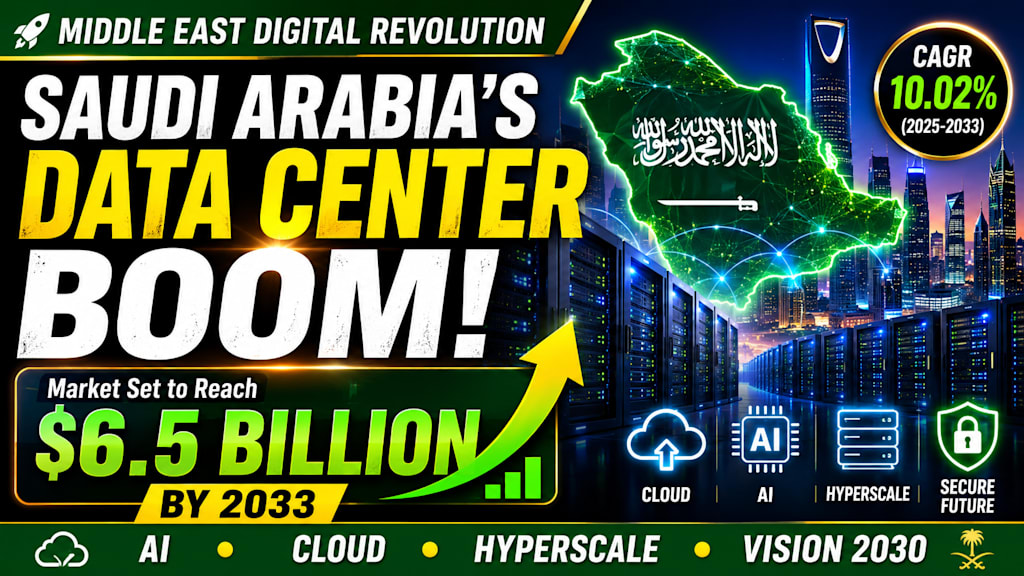
Renub Research projects the Saudi Arabia Data Center Market to rise from US$2.75 billion in 2024 to US$6.5 billion by 2033, advancing at a 10.02% CAGR as cloud adoption, AI infrastructure, and Vision 2030 spending reshape the Kingdom.

Saudi Arabia’s Data Center Story Is Getting Bigger, Faster, and More Strategic
Saudi Arabia’s data center market is no longer just a supporting part of the digital economy. It is becoming one of the Kingdom’s most important infrastructure themes, sitting at the intersection of cloud computing, artificial intelligence, cybersecurity, sovereign data rules, and national economic transformation. The market is already expanding fast, and the scale of current investment suggests this is still early in the cycle. Renub Research estimates the market at US$2.75 billion in 2024 and expects it to reach US$6.5 billion by 2033, which points to a strong long-term expansion path.
That growth story is visible on the ground. The Ministry of Communications and Information Technology said in April 2026 that Saudi Arabia now hosts more than 60 data centers developed by over 20 companies, with investments exceeding SAR16 billion, reflecting the market’s rising ability to support cloud and AI demand. The same ministry also noted that Saudi Arabia’s digital economy has become a central pillar of national growth, with data centers increasingly tied to the country’s broader technology push.
Why Demand Is Rising So Quickly
Several forces are pushing the market forward at the same time. The first is digital transformation. Saudi Arabia’s Vision 2030 agenda has created a policy environment that favors cloud adoption, sovereign digital infrastructure, and large-scale technology investment. The government’s Cloud First Policy instructs civilian government entities to prioritize cloud solutions for new IT investments and restricts the building of new data center infrastructure in many cases, which effectively channels demand toward cloud and colocation ecosystems.
The second force is the scale of the Kingdom’s digital economy itself. MCIT said in 2025 that Saudi Arabia’s digital economy had reached about SAR495 billion, contributing 15% of GDP, while the ICT market exceeded SAR180 billion in 2024. The ministry also reported that data center capacity increased 42% in 2023 to 290.5 MW, with fiber-optic coverage expanding and internet penetration approaching 99%. Those numbers matter because every step up in digital usage creates more need for compute, storage, backup, interconnection, and low-latency processing capacity.
A third driver is the growing role of artificial intelligence. Saudi Arabia is positioning itself as a regional AI and cloud hub, not just a national market for hosting servers. In 2025, the Public Investment Fund launched HUMAIN as a global AI company built around next-generation data centers, AI infrastructure, cloud capabilities, and advanced models. That is a clear signal that the Kingdom wants the data center market to support a much broader AI stack, not just conventional enterprise hosting.
Regulation, Sovereignty, and Cybersecurity Are Shaping Buying Decisions
Saudi Arabia’s data center market is also being shaped by regulation. In a market where data residency, resilience, and security are critical, policy can be as important as power availability. The National Cybersecurity Authority has the authority to strengthen cybersecurity across critical infrastructure and government services, and its Essential Cybersecurity Controls guide applies to government organizations and private-sector operators of critical national infrastructure. That creates a compliance-heavy environment, but it also raises trust in the digital ecosystem.
Data privacy and localization rules add another layer. MCIT’s computing infrastructure white paper notes that the updated personal data protection law aims to protect privacy, regulate data sharing, and prevent data abuse. For data center operators, that means a higher premium on sovereign hosting, local regions, and secure infrastructure architecture. In practical terms, this supports demand for domestic facilities rather than offshore hosting.
Cybersecurity is not just a compliance requirement; it is a market enabler. The more the Kingdom digitizes public services, finance, healthcare, retail, and industrial systems, the more it needs data centers that can support sensitive workloads safely. That is why cloud service providers, telecom operators, and hyperscale investors are all seeing opportunity in the same market.
The Climate Challenge Is Real, But It Is Also Driving Innovation
Saudi Arabia’s hot climate makes cooling one of the most important costs in data center design and operations. The original market material also highlights that cooling is a major operational expense and that the industry is moving toward more advanced cooling systems and stronger cybersecurity protections. Those realities are pushing operators to invest in liquid cooling, high-efficiency power systems, and designs that reduce energy and water usage.
That sustainability pressure is visible in recent corporate activity. Schneider Electric said in 2025 that it was showcasing AI-ready data center solutions in Saudi Arabia following its Motivair acquisition, with a focus on advanced cooling for carbon-neutral data centers. The company also signed multiple MoUs in Saudi Arabia aimed at digital transformation, energy management, and sustainable infrastructure, including support for hyperscale data centers and decarbonization efforts.
DataVolt is following a similar path. Its partnership with NEOM is designed to develop the region’s first truly sustainable, net-zero AI factory campus in Oxagon, while a later partnership with Supermicro is meant to accelerate rack-scale total liquid cooling systems for hyperscale AI campuses in Saudi Arabia and the US. This matters because the next wave of data center demand will be driven by AI workloads that consume much more power and generate much more heat than traditional enterprise applications.
What the Market Structure Looks Like
The market is spreading across several layers at once. On the component side, hardware and software both matter. On the facility side, colocation remains important, but hyperscale and edge are rising fast as cloud and AI use cases expand. Demand is also broad-based across large enterprises and SMEs, with cloud service providers, telecom companies, healthcare firms, BFSI players, retail and e-commerce operators, media businesses, and energy companies all contributing to demand. The company landscape in the source report includes Delta Electronics, Cisco, Equinix, Fujitsu, General Electric, Hitachi, Schneider Electric, and Siemens, which shows how global the competitive set has become.
That mix of players suggests the Saudi market is not just about capacity addition. It is about ecosystem building. Network equipment, power systems, cooling, security, software, cloud services, and managed connectivity all have a role to play. In a market this capital-intensive, ecosystem strength often decides which companies gain share over time.
10 Recent Developments Companies Should Not Ignore
Oracle expanded its Saudi cloud footprint when the Saudi Arabia Central (Riyadh) region became available on 31 July 2024, reinforcing local cloud availability for enterprise workloads.
PIF and Google Cloud announced a strategic partnership on 30 October 2024 to create a global AI hub near Dammam, with the deal expected to generate jobs and support GDP growth.
Microsoft reported on 4 December 2024 that construction was complete on three sites for its Saudi datacenter region, with availability expected in 2026.
DataVolt and NEOM signed an agreement on 10 February 2025 to design the region’s first truly sustainable, net-zero AI factory campus in Oxagon.
Cisco said on 9 February 2025 that it was establishing cloud services data centers in Saudi Arabia, expanding AI talent development, and planning local manufacturing.
Microsoft Arabia and the National IT Academy launched the first Microsoft Datacenter Academy in the Middle East in Saudi Arabia on 11 February 2025 to build applied datacenter skills.
AWS said on 20 March 2025 that it would launch the Saudi Arabia Region in 2026 and plans to invest US$5.3 billion, signaling long-term cloud confidence in the market.
HUMAIN, launched by PIF on 12 May 2025, was positioned as a full-stack AI company built around next-generation data centers, AI infrastructure, cloud capabilities, and advanced models.
Cisco announced on 13 May 2025 that it would join HUMAIN’s alliance to build Saudi Arabia’s future AI infrastructure, underlining the importance of networking and secure infrastructure in the AI economy.
Schneider Electric used its 12 June 2025 Saudi events to showcase AI-ready data center solutions and sign MoUs supporting digital transformation, efficiency, and sustainability across the Kingdom.
Final Thoughts
Saudi Arabia’s data center market is moving through a rare phase where policy, capital, cloud demand, AI ambition, and national strategy are all aligned. The forecast to US$6.5 billion by 2033 is impressive on its own, but the deeper story is that the Kingdom is building the digital backbone needed for a much larger transformation.
The market’s strongest advantages are clear: government support, rising digital adoption, sovereign cloud demand, and major investments from global and regional players. The biggest challenges are also clear: cooling, energy efficiency, skills shortages, and cybersecurity complexity. But in this market, those challenges are also creating opportunity for companies that can deliver resilient, efficient, and AI-ready infrastructure.
For investors, operators, and technology vendors, the message is simple. Saudi Arabia is no longer just a growth market for data centers. It is becoming one of the most important digital infrastructure destinations in the Middle East.
About the Creator
Enjoyed the story? Support the Creator.
Subscribe for free to receive all their stories in your feed.
Comments
There are no comments for this story
Be the first to respond and start the conversation.