
Saudi Arabia Revenue Cycle Management Market: Healthcare Digitization, Claims Automation & Growth Outlook
How rapid healthcare digitalization, increasing demand for efficient billing and claims processing, and growing focus on cost optimization and regulatory compliance are driving adoption of AI-powered analytics, automation, and integrated financial management solutions across the Saudi Arabia Revenue Cycle Management Market.

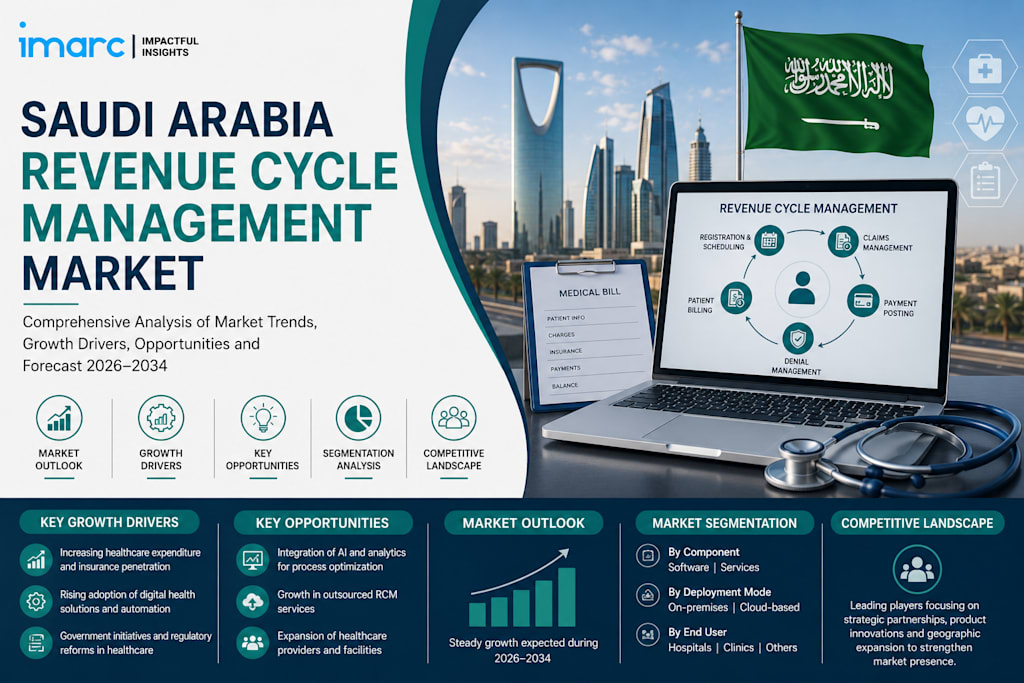
Saudi Arabia's healthcare sector is undergoing a digital revolution that's fundamentally reshaping how providers manage revenue and patient billing. Vision 2030 investments are driving a massive transformation, with healthcare spending reaching USD 69.3 billion and mandatory adoption of national digital platforms like NPHIES streamlining claims processing across the Kingdom. Healthcare organizations are recognizing that robust revenue cycle management isn't just a back-office function it's critical infrastructure that directly impacts financial sustainability and patient care quality. This convergence of regulatory pressure, technological innovation, and growing patient demand is creating an unprecedented acceleration in RCM solution adoption.
According to IMARC Group's latest data, the Saudi Arabia revenue cycle management market size was valued at USD 1,544.7 Million in 2025. Looking forward, IMARC Group expects the market to reach USD 4,009.9 Million by 2034, growing at an annual rate of 10.85% from 2026-2034.
Saudi Arabia's revenue cycle management market encompasses comprehensive solutions that healthcare organizations use to manage the entire patient financial journey from appointment scheduling through final payment collection. These systems handle critical administrative and clinical functions including patient registration, insurance verification, charge capture, medical coding, claims submission, payment processing, and denial management. RCM solutions come in various deployment models (web-based, cloud-based, on-premises) and can be standalone or integrated with electronic health records. The market serves diverse end users including hospitals, physician practices, diagnostic centers, and ambulatory care facilities across the Kingdom's Northern and Central, Western, Eastern, and Southern regions.
Saudi Arabia Revenue Cycle Management Market Growth Drivers:
- Vision 2030 Healthcare Infrastructure Investment and Digital Transformation
Saudi Arabia's Vision 2030 initiative is fundamentally reshaping healthcare infrastructure with a dedicated USD 69.3 billion investment aimed at enhancing healthcare quality and accessibility across the Kingdom. This massive public sector commitment includes constructing five new hospitals, upgrading emergency and preventive services, integrating artificial intelligence and telemedicine technologies, and mandating digital transformation across all healthcare facilities. The resulting expansion of healthcare infrastructure, patient volumes, and service complexity creates exponentially greater billing and claims management requirements. Healthcare providers must adopt sophisticated RCM solutions to manage increased transaction volumes while maintaining accuracy and compliance with evolving regulatory standards.
- Surging Patient Volumes from Population Growth and Healthcare Access Expansion
Saudi Arabia's expanding population, projected at 35.3 million individuals by mid-2024, combined with improved healthcare access and rising awareness, is driving unprecedented patient volumes across healthcare facilities. Higher patient numbers translate directly into more complex billing scenarios, increased claim volumes, and greater administrative workload that overwhelms traditional billing processes. Healthcare organizations are losing between 5-12% of their revenues due to billing errors and claim denials, while facilities throughout the Gulf Cooperation Council region lose approximately USD 4,000 per bed annually from unbilled or underbilled stays. These escalating financial losses are compelling providers to invest in automated RCM solutions that streamline workflows, enhance accuracy, reduce processing time, and maximize revenue capture.
- Medical Tourism Surge Creating International Billing Complexity
Saudi Arabia's medical tourism sector is experiencing explosive growth, expanding from USD 1,341.1 million in 2024 to a projected USD 7,918.6 million by 2033. This rapid expansion brings international patients requiring specialized billing approaches including multi-currency transactions, diverse international insurance plan navigation, and complex payment coordination across borders. Medical tourism introduces operational challenges that conventional billing systems cannot adequately address, including managing patients from multiple countries with varying insurance requirements, regulatory compliance complexities, and international payment processing. Healthcare providers seeking competitive advantage in the growing medical tourism market must implement advanced RCM solutions capable of handling international billing scenarios with flexibility and precision.
Saudi Arabia Revenue Cycle Management Market Trends:
- Artificial Intelligence and Machine Learning Revolutionizing RCM Processes
Advanced AI and machine learning algorithms are fundamentally transforming revenue cycle management by automating complex billing processes and improving accuracy. AI-driven predictive analytics reduce administrative costs by 30-40% while decreasing processing times by 25-35%, delivering significant efficiency gains especially critical for managing expanding patient volumes. AI systems identify patterns indicating potential claim denials, recommend optimal coding strategies, and automatically flag accounts requiring special attention. These intelligent systems learn continuously from historical data to predict and prevent common billing issues, enhance charge capture accuracy, and optimize payment posting workflows. Saudi Arabia's AI-driven analytics market is projected to reach SAR 2 billion, providing RCM solution providers substantial opportunities to deliver advanced intelligence that improves financial performance.
- NPHIES Platform Implementation and Mandatory Regulatory Compliance
The National Platform for Health and Insurance Exchange Services (NPHIES) has become the centerpiece of Saudi Arabia's healthcare digital transformation, with 75% of healthcare providers now integrated into this mandatory system. NPHIES streamlines claims submission, standardizes healthcare data exchange between providers and insurers, and enhances financial forecasting through unified digital infrastructure. This platform integration is no longer optional it's a mandatory requirement for operational continuity and regulatory compliance. In April 2025, Saudi Arabia further advanced RCM transformation through NPHIES, enabling faster and more accurate reimbursements while requiring healthcare organizations to upgrade technology infrastructure and staff training. Providers must invest in RCM solutions specifically designed for NPHIES compliance to meet regulatory mandates.
- Integration and Cloud-Based Solutions Dominating Market Growth
Integrated RCM solutions are increasingly displacing standalone systems, with integrated offerings commanding 55.35% of the market share in 2024 and growing at the fastest rate. Healthcare organizations recognize that integrating RCM with electronic health records, inventory management, clinical workflows, and financial reporting creates seamless operational ecosystems that eliminate data silos and streamline patient-to-revenue processes. Cloud-based deployment models are gaining traction due to superior scalability, flexibility, reduced capital expenditure, and accessibility benefits particularly valuable for multi-facility healthcare networks. These modern platforms connect insurance verification, billing, clinical documentation, and financial reporting into unified systems, providing real-time visibility into revenue cycle performance and identifying optimization opportunities healthcare providers can immediately act upon.
Recent News and Developments in Saudi Arabia Revenue Cycle Management Market:
- April 2025: Saudi Arabia accelerated its healthcare digital transformation through NPHIES under Vision 2030, implementing enhanced revenue cycle management capabilities that streamline claims, standardize data, and improve financial forecasting. The platform enables faster and more accurate reimbursements, though healthcare providers must invest in technology upgrades and staff training to fully leverage NPHIES functionality and maintain regulatory compliance across all claims processing operations.
- May 2024: Ecaresoft and Accumed announced a strategic partnership transforming revenue cycle management for outpatient care centers across Saudi Arabia. The collaboration integrates Ecaresoft's advanced digital healthcare platform with Accumed's specialized RCM services, bringing together deep expertise in healthcare technology and revenue cycle optimization. The partnership aims to boost operational efficiency, reduce claim rejections, improve financial performance, and enhance overall patient care quality for participating healthcare providers.
Note: If you require specific details, data, or insights that are not currently included in the scope of this report, we are happy to accommodate your request. As part of our customization service, we will gather and provide the additional information you need, tailored to your specific requirements. Please let us know your exact needs, and we will ensure the report is updated accordingly to meet your expectations.
About the Creator
Faisal Al-Harbi
Market research professional based in Saudi Arabia (KSA), focused on industry trends, market growth, and economic insights.
Writing data-driven articles on Saudi markets, business outlook, and Vision 2030–driven sectors.
Enjoyed the story? Support the Creator.
Subscribe for free to receive all their stories in your feed.
Comments
There are no comments for this story
Be the first to respond and start the conversation.