
Saudi Arabia Prefabricated Buildings Market Witnesses Strong Growth Trend
How rapid urbanization, large-scale infrastructure and housing developments under Vision 2030, and growing demand for cost-effective, sustainable, and time-efficient construction solutions are driving adoption of modular technologies, advanced building materials, and off-site construction methods across the Saudi Arabia Prefabricated Buildings Market.

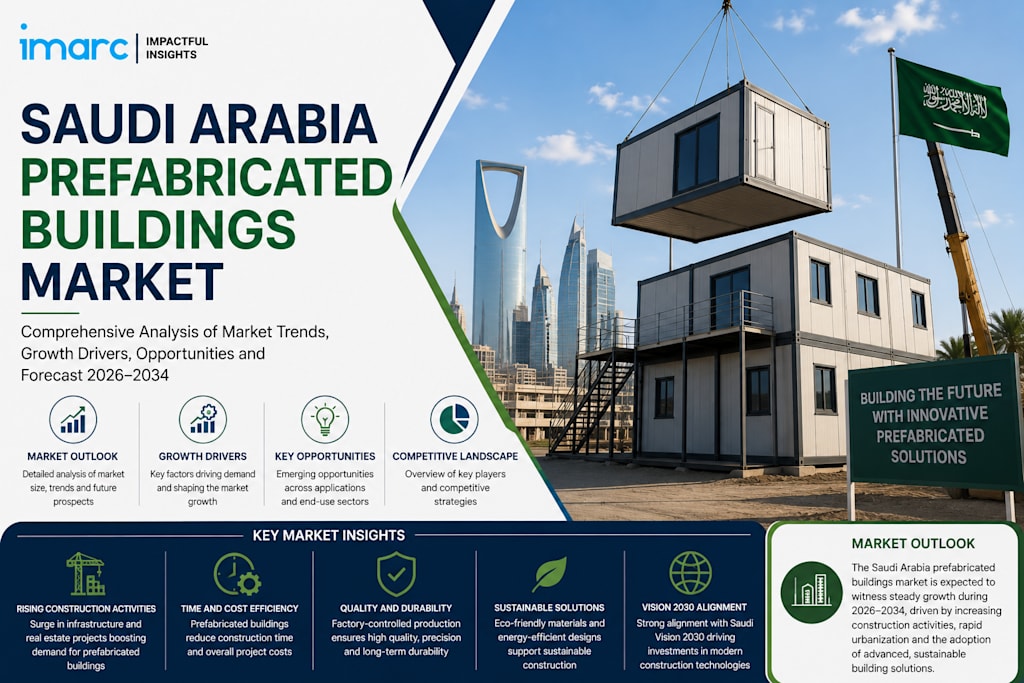
Saudi Arabia’s prefabricated buildings market is no longer just a niche alternative to conventional construction it’s quickly becoming the method of choice for a Kingdom that needs to build faster, smarter, and at a scale that traditional techniques simply can’t keep up with. With hundreds of billions of dollars flowing into megaprojects, logistics zones, schools, hospitals, and smart cities, the demand for off-site manufactured structures has never been stronger. According to IMARC Group’s latest data, The Saudi Arabia prefabricated buildings market size reached USD 1.4 Billion in 2025. Looking forward, IMARC Group expects the market to reach USD 2.3 Billion by 2034, exhibiting a growth rate (CAGR) of 5.80% during 2026-2034.
What’s making this market compelling right now is the convergence of genuine construction pressure and a government committed to solving it through technology and capital. Saudi Arabia’s construction pipeline spanning NEOM, Red Sea Global, Qiddiya, King Salman Park, and 59 planned logistics zones represents arguably the most ambitious building programme in the world by any single country. Prefabrication addresses the core problems that conventional construction cannot: compressed timelines, labor shortages, quality control at scale, and sustainability targets. The market is segmented by material type into concrete, glass, metal, timber, and others, and by application into residential, commercial, and others, spanning four key regions: Northern and Central Region, Western Region, Eastern Region, and Southern Region.
Saudi Arabia Prefabricated Buildings Market Growth Drivers:
- Mega Projects and Smart City Ambitions Demanding Off-Site Speed
The USD 1.6 billion “Heart of Khobar” smart city project a 268,000 sqm multipurpose development combining hotels, offices, retail, parks, and theaters is exactly the kind of project that makes prefabrication indispensable. Tight completion schedules, complex structural requirements, and sustainability mandates all favor factory-manufactured components over traditional site-based builds. NEOM’s phased delivery model is similarly dependent on modular construction to manage the sheer logistics of building a new city in a remote desert corridor. For developers working on Vision 2030 projects, prefabrication isn’t just a cost option it’s a delivery mechanism for meeting government-imposed timelines without compromising the quality benchmarks these landmark developments demand.
- Technology Integration Making Prefabrication More Precise and Scalable
3D printing, robotic assembly, and Building Information Modeling (BIM) have fundamentally changed what prefabricated construction can deliver. BIM enables precise digital models that reduce material waste and compress planning cycles before a single component leaves the factory floor. Automated manufacturing ensures dimensional consistency across thousands of identical units critical for large housing or hospitality rollouts. China Harbour Engineering Company’s 200,000 sqm modular manufacturing plant in northern Riyadh opened in March 2025 to supply components for ROSHN’s Sedra housing project uses advanced robotics and digital production systems that represent exactly this shift. When a single facility can match production velocity to a megaproject’s delivery schedule, prefabrication becomes the backbone of the build, not a supplement.
- Education and Healthcare PPP Programs Requiring Fast, Scalable Delivery
The completion of Phase 1 of Saudi Arabia’s Wave 2 PPP Education program which delivered 60 new schools in Medina demonstrated exactly why prefabricated construction has become the preferred method for public-sector rollouts. When you need dozens of identically specified facilities built simultaneously across a region, off-site manufacturing is the only approach that reliably hits both the cost target and the handover date. The same logic applies to healthcare. Saudi Arabia’s healthcare construction pipeline, driven by Vision 2030’s goal of expanding hospital beds and primary care coverage, is generating sustained demand for modular medical facilities that can be commissioned and operational faster than any site-built equivalent.
Saudi Arabia Prefabricated Buildings Market Trends:
- Large-Scale Domestic Manufacturing Facilities Replacing Import Dependency
The opening of China Harbour Engineering Company’s 200,000 sqm modular plant in Riyadh and NMDC Energy’s AED 200 million fabrication yard in Ras Al Khair Special Economic Zone spanning 400,000 sqm with a 40,000-ton annual production capacity signals a structural shift in how Saudi Arabia sources prefabricated components. Rather than importing pre-built modules or relying on small-scale local producers, the Kingdom is building industrial-scale manufacturing capacity inside its borders. This reduces lead times, lowers logistics costs, creates local employment, and aligns with the National Industrial Development and Logistics Program’s localization targets. For project owners, domestic supply means predictable delivery schedules and less exposure to global shipping disruptions.
- Logistics Zone Expansion Creating Consistent New-Build Pipelines
The Saudi government committed USD 2.66 billion to develop 18 new logistics zones as part of its push to grow from 55th to a top-10 ranking on the Global Logistics Performance Index. The broader target is 59 logistics zones by 2030 each requiring warehouses, operational facilities, customs processing centers, and worker accommodation built on accelerated timescales. Prefabricated structures are purpose-suited to this: they can be delivered in modular batches as zones are activated, scaled incrementally as tenant demand grows, and reconfigured if zone specifications evolve. For prefab manufacturers, these logistics corridors represent a dependable, multi-year procurement pipeline that extends well beyond individual project cycles.
- Sustainability Standards Elevating Prefab’s Competitive Position
Saudi Arabia’s construction sector is increasingly held to environmental performance benchmarks, and prefabricated buildings have a measurable advantage here. Factory-controlled manufacturing generates up to 52% less material waste compared to conventional site construction, and the precision of off-site production reduces rework and over-ordering. ROSHN’s Sedra project which explicitly incorporates modular manufacturing to deliver affordable housing aligned with Vision 2030’s sustainability mandate is a live demonstration of how prefab and green building objectives reinforce each other. As Saudi Arabia’s Green Building Code adoption expands and net-zero construction targets become embedded in public procurement specifications, prefabrication’s sustainability credentials become a competitive advantage rather than just an incidental benefit.
Recent News and Developments in Saudi Arabia Prefabricated Buildings Market
- March 2025: China Harbour Engineering Company (CHEC) opened a 200,000 sqm modular manufacturing plant in northern Riyadh to supply prefabricated components for ROSHN’s Sedra housing project, backed by the Public Investment Fund. The facility deploys advanced robotics and digital production systems to boost construction efficiency and aligns directly with Saudi Vision 2030’s goals of delivering sustainable, affordable housing at scale through modern modular building methods.
- January 2025: NMDC Energy inaugurated an AED 200 million fabrication yard in Saudi Arabia’s Ras Al Khair Special Economic Zone. Spanning 400,000 sqm, the facility will produce offshore structures and modular onshore prefabricated units with a 40,000-ton annual capacity. The project is designed to support regional energy and construction goals while promoting high-tech, sustainable manufacturing within the Kingdom’s growing industrial base.
- 2024: The Saudi government invested USD 2.66 billion in the development of 18 new logistics zones as part of its National Transport and Logistics Strategy, aiming to expand the total to 59 zones by 2030. The initiative creates a sustained construction pipeline for prefabricated warehouses, operational facilities, and worker accommodation across the Kingdom, positioning prefab contractors as critical partners in the country’s logistics infrastructure buildout.
Note: If you require specific details, data, or insights that are not currently included in the scope of this report, we are happy to accommodate your request. As part of our customization service, we will gather and provide the additional information you need, tailored to your specific requirements. Please let us know your exact needs, and we will ensure the report is updated accordingly to meet your expectations.
About the Creator
Shubham Sharma
Market research enthusiast sharing insights on global industries, emerging trends, growth opportunities, and data-driven analysis across diverse markets.
Enjoyed the story? Support the Creator.
Subscribe for free to receive all their stories in your feed.
Comments
There are no comments for this story
Be the first to respond and start the conversation.