
Saudi Arabia Precision Irrigation Market Set for Strong Expansion: Forecast to Reach US$ 183.4 Million by 2033
Rising Water Scarcity, Vision 2030 Reforms, and Smart Farming Technologies Accelerate Adoption Across Agriculture and Urban Landscapes

Introduction
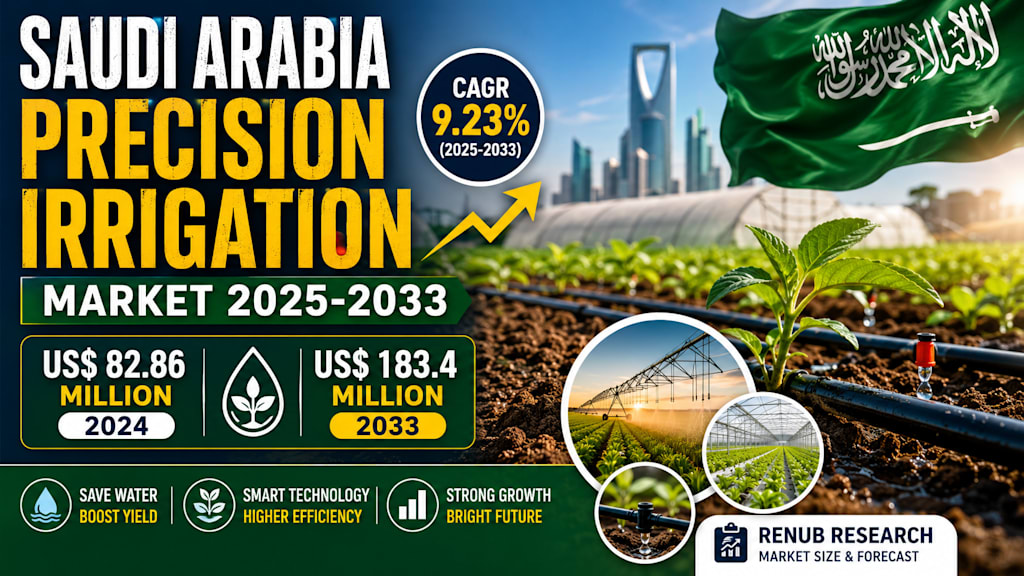
The Saudi Arabia Precision Irrigation Market is entering a transformative growth phase as the Kingdom intensifies its focus on water conservation, agricultural modernization, and food security. According to Renub Research, the market is projected to rise from US$ 82.86 Million in 2024 to US$ 183.4 Million by 2033, registering a CAGR of 9.23% during 2025–2033.
In a country where arid climatic conditions dominate and freshwater resources are severely limited, precision irrigation has emerged as a critical enabler of sustainable agriculture. By integrating advanced technologies such as IoT-based sensors, GPS mapping, automated controllers, and real-time soil monitoring systems, precision irrigation ensures optimal water usage while maximizing crop productivity.
The increasing pressure on food systems, combined with government-backed agricultural transformation under Saudi Vision 2030, is reshaping how farming is conducted across the Kingdom. From large-scale wheat farms to high-tech greenhouses and even residential landscaping, precision irrigation is becoming a foundational pillar of modern water management.
Saudi Arabia Precision Irrigation Market Overview
Precision irrigation refers to the application of water in a controlled, efficient, and data-driven manner to match the exact needs of crops. Unlike traditional flood irrigation, this system minimizes water wastage by delivering water directly to plant roots based on real-time environmental and soil conditions.
In Saudi Arabia, where agriculture consumes more than 80% of freshwater resources, the importance of precision irrigation cannot be overstated. The country relies heavily on groundwater reserves and desalinated water, both of which are under increasing pressure due to population growth and industrial expansion.
To address these challenges, farmers are rapidly adopting drip irrigation systems, center pivot sprinklers, and smart irrigation controllers. These technologies allow continuous monitoring of soil moisture, evapotranspiration levels, and weather patterns, ensuring that irrigation schedules are optimized for maximum efficiency.
Government-backed initiatives are also playing a crucial role. Organizations such as the Saudi Irrigation Organization (SIO) and global partners like the Food and Agriculture Organization (FAO) are actively promoting training programs and knowledge transfer initiatives. These efforts are strengthening technical capacity among farmers and encouraging the transition toward digital agriculture systems.
Additionally, large-scale futuristic projects like NEOM and its food subsidiary Topian are integrating high-tech greenhouse farming with precision irrigation, setting new benchmarks for agricultural innovation in the region.
Market Size and Forecast (Renub Research Insight)
2024 Market Size: US$ 82.86 Million
2033 Forecast Value: US$ 183.4 Million
CAGR (2025–2033): 9.23%
This steady upward trajectory reflects strong structural demand for water-efficient irrigation systems across agriculture, landscaping, and controlled-environment farming. The market expansion is primarily driven by technological advancement, government subsidies, and the increasing commercialization of high-value crops.
Key Growth Drivers
1. Severe Water Scarcity and Resource Optimization
Saudi Arabia is one of the most water-stressed countries globally. With limited rainfall and declining groundwater levels, efficient water use has become a national priority. Precision irrigation systems reduce evaporation losses and ensure water reaches plant roots directly, significantly improving efficiency.
The Saudi Water Authority has reinforced national commitments toward sustainable water management, aligning with global climate initiatives such as COP16 under the United Nations Convention to Combat Desertification (UNCCD). These policy efforts are accelerating adoption across farms.
2. Vision 2030 Agricultural Transformation
Under Saudi Vision 2030, the government is actively promoting agricultural modernization to reduce dependency on food imports. Subsidies, financing support, and infrastructure investments are encouraging farmers to shift from traditional irrigation methods to advanced smart systems.
Digital agriculture platforms integrating sensors, IoT devices, and AI-based analytics are becoming increasingly common, improving decision-making and resource allocation across farms.
3. Expansion of High-Value and Greenhouse Crops
Saudi Arabia’s shift toward high-value crops such as vegetables, fruits, and vineyards is a major market driver. These crops require precise water and nutrient management, making drip irrigation systems particularly suitable.
Greenhouse farming is expanding rapidly, supported by controlled environments that rely heavily on automated irrigation systems. Projects like NEOM Topian’s Oxagon greenhouse facility highlight the Kingdom’s ambition to build sustainable food production ecosystems.
Market Challenges
High Initial Investment Costs
One of the biggest barriers to adoption is the high upfront cost of precision irrigation systems. Equipment such as drip lines, sensors, controllers, and automation systems requires significant capital investment. Small and medium farmers often struggle to afford these technologies without subsidies or financial assistance.
Limited Technical Knowledge and Skilled Workforce
The successful implementation of precision irrigation requires expertise in agronomy, soil science, and data interpretation. However, many farmers still lack adequate training in operating advanced systems. This skill gap limits optimal utilization and slows down large-scale adoption.
To address this, organizations like the FAO and Saudi Irrigation Organization (SIO) are conducting training programs, but widespread capacity building is still needed.
Market Segmentation Insights
By Type
Drip Irrigation
Sprinkler Irrigation
Others
Drip irrigation dominates high-value crop farming, while sprinkler systems are widely used in large-scale field crops.
By Crop Type
Field Crops
Vegetable Crops
Orchard Crops
Vineyards
Others
Vegetable and orchard crops are the fastest-growing segments due to rising domestic demand and export opportunities.
By Application
Agricultural Fields
Greenhouses
Residential Landscaping
Turf & Public Spaces
Agriculture remains the dominant application, but residential adoption is steadily increasing due to urban greening initiatives.
Regional and City-Level Insights
Dhahran
Dhahran is emerging as a key hub for agricultural innovation and landscaping projects. Adoption of smart irrigation is increasing due to strong institutional support and research-driven farming practices.
Jeddah
Jeddah’s surrounding agricultural belt is witnessing rising use of drip irrigation systems to meet urban food demand. Municipal landscaping projects also support growth.
Dammam
Dammam combines agricultural fields and urban development, creating balanced demand for both drip and sprinkler irrigation systems. Industrial investment is also encouraging technology adoption.
Competitive Landscape
The Saudi precision irrigation market features a mix of global leaders and regional players focused on technology innovation and system integration.
Key companies include:
Jain Irrigation Systems Ltd
Lindsay Corporation
The Toro Company
Valmont Industries
These companies are focusing on automation, IoT integration, and water-efficient irrigation solutions tailored for arid regions like the Middle East.
10 Recent Developments (Vocal Format)
Jan 2025 – Saudi Irrigation Organization (SIO): Launched advanced farmer training programs to enhance smart irrigation adoption.
Dec 2024 – NEOM Topian: Opened its first high-tech greenhouse facility at Oxagon with automated irrigation systems.
Dec 2024 – Saudi Water Authority: Announced strategic initiatives at COP16 to strengthen water conservation policies.
Nov 2024 – FAO & SIO Collaboration: Introduced intensive training on modern irrigation technologies for lead farmers.
Oct 2024 – Ministry of Environment, Water and Agriculture: Expanded subsidies for drip irrigation systems across small farms.
Sep 2024 – Private Agri-Tech Firms: Increased deployment of IoT-based soil moisture sensors across large farms.
Aug 2024 – Agricultural Development Fund: Enhanced financing schemes for precision irrigation equipment purchase.
Jul 2024 – Regional Farming Cooperatives: Began pilot projects for AI-based irrigation scheduling systems.
Jun 2024 – Greenhouse Expansion Projects: Several private investors expanded hydroponic farming facilities using smart irrigation.
May 2024 – Smart City Landscaping Projects: Urban municipalities increased adoption of automated sprinkler systems for parks and green zones.
Final Thoughts
The Saudi Arabia Precision Irrigation Market stands at the forefront of the Kingdom’s agricultural transformation journey. Driven by water scarcity, technological advancement, and strong policy backing under Vision 2030, the market is evolving rapidly toward fully digital and data-driven farming systems.
While challenges such as high initial investment and skill gaps persist, continued government support, international collaboration, and private sector innovation are expected to overcome these barriers. As precision irrigation becomes more accessible and affordable, it will play a decisive role in securing Saudi Arabia’s long-term food security and sustainable agricultural future.
About the Creator
Enjoyed the story? Support the Creator.
Subscribe for free to receive all their stories in your feed.
Comments
There are no comments for this story
Be the first to respond and start the conversation.