
Saudi Arabia Poultry Meat Market to Reach US$ 5.85 Billion by 2034 as Urbanization and Food Security Initiatives Drive Growth
Rising population, expanding quick-service restaurants, and strong government support for domestic poultry production are accelerating Saudi Arabia’s poultry meat industry

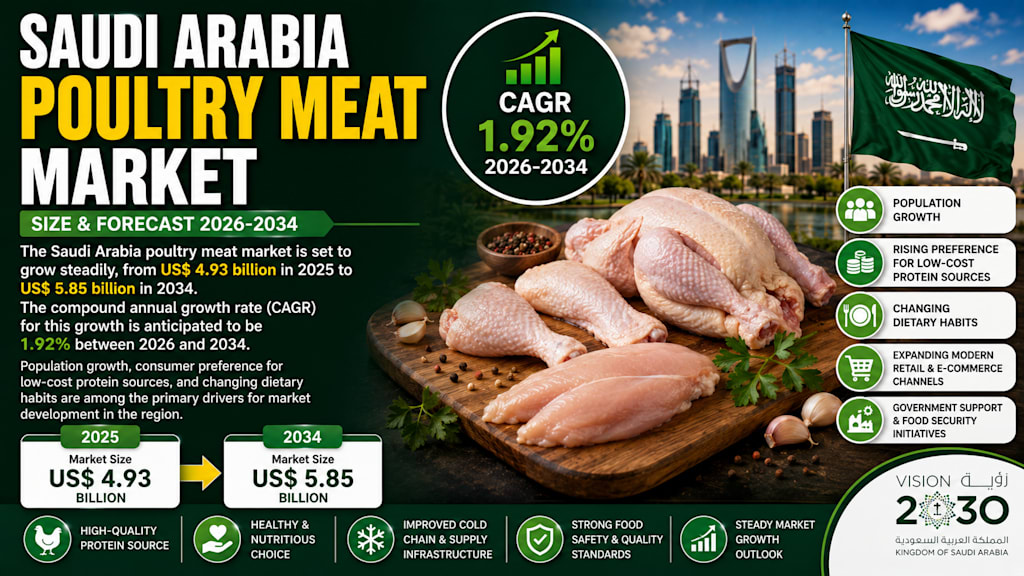
The Saudi Arabia poultry meat market is expected to witness stable growth over the coming decade as rising urbanization, increasing protein consumption, and government-backed food security initiatives continue supporting domestic demand. According to Renub Research, the Saudi Arabia poultry meat market is projected to grow from US$ 4.93 billion in 2025 to US$ 5.85 billion by 2034, registering a CAGR of 1.92% from 2026 to 2034. Population growth, changing dietary habits, growing preference for affordable protein sources, and expansion of modern retail and foodservice sectors are among the major factors driving the market forward.
Poultry meat remains one of the most important protein sources in Saudi Arabia because of its affordability, accessibility, nutritional value, and compatibility with halal dietary requirements. Chicken dominates the market and plays a central role in both traditional Saudi cuisine and international food offerings available across restaurants and retail outlets.
The market is also evolving rapidly as consumers increasingly seek healthier proteins, convenient processed foods, and high-quality fresh or chilled poultry products. At the same time, Saudi Arabia’s Vision 2030 strategy continues encouraging greater domestic poultry production and higher levels of self-sufficiency, creating long-term opportunities for industry expansion.
Rising Population and Urbanization Are Strengthening Demand
One of the strongest growth drivers for the Saudi Arabia poultry meat market is the country’s expanding population and rapid urbanization.
The report notes that Saudi Arabia’s population reached 33.26 million people in 2023 and is expected to grow significantly by 2050. Rising urban populations are contributing to changing food consumption patterns, with consumers increasingly prioritizing protein-rich diets and convenient meal solutions.
Poultry meat is especially attractive because it is more affordable than beef or lamb while still offering strong nutritional value. Chicken remains the preferred protein choice for many households because it can be incorporated into a wide variety of traditional and modern dishes.
Urban lifestyles are also influencing consumption habits. Busy consumers increasingly seek products that are easy to cook, store, and prepare, helping support stronger demand for chilled, frozen, and processed poultry products.
The country’s large expatriate population is another major contributor to market growth. Consumers from South Asia, the Middle East, and other international regions rely heavily on poultry as an affordable and versatile protein source, increasing overall consumption levels across Saudi Arabia.
Quick-Service Restaurants and Foodservice Expansion Are Boosting Consumption
The rapid expansion of quick-service restaurants and foodservice operations is playing a major role in increasing poultry demand across the Kingdom.
Fast-food chains, casual dining restaurants, hotels, catering companies, and international franchises heavily depend on poultry products for menu items such as fried chicken, burgers, sandwiches, nuggets, shawarma, and grilled meals.
The growing popularity of dining out, food delivery platforms, and online ordering applications has further accelerated poultry consumption. Technology-driven delivery services are making poultry-based meals more accessible and convenient for urban consumers.
Saudi Arabia’s Vision 2030 tourism initiatives are also contributing to stronger demand. Expanding hospitality infrastructure, rising tourism activity, and growing entertainment sectors are increasing the number of restaurants, hotels, and catering operations throughout the country.
The report highlights that international foodservice brands entering the Saudi market are introducing new poultry-based menu concepts tailored to local preferences, further supporting market growth.
This expansion of foodservice channels is expected to remain a key long-term driver for poultry meat demand across major Saudi cities.
Government Support and Vision 2030 Are Encouraging Domestic Production
Government initiatives are playing a central role in transforming Saudi Arabia’s poultry meat industry.
Under Vision 2030, Saudi Arabia has implemented several policies and investment programs aimed at improving food security and reducing dependence on imports. Subsidies, financing support, modern agricultural technologies, and feed-efficiency programs are all helping strengthen domestic poultry production.
The government has also encouraged private-sector investment and foreign partnerships within the poultry industry to improve production capabilities and modernize supply chains.
According to the report, Saudi Arabia increased poultry self-sufficiency levels from 45% in 2016 to approximately 68% by the time of the Middle East Poultry Expo 2025. The Kingdom is targeting 80% self-sufficiency through continued investment and policy support.
Bloomberg reports cited in the study indicate that the Saudi government invested approximately USD 5 billion to expand broiler chicken production capacity to 1.3 million tons annually.
These investments are helping strengthen domestic production stability while reducing vulnerability to global supply-chain disruptions and import-related risks.
Fresh and Chilled Poultry Products Continue Dominating Consumer Preferences
Fresh and chilled poultry meat remains one of the most important segments within Saudi Arabia’s poultry industry.
Consumers strongly associate fresh poultry with better quality, freshness, and taste. Cultural preferences and trust in locally produced products also support strong demand for chilled poultry across households and retail channels.
Government support for domestic poultry farming has further strengthened the fresh poultry segment by increasing local production capacity and improving supply-chain infrastructure.
Modern logistics systems, refrigerated transportation, and cold-storage technologies are helping ensure wider availability of fresh poultry products across urban and semi-urban regions.
Health-conscious consumers increasingly prefer fresh poultry because of perceptions regarding food safety, nutritional value, and product quality. As retail infrastructure continues expanding, fresh poultry demand is expected to remain highly resilient.
Frozen Poultry Meat Supports Supply Stability
Frozen poultry products also play a crucial role within Saudi Arabia’s poultry ecosystem.
Because of the country’s climate conditions and high demand levels, frozen poultry products help maintain stable supply throughout the year. Consumers value frozen products because they are affordable, convenient, and easy to store.
Imports continue to represent a major source of frozen poultry supply, especially during periods of high consumption.
Advancements in freezing technology and cold-chain infrastructure have significantly improved frozen poultry quality in recent years, helping reduce negative perceptions regarding texture and freshness.
The foodservice industry also relies heavily on frozen poultry because of its consistency, cost-effectiveness, and operational convenience.
As consumer lifestyles become increasingly convenience-oriented, frozen poultry demand is expected to continue growing steadily.
Processed Poultry Products Are Becoming More Popular
Processed poultry products are gaining strong momentum across Saudi Arabia because of changing lifestyles and growing demand for convenient meal solutions.
Products such as poultry nuggets, sausages, deli meats, marinated cuts, tenders, and meatballs are becoming increasingly popular among urban consumers and younger households.
The report highlights that poultry meatballs, in particular, are seeing rising demand because of their versatility, ease of preparation, and compatibility with both traditional and international cuisines.
Busy work schedules and urban lifestyles are encouraging consumers to purchase ready-to-cook and ready-to-eat poultry products that save time while maintaining flavor and nutritional value.
Manufacturers are responding by introducing healthier formulations with lower fat content, reduced preservatives, and improved packaging solutions aimed at health-conscious buyers.
Imported Feed Dependence Remains a Major Challenge
Despite strong growth prospects, the Saudi Arabia poultry meat market continues facing several operational challenges.
One of the most significant issues is the country’s dependence on imported feed ingredients such as corn and soybean meal. Saudi Arabia’s arid climate limits domestic feed crop production, forcing poultry producers to rely heavily on international suppliers.
Volatile feed prices, transportation expenses, and currency fluctuations directly affect production costs and industry profitability.
Smaller poultry producers are particularly vulnerable because they often have fewer financial resources to absorb sudden cost increases.
Maintaining affordable poultry prices while managing rising production expenses remains one of the industry’s biggest long-term challenges.
Disease Risks and Biosecurity Concerns Continue Affecting the Industry
Disease outbreaks and biosecurity risks also remain major concerns for the Saudi poultry industry.
The report highlights the potential impact of diseases such as avian influenza, which can disrupt production, reduce flock numbers, and damage consumer confidence.
Biosecurity management requires significant investment in hygiene systems, disease monitoring, veterinary controls, and operational protocols. These measures can be expensive and difficult to maintain, especially for smaller farms.
Disease outbreaks may also lead to supply-chain disruptions and reduced profitability across the poultry value chain.
As domestic production expands, maintaining strong biosecurity systems will remain critical for ensuring long-term market stability and consumer trust.
Riyadh Remains the Largest Poultry Meat Market
Riyadh represents the most important poultry meat market in Saudi Arabia because of its large population, high urbanization rate, and strong purchasing power.
Consumers in Riyadh rely heavily on poultry as an affordable and versatile protein source suitable for both traditional Saudi dishes and international cuisine.
The city benefits from extensive retail infrastructure, including supermarkets, hypermarkets, specialty stores, and online grocery platforms that ensure wide product availability.
The foodservice sector in Riyadh also plays a major role in driving demand. Restaurants, hotels, and fast-food chains consume large volumes of poultry products throughout the year.
Government support for domestic production has further improved supply-chain efficiency and strengthened product availability across the capital.
Jeddah Benefits from Tourism and International Food Culture
Jeddah’s poultry meat market is heavily influenced by its position as a major commercial hub, port city, and tourism center.
The city’s multicultural population and large expatriate community support strong demand for a diverse range of poultry products and cuisines. Poultry plays an important role in both traditional Saudi food and international restaurant offerings throughout the city.
Jeddah’s seaport also facilitates frozen poultry imports, helping maintain stable supply levels across retail and foodservice channels.
The city’s expanding hospitality industry and growing demand for convenient food products continue supporting poultry market growth.
Dammam and Dhahran Continue Supporting Regional Growth
Dammam and Dhahran remain important regional poultry markets because of their strong industrial activity, affluent populations, and expanding retail infrastructure.
Dammam benefits from its strategic location near trade centers and Gulf markets, allowing efficient distribution of poultry products. Supermarkets, hypermarkets, and traditional markets all contribute to strong local demand.
Dhahran’s high-income consumers increasingly seek premium poultry products, including fresh, organic, and processed varieties.
Both cities also show rising demand for ready-to-cook and convenience-oriented poultry products due to busy working lifestyles and expanding foodservice activity.
Key Companies Operating in the Saudi Arabia Poultry Meat Market
Major companies operating in the market include Al-Watania Poultry, Almarai Food Company, Almunajem Foods, Americana Group, BRF, Sunbulah Group, Tanmiah Food Company, and The Savola Group.
These companies compete through domestic production expansion, cold-chain investment, processed product innovation, retail partnerships, and foodservice distribution capabilities.
Final Thoughts
Saudi Arabia’s poultry meat market is entering a period of stable and strategically important growth supported by rising population levels, expanding urbanization, stronger foodservice activity, and government-backed food security initiatives.
Consumers continue favoring poultry because of its affordability, nutritional value, halal compatibility, and versatility across traditional and modern cuisines. At the same time, Vision 2030 policies aimed at improving domestic self-sufficiency are strengthening production capacity and supply-chain resilience.
According to Renub Research, the Saudi Arabia poultry meat market is projected to reach US$ 5.85 billion by 2034, reflecting the long-term importance of poultry within the Kingdom’s evolving food ecosystem.
Although challenges related to imported feed costs, biosecurity risks, and operational expenses remain significant, ongoing investment in domestic production, modern logistics, and processed poultry innovation is expected to support the next phase of market development.
About the Creator
Enjoyed the story? Support the Creator.
Subscribe for free to receive all their stories in your feed.
Comments
There are no comments for this story
Be the first to respond and start the conversation.