
Saudi Arabia Petrochemicals Market: Industrial Diversification, Export Growth & Expansion Outlook
How abundant hydrocarbon resources, rising investments in downstream diversification under Vision 2030, and increasing global demand for specialty chemicals and sustainable petrochemical products are driving capacity expansion, technological innovation, and export growth across the Saudi Arabia Petrochemicals Market.

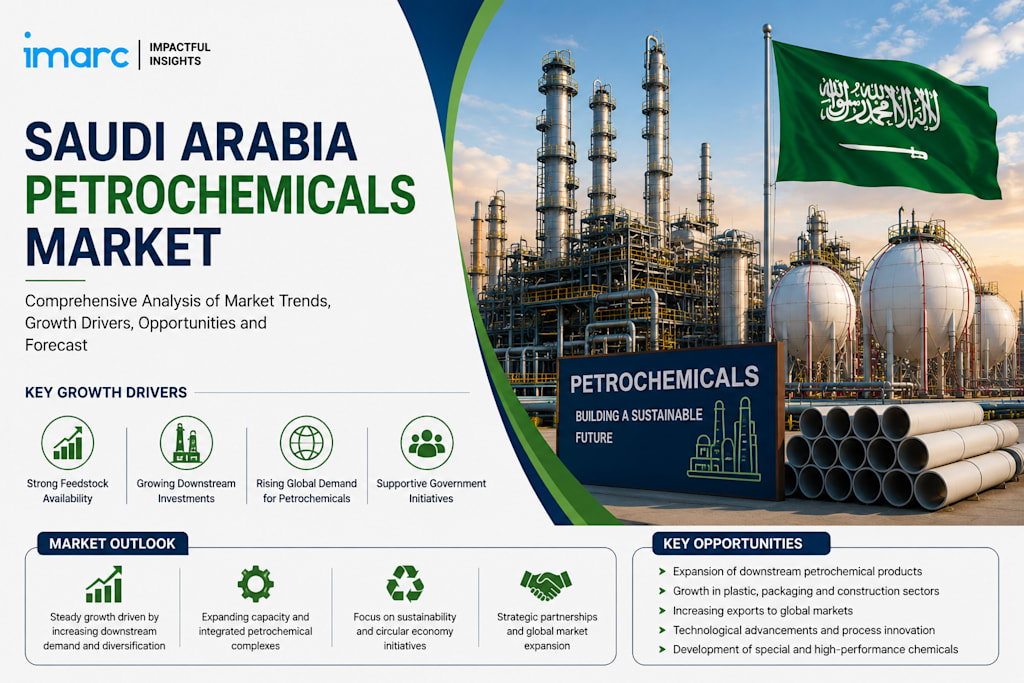
Saudi Arabia’s petrochemical industry sits at the intersection of two powerful forces an unmatched natural resource base and a government determined to diversify far beyond crude oil exports. The Kingdom’s petrochemical sector already accounts for nearly 80% of the entire Gulf Cooperation Council’s petrochemical revenue, with the sector generating over SAR 310 billion (approximately USD 82.7 billion) annually. According to IMARC Group’s latest data, The Saudi Arabia petrochemicals market size reached USD 6.3 Billion in 2025. Looking forward, IMARC Group expects the market to reach USD 9.2 Billion by 2034, exhibiting a growth rate (CAGR) of 4.37% during 2026-2034.
The industry’s growth story is about more than just scale it’s a deliberate transition from commodity chemicals to higher-value downstream products. Saudi Arabia’s petrochemical production capacity is targeting a doubling from approximately 75 million tonnes per year to over 140 million metric tonnes, driven by advantaged feedstock costs, integrated infrastructure across Jubail and Yanbu industrial cities, and a series of major capital projects currently in development. Saudi petrochemical exports reached approximately USD 45-50 billion, representing the country’s largest non-crude export category. The market is segmented by type covering ethylene, propylene, butadiene, benzene, toluene, xylene, methanol, and others with applications spanning polymers, paints and coatings, solvents, rubber, adhesives and sealants, surfactants and dyes, and others. End-use industries include packaging, automotive and transportation, construction, electrical and electronics, and healthcare, across four key regions: Northern and Central, Western, Eastern, and Southern Saudi Arabia.
Saudi Arabia Petrochemicals Market Growth Drivers:
- Abundant Feedstock Advantage and Integrated Refining Infrastructure
Saudi Arabia’s cost advantage in petrochemical production is structural, not cyclical. The Kingdom’s access to low-cost ethane and naphtha feedstocks supplied directly from one of the world’s largest hydrocarbon reserves gives domestic producers a margin buffer that competitors in Europe and Asia simply cannot match. Jubail Industrial City alone hosts over 150 petrochemical and chemical plants connected by an integrated pipeline and utilities network. The Aramco-SABIC integration deepened this further, creating a vertically integrated crude-to-chemicals pathway that can convert up to 50% of a crude barrel output directly into chemical feedstocks fundamentally improving production economics and enabling competitive exports to global markets at scale.
- Vision 2030 Industrial Diversification and Export Ambition
The Saudi government has made petrochemical expansion a central pillar of its economic diversification agenda. The Ministry of Energy’s feedstock allocation approvals in March 2025 for two new complexes in Jubail including a joint Sipchem-LyondellBasell cracker targeting 1.5 million tonnes per year of ethylene signal sustained policy commitment to growing the downstream base. The sector already employs approximately 250,000 workers directly and indirectly and has been a primary vehicle for industrial skills development. SABIC’s planned USD 4 billion capital expenditure program and Aramco’s USD 48-58 billion annual investment envelope both reflect how aggressively the Kingdom is using petrochemicals as a strategic economic lever.
- Rising Global Demand for Plastics, Polymers, and Specialty Chemicals
Global demand for petrochemical-derived products is not slowing down. As electric vehicles replace combustion engines, oil’s role as a transport fuel declines but demand for lightweight plastics in EV bodies, synthetic rubber in tires, and specialty polymers in battery components is accelerating. The packaging, electronics, and construction industries collectively represent Saudi Arabia’s largest petrochemical end-user segments. SABIC’s USD 6.4 billion joint venture in Fujian, China designed to produce 1.8 million metric tonnes of ethylene per year is a direct response to growing Asian demand, and positions the Kingdom to capture long-term growth in the world’s most dynamic chemicals consumption market.
Saudi Arabia Petrochemicals Market Trends:
- Shift to High-Value Downstream and Specialty Chemicals
Saudi Arabia is deliberately moving up the chemical value chain. Rather than continuing to export bulk commodity chemicals at thin margins, producers like SABIC and Aramco are investing heavily in specialty chemicals, advanced polymers, and performance materials for use in automotive, aerospace, electronics, and healthcare applications. The Tasnee-approved complex in Jubail targeting 3.3 million tonnes per year of polyethylene, MTBE, and specialty chemicals with an expected launch by Q4 2030 represents this upstream-to-specialty progression in action. This pivot generates better margins, reduces export commodity-price exposure, and aligns with Vision 2030’s objective of building knowledge-intensive industries that require domestic technical capability.
- Hydrogen and Ammonia Emerging as Strategic Growth Frontiers
Saudi Arabia is extending its petrochemical base into blue and green hydrogen, leveraging its natural gas reserves and growing renewable capacity to target export markets in Europe and Asia. The NEOM Green Hydrogen Project is designed to produce 650 tonnes of hydrogen per day, making it the largest facility of its kind globally upon completion. Low-carbon ammonia a hydrogen carrier for maritime and industrial applications is another priority sector, with Aramco and NEOM both investing at scale. This positions Saudi Arabia not just as a dominant oil and chemicals exporter, but as a future anchor supplier to the clean energy supply chains being built across Japan, South Korea, Germany, and the Netherlands.
- Sustainability, Carbon Capture, and Circular Economy Integration
Environmental compliance is becoming a competitive requirement rather than an optional upgrade for Saudi petrochemical producers. SABIC operates the world’s largest carbon capture and purification plant, sequestering 500,000 metric tonnes of CO₂ annually from ethylene glycol production and reusing it as feedstock reducing both emissions and input costs. The company has publicly committed to achieving carbon neutrality from its operations by 2050. Saudi Arabia’s growing investment in green technologies, waste-to-value processes, and bio-based chemicals is reshaping how international buyers perceive the sector, attracting ESG-focused investors and enabling access to European and North American supply chains with stricter carbon-accounting requirements.
- Recent News and Developments in Saudi Arabia Petrochemicals Market
- March 2025: Saudi Arabia’s Ministry of Energy approved feedstock allocation for two major new petrochemical complexes in Jubail. Sipchem and LyondellBasell announced a joint project featuring a mixed-feed cracker with a capacity of 1.5 million tonnes per year of ethylene and 1.8 million tonnes per year of polymers. In a separate approval, Tasnee received clearance for a complex targeting 3.3 million tonnes per year of polyethylene, MTBE, and specialty chemicals, with a planned launch by Q4 2030.
- February 2025: SABIC returned to profitability in 2024, posting a net profit of SAR 1.5 billion (USD 400 million) a significant turnaround from a SAR 2.8 billion loss in 2023. CEO Abdulrahman Al Fageeh confirmed the company would commit up to USD 4 billion in capital expenditure on new projects, reinforcing SABIC’s long-term investment appetite despite a challenging global chemicals pricing environment.
Note: If you require specific details, data, or insights that are not currently included in the scope of this report, we are happy to accommodate your request. As part of our customization service, we will gather and provide the additional information you need, tailored to your specific requirements. Please let us know your exact needs, and we will ensure the report is updated accordingly to meet your expectations.
About the Creator
Faisal Al-Harbi
Market research professional based in Saudi Arabia (KSA), focused on industry trends, market growth, and economic insights.
Writing data-driven articles on Saudi markets, business outlook, and Vision 2030–driven sectors.
Enjoyed the story? Support the Creator.
Subscribe for free to receive all their stories in your feed.
Comments
There are no comments for this story
Be the first to respond and start the conversation.