
Saudi Arabia PE Pipes Market: Infrastructure Development, Water Management & Growth Outlook
How accelerating infrastructure development under Vision 2030, expanding water supply and sanitation networks, and rising demand from oil & gas and urban construction sectors are driving adoption of durable, corrosion-resistant piping solutions, technological advancements, and market growth in the Saudi Arabia PE pipes market
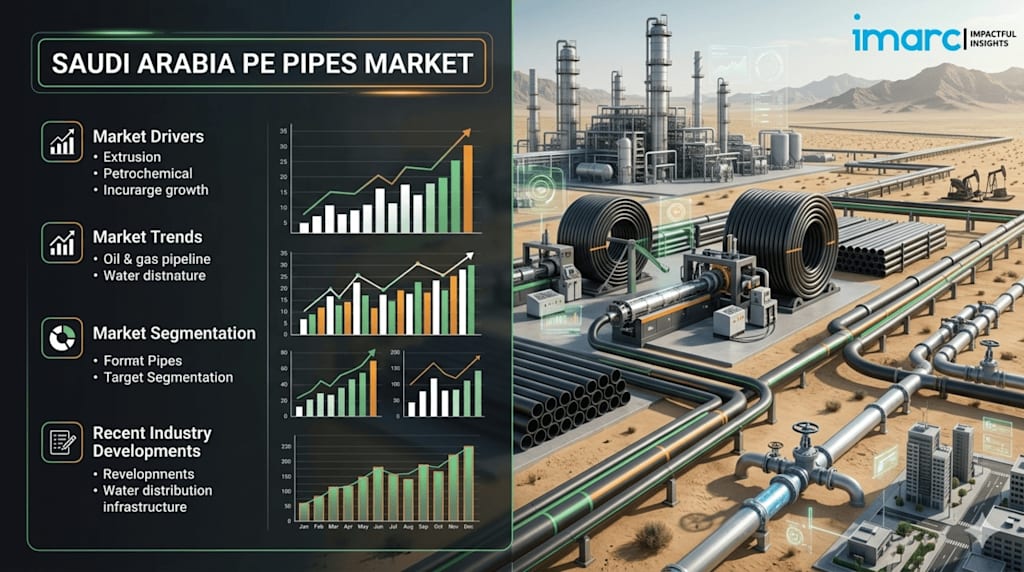
Infrastructure development under Vision 2030, rising urbanization, and growing investments in water distribution and oil and gas networks are driving PE pipe demand, backed by the material's corrosion resistance, durability in harsh desert conditions, and expanding local manufacturing. According to IMARC Group's latest data, The Saudi Arabia PE pipes market size reached 298.74 Thousand Tons in 2025. Looking forward, IMARC Group estimates the market to reach 448.47 Thousand Tons by 2034, exhibiting a CAGR of 4.62% from 2026-2034. HDPE currently dominates the market, holding a type share of over 62.9% in 2025.
Saudi Arabia PE Pipes Market Growth Drivers:
- Vision 2030-Driven Infrastructure Investments
The Saudi government allocated USD 9.17 billion for infrastructure development in 2023, and the spending has only accelerated since. Large-scale water, sewage, and utility projects across the Kingdom are the most direct driver of PE pipe demand. In April 2025, the National Water Company completed a SAR 400 million project delivering desalinated water to three Riyadh-region governorates, requiring extensive HDPE pipeline networks. With mega-projects under NEOM, the Red Sea Project, and multiple smart city initiatives still rolling out, demand for durable piping systems is nowhere near its peak.
- Water Supply Expansion and Desalination Network Buildout
Water supply accounts for 54.2% of Saudi Arabia's PE pipe consumption, and given the Kingdom's dependence on desalination, that figure is not shrinking. Saudi Arabia has invested USD 80 billion in desalination infrastructure, targeting capacity of 8.5 million cubic meters per day. NEOM's seawater desalination facility alone will eventually deliver 1 million cubic meters daily, all requiring massive HDPE distribution networks downstream. The National Water Company announced plans for a USD 40 million Riyadh sewage expansion in November 2025, covering 18.5 kilometers of HDPE pipes, which shows the sheer scale of ongoing investment.
- Oil, Gas, and Mining Sector Demand for Durable Piping
PE pipes are increasingly the material of choice in Saudi Arabia's oil, gas, and growing mining sectors, where chemical resistance and long service life matter more than upfront cost. In January 2025, Strohm secured a contract to supply 33 kilometers of thermoplastic composite pipes for Aramco's Fadhili gas plant expansion. On the mining side, the government awarded exploration licenses in March 2025 to international firms including India's Vedanta and a consortium of Ajlan & Bros and China's Zijin Mining, covering copper and precious metal regions. Each new mining project brings pipeline infrastructure requirements that feed directly into PE pipe demand.
Saudi Arabia PE Pipes Market Trends:
- Smart City Development Driving Intelligent Pipeline Networks
Smart city projects are changing what buyers expect from pipeline systems. Municipal authorities are specifying leak-resistant PE pipes with IoT monitoring integration as a standard requirement, not an optional upgrade. In 2024, the National Water Company piloted a fibre-optic-based leak detection system in Burayada to demonstrate how digital pipeline management works at scale. The shift matters commercially because smart-city specs tend to favor HDPE over older alternatives, consolidating HDPE's already-dominant 62.9% type share and raising the technical bar for all suppliers operating in the Saudi market.
- Growth of Insulated Polyethylene Piping for Extreme Environments
Insulated PE piping systems are gaining traction in district cooling, water transmission, and industrial utilities across Saudi Arabia, where extreme desert temperatures make thermal performance a practical concern, not just a specification checkbox. In July 2024, Perma-Pipe International Holdings secured USD 10 million in contracts covering infrastructure projects in Riyadh, Madinah, and Mekkah using advanced XTRU-THERM insulation technology. These contracts show how specialized piping solutions are carving out a growing share of a market that was previously dominated by standard uninsulated HDPE and MDPE product lines.
- Local Manufacturing Expansion Reducing Import Dependence
Saudi Arabia is actively building out domestic PE pipe manufacturing capability as part of its broader industrial localization agenda. In February 2025, the Ministry of Energy allocated feedstock for new industrial complexes in Jubail Industrial City by Tasnee and Sipchem, targeting a combined polyethylene production capacity of 3.3 million metric tonnes. January 2025 also saw a wave of new industrial licenses and factory openings creating upstream capacity. Local production lowers landed costs for buyers, reduces supply chain exposure, and aligns with Vision 2030's target to grow the industrial sector's GDP contribution, which means government contracts increasingly favor domestically manufactured pipe solutions.
Recent News and Developments in Saudi Arabia PE Pipes Market
- April 2025: The National Water Company completed a SAR 400 million desalinated water delivery project serving three governorates in the Riyadh region. The project required extensive HDPE pipeline networks and stands as one of the clearest examples of the scale of infrastructure investment currently driving PE pipe demand across the Kingdom.
- February 2025: China Harbour Engineering Co. and CCCC Fourth Harbor Engineering Bureau completed installation of the world's largest diameter submarine HDPE pipeline at Jizan Industrial City's Seawater Cooling Project. The milestone demonstrated new installation capabilities for extreme-scale HDPE pipeline infrastructure in Saudi industrial zones.
- January 2025: Strohm secured a contract to supply 33 kilometers of thermoplastic composite pipes for Saudi Aramco's Fadhili gas plant expansion. The contract highlighted increasing operator preference for non-metallic, corrosion-resistant piping solutions in Saudi Arabia's upstream oil and gas sector.
- November 2025: Saudi Arabia's National Water Company announced plans to award a USD 40 million contract for the Riyadh sewage system expansion, covering 18.5 kilometers of HDPE pipes with diameters ranging from 200mm to 500mm, continuing the steady pace of urban utility infrastructure upgrades across the capital.
Note: If you require specific details, data, or insights that are not currently included in the scope of this report, we are happy to accommodate your request. As part of our customization service, we will gather and provide the additional information you need, tailored to your specific requirements. Please let us know your exact needs, and we will ensure the report is updated accordingly to meet your expectations.
About the Creator
Shubham Sharma
Market research enthusiast sharing insights on global industries, emerging trends, growth opportunities, and data-driven analysis across diverse markets.
Enjoyed the story? Support the Creator.
Subscribe for free to receive all their stories in your feed.
Comments
There are no comments for this story
Be the first to respond and start the conversation.