
Saudi Arabia Payments Market: Digital Payments, Cashless Economy & Growth Outlook
How rapid digitalization, rising adoption of contactless and mobile payments, and strong fintech ecosystem growth are driving transaction volumes, financial inclusion, and innovation in the Saudi Arabia payments market

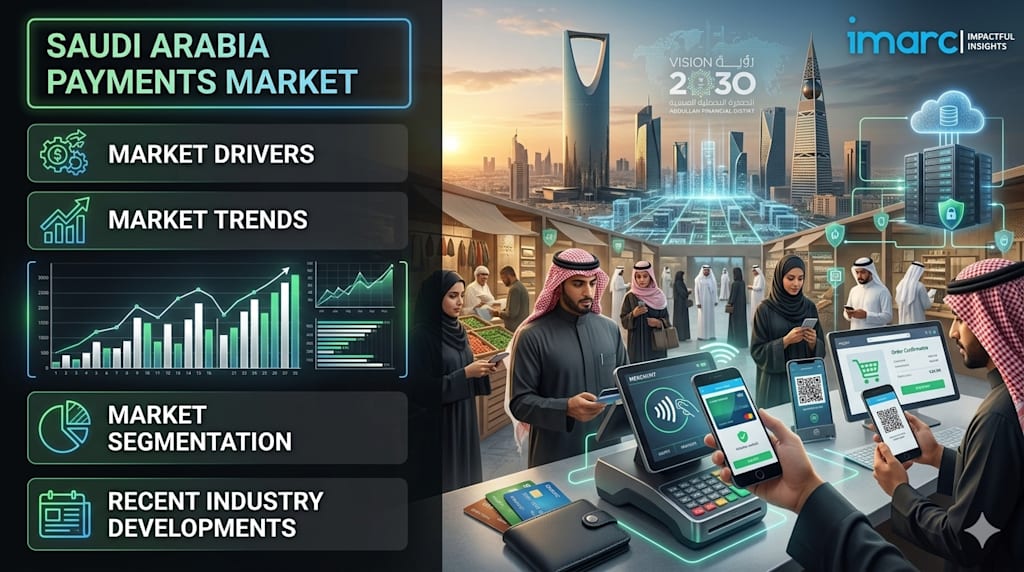
According to IMARC Group's latest research publication, Saudi Arabia payments market size reached USD 32.3 Billion in 2025. The market is projected to reach USD 101.2 Billion by 2034, exhibiting a growth rate (CAGR) of 13.54% during 2026-2034.
How AI is Reshaping the Future of Saudi Arabia Payments Market
• Fraud Detection and Risk Management: AI-powered systems analyze millions of transactions in real-time, identifying suspicious patterns and reducing fraud by up to 35%. Major Saudi banks deployed machine learning algorithms across mobile payment apps, cutting unauthorized transactions significantly while building customer confidence in digital wallets and contactless payments across the Kingdom.
• Personalized Payment Experiences: Machine learning algorithms tailor payment options based on user behavior, spending patterns, and preferences. Banks and fintech companies leverage AI to offer customized credit products, instant loan approvals, and smart recommendations, creating seamless experiences that drive adoption among Saudi Arabia's 34 million smartphone users.
• Voice-Activated Payment Authentication: Natural language processing enables instant payment authorization through voice biometrics. STC Pay introduced voice commands allowing customers to complete transactions without touching their devices, dramatically improving speed and accessibility while maintaining security through advanced authentication that recognizes individual voice patterns.
How Vision 2030 is Revolutionizing Saudi Arabia Payments Industry
Vision 2030's Financial Sector Development Program has fundamentally transformed how Saudi Arabia handles money. The government set an ambitious target to make non-cash transactions the norm, and the results speak for themselves electronic payments now account for 85% of retail transactions, smashing the original target two years ahead of schedule. SAMA's instant payment system SARIE processed 593 million transactions in just one year, growing 50% annually since launch, while POS terminals reached 2 million and processed 10.4 billion card payments. The Saudi Central Bank created a regulatory sandbox that welcomed over 280 fintech companies, up from just 10 in 2018, giving innovators room to test new payment services without compromising consumer protection. Digital wallets exploded to 14.4 million active users, growing 52% year-over-year. The government's Fintech Strategy, approved in 2022, coordinates efforts across multiple agencies to build a thriving fintech hub by 2030, backed by over SAR 7.9 billion in cumulative investment 204% above the original target. Open banking frameworks now enable secure data sharing, letting banks and fintechs collaborate on embedded finance solutions. Foreign players like Google Pay and Alipay+ received regulatory approval, bringing global expertise while local champions like STC Pay and Tamara scaled rapidly. The National Digital Transformation Program embedded mobile payments into everyday citizen services, from utility bills to healthcare appointments, with roughly USD 1 billion allocated toward digital payment infrastructure. What makes this revolutionary isn't just the speed it's the coordination across government, regulators, and private sector to create an ecosystem where innovation thrives alongside robust consumer protection.
Saudi Arabia Payments Market Trends & Drivers:
Digital wallets are becoming the payment method of choice, with 14.4 million active users growing 52% annually and acceptance spreading across 77,000 e-commerce merchants. Real-time payment systems like SARIE are replacing traditional transfers, offering instant settlement 24/7 for transactions under SAR 20,000 with fees capped at just one riyal. Buy-now-pay-later platforms like Tamara achieved 33% penetration of the domestic population, fundamentally changing how people shop online. Open banking is unlocking innovation, with SAMA granting first operational licenses to fintechs like Lean Technologies, enabling secure API data sharing that powers personalized lending, budgeting tools, and embedded finance in non-financial platforms. Contactless payments dominate 96% of all POS transactions are now contactless, with 52% being cardless through tokenized mobile payments. Foreign payment giants are entering the market as Google Pay launched via Mada network and Alipay+ prepares to serve 1.7 billion international users visiting the Kingdom. AI-powered fraud detection has become standard, with major banks deploying machine learning that cuts unauthorized transactions by 35%, building trust that accelerates digital adoption.
Key Highlights of the Report:
Market Breakup by Mode of Payment:
• Point of Sale
• Card Payments
• Digital Wallet
• Cash
• Others
• Online Sale
• Card Payments
• Digital Wallet
• Others
Market Breakup by End Use Industry:
• Retail
• Entertainment
• Healthcare
• Hospitality
• Others
Market Breakup by Region:
• Northern and Central Region
• Western Region
• Eastern Region
• Southern Region
Market Growth Drivers:
• Smartphone Penetration and Mobile-First Economy: With smartphone penetration hitting 95%, approximately 34 million Saudi users have instant access to digital payment platforms with minimal friction. This mobile-first population drives explosive growth in mobile wallets, contactless payments, and app-based financial services. Young, tech-savvy demographics expect seamless experiences, pushing banks and fintechs to innovate continuously. The widespread availability of high-speed internet and affordable smartphones removes traditional barriers, making digital payments accessible across urban and rural areas alike, accelerating the shift away from cash.
• E-Commerce Boom and Digital Consumer Behavior: Saudi Arabia's digital economy is racing toward USD 133 billion by 2030, fueled by explosive e-commerce growth that demands efficient online payment solutions. Online retail platforms expanded acceptance to 77,000 merchants, growing 32% year-over-year, while digital wallet adoption surged alongside consumer expectations for instant checkout experiences. BNPL platforms like Tamara captured 33% of the population, fundamentally changing purchase behavior. COVID-19 accelerated this transformation as consumers and businesses sought contactless payment options, creating permanent behavioral shifts that continue driving demand for sophisticated digital payment infrastructure and innovative fintech services.
• Regulatory Innovation and Fintech-Friendly Ecosystem: SAMA's progressive regulatory approach created an environment where innovation thrives alongside consumer protection. The regulatory sandbox welcomed 25 fintechs to test services safely, while 280 licensed fintech companies up from just 10 in 2018 received clear operating frameworks. SAMA's 2025 credit card reforms capped fees, introduced 25-day grace periods, and reduced consumer costs, building trust in digital financial services. Open banking licenses granted to firms like Lean Technologies enable secure data sharing that powers next-generation services. Updated investment laws streamlined procedures and strengthened investor protections, positioning Saudi Arabia as an attractive, stable destination for SAR 7.9 billion in fintech capital.
Recent News and Developments in Saudi Arabia Payments Market:
• March 2026: SAMA granted first open banking licenses to fintech firms like Lean Technologies, transitioning from sandbox trials to full operations and enabling secure API data sharing that powers greater innovation and financial inclusion across the Kingdom.
• February 2026: Google Pay launched Tap to Pay via Mastercard and SAMA partnership through the Mada network, enabling secure contactless payments directly from Android smartphones at retail outlets nationwide, expanding seamless mobile payment options.
• January 2026: Riyad Bank's Jeel partnered with Ripple to explore blockchain for cross-border payments, digital asset custody, and tokenization within the regulatory sandbox, enhancing transaction speed and transparency in financial services.
• December 2025: Saudi Arabia achieved 79% non-cash retail transactions, surpassing the 2025 target ahead of schedule, driven by widespread adoption of mobile wallets, instant payment rails like SARIE, and expanded POS terminal networks reaching 2 million locations.
• September 2025: Hala raised USD 157 million in Series B funding to expand embedded financial services for MSMEs, while Tamara secured up to USD 2.4 billion in Shariah-compliant facilities to grow BNPL and payment offerings across Saudi Arabia's booming e-commerce sector.
Note: If you require specific details, data, or insights that are not currently included in the scope of this report, we are happy to accommodate your request. As part of our customization service, we will gather and provide the additional information you need, tailored to your specific requirements. Please let us know your exact needs, and we will ensure the report is updated accordingly to meet your expectations.
About the Creator
Shubham Sharma
Market research enthusiast sharing insights on global industries, emerging trends, growth opportunities, and data-driven analysis across diverse markets.
Enjoyed the story? Support the Creator.
Subscribe for free to receive all their stories in your feed.
Comments
There are no comments for this story
Be the first to respond and start the conversation.