
Saudi Arabia Oil and Gas Midstream Market: Pipeline Expansion, Storage Capacity & Energy Security Growth
How expanding pipeline networks, increasing storage capacity, and strategic infrastructure investments are enhancing efficiency, strengthening supply chain resilience, and supporting export capabilities across the Saudi Arabia oil and gas midstream market.

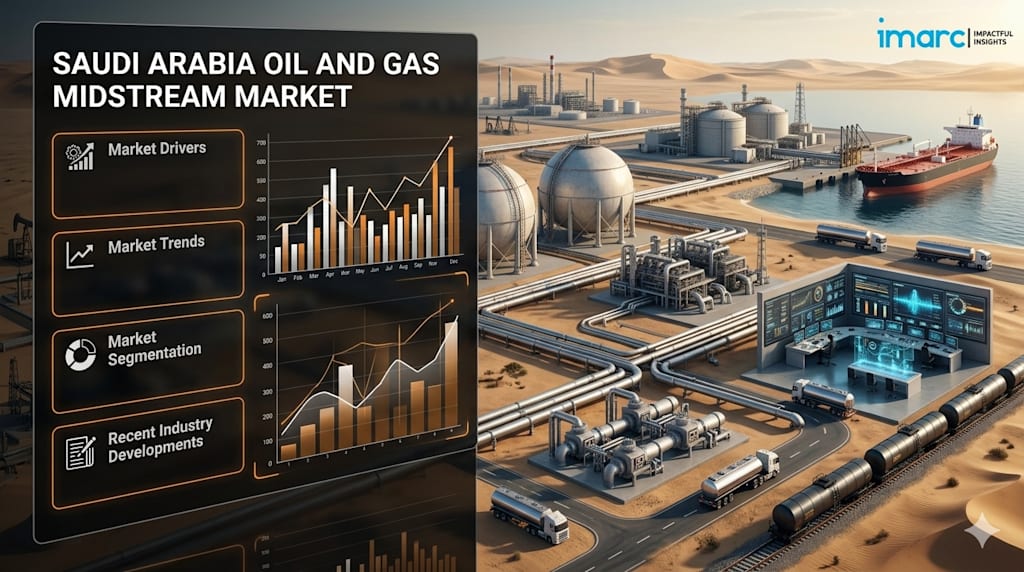
Continual advancements in transport networks, increased storage capabilities, rising global energy requirements, integration of innovative digital tools, efforts to shift toward cleaner energy sources, and policies aimed at fostering economic diversification are driving the Saudi Arabia oil and gas midstream market. According to IMARC Group's latest data, the Saudi Arabia oil and gas midstream market size was valued at USD 85.3 Billion in 2025. Looking forward, IMARC Group estimates the market to reach USD 128.7 Billion by 2034, exhibiting a CAGR of 4.67% from 2026-2034. The market is primarily driven by expanding storage capacity, rising investments in modern tank farms, and the development of export terminals along the Red Sea and Persian Gulf shores.
Saudi Arabia's midstream oil and gas sector is the backbone of one of the world's most consequential energy supply chains. It connects massive upstream production fields to domestic industries and international export terminals, making it indispensable to both the Kingdom's economy and global energy stability. As the country pushes forward with Vision 2030, the midstream segment is being transformed through pipeline expansions, digital upgrades, and a meaningful pivot toward natural gas infrastructure. Investors and energy companies are paying close attention as deal sizes grow larger, infrastructure targets become more ambitious, and the Kingdom cements its position as a long-term energy powerhouse.
Saudi Arabia Oil and Gas Midstream Market Growth Drivers:
- Expanding Pipeline Infrastructure and Export Connectivity
Saudi Arabia's midstream growth is closely tied to its expanding network of pipelines and export terminals. The country's Master Gas System continues to be upgraded to handle increasing volumes of natural gas, while new subsea pipelines and offshore platforms are strengthening connectivity with global markets. In a clear signal of this momentum, Saipem secured two offshore engineering and construction contracts in Saudi Arabia worth USD 1 Billion, covering subsea pipeline installation and offshore platform development. Export terminals along the Red Sea and Persian Gulf are also being enhanced to serve growing energy demand across Asia and Europe, reinforcing Saudi Arabia's position as a critical global energy supplier.
- Rising Storage Capacity and Energy Security Investments
Reliable storage infrastructure is increasingly viewed as a strategic necessity for managing supply-demand fluctuations and supporting consistent export commitments. Saudi Arabia's investment in modern tank farms, automated storage systems, and strategically located facilities at Yanbu and Ras Tanura reflects this priority. A concrete example is the Hawiyah Gas Storage facility, developed by Aramco as the Kingdom's first natural gas storage project. The facility can inject up to 2 billion standard cubic feet of processed gas per day into the Master Gas System, directly supporting energy security during peak demand periods. This initiative aligns with Vision 2030's carbon reduction and energy diversification goals, making storage a key competitive pillar.
- Strategic Partnerships and Foreign Investment Inflows
International partnerships are playing a growing role in accelerating Saudi Arabia's midstream development. Saudi Aramco signed contracts exceeding USD 25 Billion for the development of the main gas network at the Jafurah gas field, one of the world's largest unconventional gas fields. Additionally, Sinopec's engineering subsidiary signed a USD 11 Billion agreement with Aramco to construct natural gas pipelines across the Kingdom. These deals bring in not just capital but also advanced technical expertise, helping Saudi Arabia build world-class infrastructure faster. The combination of government-backed ambition and international corporate confidence is creating a highly favorable environment for sustained midstream market expansion.
Saudi Arabia Oil and Gas Midstream Market Trends:
- Adoption of Digital Technologies in Midstream Operations
Digital transformation is rapidly changing how Saudi Arabia manages its midstream network. Companies are deploying SCADA systems, IoT-enabled pipeline sensors, real-time monitoring tools, and predictive maintenance platforms to boost efficiency and reduce operational risks. Saudi Aramco announced several agreements to expand the deployment of artificial intelligence across its operations, targeting improvements in efficiency, sustainability, and overall digital performance. These tools are especially valuable across Saudi Arabia's extensive pipeline network, where early leak detection and automated responses can prevent both environmental damage and costly downtime. Digitization is now a core competitive strategy rather than an optional upgrade.
- Diversification into Natural Gas Infrastructure
Natural gas is increasingly central to Saudi Arabia's energy strategy, and midstream infrastructure is following suit. New pipelines, processing facilities, and LNG-related assets are being built to support both domestic consumption and future export potential. GAS Arabian Services Company signed two gas pipeline contracts worth SAR 598 Million (approximately USD 159.3 Million) with the Saudi Power Procurement Company, covering projects in Taiba and Qassim. Meanwhile, Saudi Aramco awarded contracts worth USD 7.7 Billion to expand its Fadhili Gas Processing Plant to handle growing domestic and international demand. These developments reflect a deliberate and well-funded push to integrate natural gas more deeply into the Kingdom's midstream backbone.
- Push Toward Sustainability and Clean Energy Integration
Environmental compliance and clean energy integration are reshaping competitive strategy across the midstream sector. Companies operating in Saudi Arabia are increasingly expected to meet higher sustainability standards, particularly around emissions, carbon capture, and energy efficiency. SLB, Aramco, and Linde announced a landmark agreement to develop a carbon capture and storage hub in Jubail, projected to be among the world's largest, with a target capture capacity of up to 9 million metric tons per year upon completion of phase one. This move signals that sustainability is no longer separate from infrastructure planning. It is being built directly into the midstream investment pipeline, creating new opportunities for technology providers and engineering firms.
Recent News and Developments in Saudi Arabia Oil and Gas Midstream Market
- April 2026: East-West Pipeline restored to full 7 million bpd capacity following regional disruptions, enabling secure crude exports to Yanbu via alternative Red Sea routes.
- March 2026: Tanajib Gas Plant begins operations processing 2.6 Bcf/D raw gas with integrated digital systems, optimizing associated gas flow from offshore Marjan and Zuluf fields.
- February 2026: Aramco finalizes first Jafurah condensate export deals with Chevron, ExxonMobil, and Indian Oil Corp, expanding midstream liquids handling from the $100 billion shale facilities.
- January 2026: AI-powered digital twins deployed across 2,000 km of critical pipelines, cutting unplanned downtime by 25% and strengthening real-time monitoring in gas transmission networks.
- March 2026: Autonomous AI agents rolled out at Fadhili Gas Plant for self-optimizing acid gas removal, improving efficiency in processing 2.5 Bcf/D raw gas through real-time adaptive controls.
Note: If you require specific details, data, or insights that are not currently included in the scope of this report, we are happy to accommodate your request. As part of our customization service, we will gather and provide the additional information you need, tailored to your specific requirements. Please let us know your exact needs, and we will ensure the report is updated accordingly to meet your expectations.
About the Creator
Kishan Kumar
My name is Kishan Roy and I am a market analyst having 5 years of experience and a skilled researcher with a keen eye for consumer trends and data-driven insights.
Enjoyed the story? Support the Creator.
Subscribe for free to receive all their stories in your feed.
Comments
There are no comments for this story
Be the first to respond and start the conversation.