
Saudi Arabia Network Security Market: Cyber Threat Landscape, Zero Trust & Growth Outlook
How rapid digital transformation under Vision 2030, rising frequency of sophisticated cyberattacks, and increasing adoption of cloud computing and remote work models are driving demand for AI-powered threat detection, zero-trust architectures, and advanced network protection solutions across the Saudi Arabia Network Security Market.

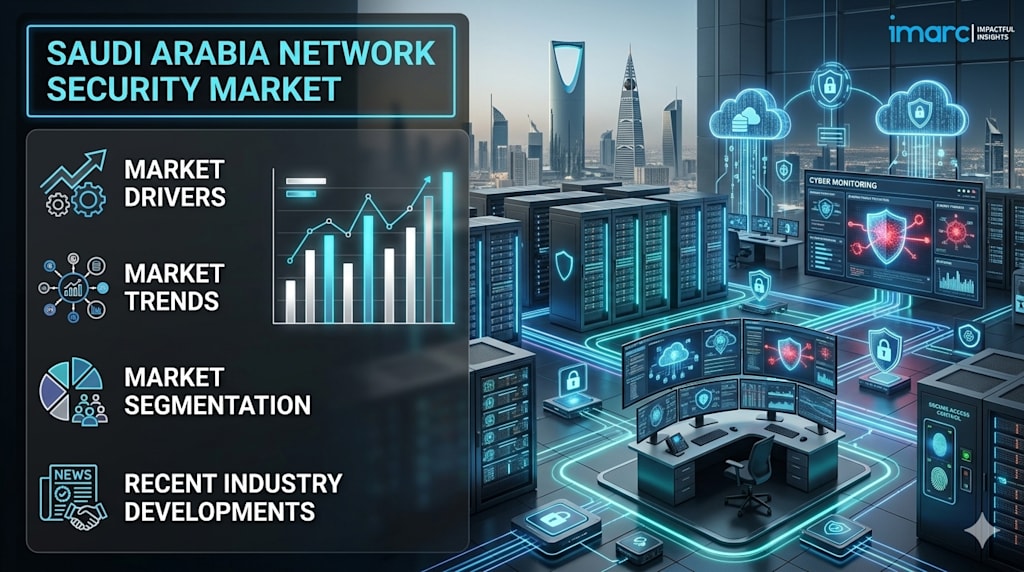
Rising cyber threats, rapid digital transformation under Saudi Vision 2030, and growing adoption of cloud and IoT technologies are propelling demand for network security solutions across the Kingdom. According to IMARC Group’s latest data, The Saudi Arabia network security market size was valued at USD 417.8 Million in 2025. Looking forward, IMARC Group estimates the market to reach USD 1,064.3 Million by 2034, exhibiting a CAGR of 10.95% from 2026-2034.
Saudi Arabia’s network security market is rapidly maturing as the country pushes forward with large-scale digitalization across government, finance, energy, and healthcare. From deploying next-generation firewalls and intrusion detection systems to investing in AI-driven threat intelligence platforms, organizations across the Kingdom are treating cybersecurity not as a compliance checkbox but as a strategic business priority. The country has already recorded over 110 million cyberattacks in recent years across its key sectors, and the average cost of a breach to a Saudi organization now exceeds the global average by around 69% a sobering reminder of what’s at stake. Key growth areas include cloud-based security deployment, managed security services, network access control, and DDoS mitigation, with both large enterprises and SMEs accelerating adoption at scale.
Saudi Arabia Network Security Market Growth Drivers:
- Vision 2030 and Government-Led Digital Transformation
Saudi Vision 2030 is the single biggest catalyst behind the Kingdom’s surging cybersecurity investments. As the government modernizes public services, builds smart cities like NEOM, and digitizes industries from healthcare to oil and gas, the attack surface is expanding fast. The National Cybersecurity Authority (NCA) has responded with mandatory compliance frameworks, while the government has committed around USD 1.2 billion to train nearly 100,000 cybersecurity professionals. In 2024, Saudi Arabia achieved a perfect 100/100 score across all five pillars of the UN Global Cybersecurity Index a reflection of how seriously the Kingdom takes network defense as a national priority.
- Escalating Cyber Threats Targeting Critical Infrastructure
Saudi Arabia’s oil and gas sector, financial institutions, and government bodies are prime targets for increasingly sophisticated cyberattacks. Trend Micro alone detected 110 million threats in the Kingdom in a single year more than double what was recorded the prior year. The average cost of a cyberattack to a Saudi organization sits at approximately USD 6.53 million, well above global norms. This has pushed enterprises to rapidly adopt advanced solutions like next-generation firewalls, unified threat management systems, and real-time intrusion prevention platforms. The urgency is real, and organizations are moving fast to close vulnerabilities before they become costly incidents.
- Regulatory Compliance and Data Protection Laws
The introduction of Saudi Arabia’s Personal Data Protection Law (PDPL) and evolving frameworks from the NCA, SAMA, and the Communications, Space and Technology Commission (CST) have fundamentally shifted how organizations approach network security. Compliance is no longer optional non-adherence carries financial and reputational consequences. Sectors including BFSI, healthcare, and energy are now mandated to implement multi-layered security architectures. SAMA’s 2025 directive, for instance, requires real-time transaction monitoring and multi-factor authentication across all banks. These regulations are translating directly into procurement decisions and accelerating enterprise investments in network security infrastructure.
Saudi Arabia Network Security Market Trends:
- Rapid Cloud Adoption and Cloud-Native Security Demand
As Saudi enterprises migrate to cloud platforms at scale, cloud-native security tools have moved from “nice to have” to operationally essential. Cloud access security brokers (CASB), cloud workload protection platforms (CWPP), and identity-based access controls like IAM and MFA are seeing strong uptake. Trend Micro, in partnership with Google Cloud, now hosts its sovereign cloud security platform locally in Saudi Arabia to keep sensitive data within national borders. Meanwhile, the country’s ICT market valued at over USD 40.9 billion is the largest in the Middle East and Africa region, with cloud security identified as the single fastest-growing cybersecurity sub-segment, expected to dominate network security innovation through the coming years.
- AI-Driven Threat Detection and Zero Trust Architecture
The shift to AI-powered security is happening quickly across Saudi Arabia’s enterprise and government sectors. Organizations are deploying machine learning models that can process network traffic, surveillance logs, and access records simultaneously reducing threat response times by up to 60% in high-security environments. Alongside this, Zero Trust Architecture is gaining significant traction, particularly in BFSI and government agencies, where the principle of “never trust, always verify” aligns well with strict data sovereignty requirements. Saudi Aramco has already announced collaborations with cybersecurity startups to develop AI-powered network defense solutions tailored for critical infrastructure protection.
- Managed Security Services and Public-Private Partnerships
A growing number of Saudi organizations especially SMEs are turning to managed security service providers (MSSPs) to close internal skills gaps and reduce infrastructure overhead. Security-as-a-Service models are gaining mainstream acceptance given their scalability and cost efficiency. At the same time, public-private collaboration is shaping the market: Cisco established a new regional head office in Riyadh and launched its Country Digital Acceleration Program, while local players like sirar by stc are expanding sovereign SOC operations aligned with national regulations. These partnerships are accelerating knowledge transfer, building local cybersecurity talent, and enabling the deployment of cutting-edge tools tailored to Saudi-specific operational requirements.
Recent News and Developments in Saudi Arabia Network Security Market
- February 2025: Proofpoint announced a significant investment in Saudi Arabia, launching local data center operations to deliver full data sovereignty alongside cloud-based threat protection. The move is designed to meet the Kingdom’s strict data residency requirements under the PDPL while offering enterprise-grade email and network security solutions to Saudi organizations.
- January 2025: Honeywell opened a new cybersecurity center in Jubail, Saudi Arabia, dedicated to protecting Operational Technology (OT) environments in critical industrial sectors. The facility focuses on real-time threat monitoring and compliance for the Kingdom’s energy and manufacturing infrastructure, addressing a long-standing gap in OT-specific network security coverage.
Note: If you require specific details, data, or insights that are not currently included in the scope of this report, we are happy to accommodate your request. As part of our customization service, we will gather and provide the additional information you need, tailored to your specific requirements. Please let us know your exact needs, and we will ensure the report is updated accordingly to meet your expectations.
About the Creator
Shubham Sharma
Market research enthusiast sharing insights on global industries, emerging trends, growth opportunities, and data-driven analysis across diverse markets.
Enjoyed the story? Support the Creator.
Subscribe for free to receive all their stories in your feed.
Comments
There are no comments for this story
Be the first to respond and start the conversation.