
Saudi Arabia Milk Powder Market: Imports, Urban Lifestyles, and Long-Shelf-Life Demand Keep Growth on Track
Saudi Arabia’s milk powder market is expanding steadily as consumers, food processors, and retailers continue to favor a dairy product that fits the country’s climate, lifestyle, and supply chain realities.

Market Snapshot
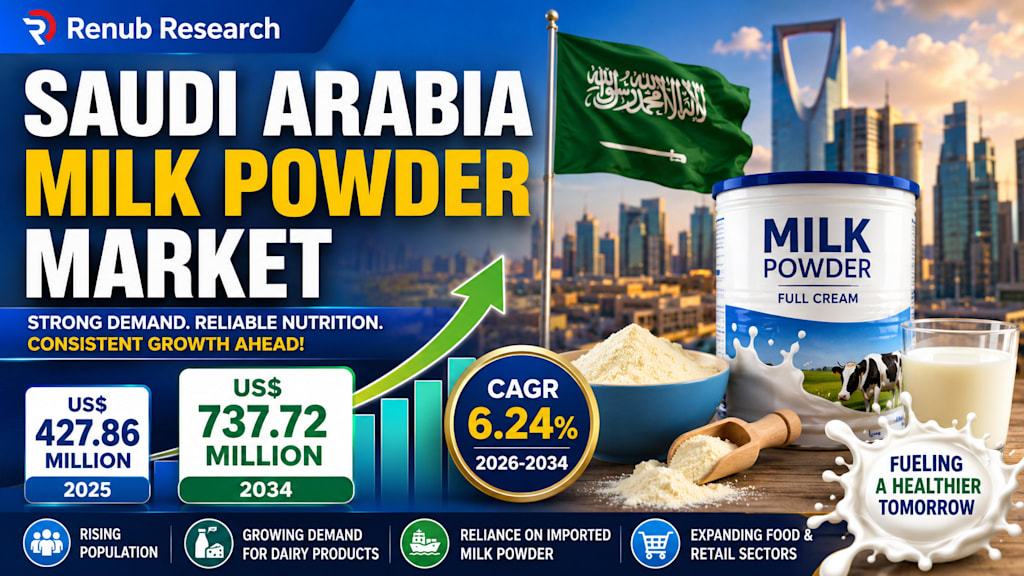
Saudi Arabia’s milk powder market is projected to rise from US$ 427.86 million in 2025 to US$ 737.72 million by 2034, expanding at a CAGR of 6.24% from 2026 to 2034. The growth story is being shaped by population growth, rising demand for dairy-based products, and the country’s dependence on imported milk powder to meet local needs.
Milk powder has become more than a pantry staple in Saudi Arabia. It is now a practical answer to climate, convenience, storage, and food manufacturing requirements. In a market where hot weather makes fresh milk handling more challenging, milk powder offers a stable, versatile, and long-lasting alternative that fits household consumption as well as commercial use.
Why Milk Powder Has a Strong Place in Saudi Arabia
The appeal of milk powder in Saudi Arabia starts with its simple utility. It can be stored for long periods, mixed with water when needed, and used in tea, coffee, cooking, baking, desserts, and processed foods. That flexibility gives it an edge in both households and the food service industry. The product is also available in several forms, including whole milk powder, skim milk powder, and fortified variants, making it suitable for different consumer needs and price points.
What makes the market especially interesting is how closely it reflects Saudi Arabia’s daily routine. Busy lifestyles, urban living, and a strong culture of convenient food consumption all support the continued use of milk powder. This is not a niche product in the country; it is part of everyday food behavior.
Convenience Is Becoming a Bigger Buying Trigger
One of the clearest growth engines for the market is the rising demand for convenient, long-shelf-life dairy products. Milk powder does not require refrigeration in the same way fresh milk does, which makes it especially well suited to Saudi Arabia’s hot climate. Consumers value products that are easy to transport, store, and prepare, and milk powder fits that need well.
This convenience factor matters across more than just home kitchens. It also matters for food service operators, bakeries, cafes, and restaurants that need ingredients with consistent quality and dependable shelf life. Milk powder is used in beverages, cooking, baking, processed foods, confectionery, and baby food, giving it wide utility across the value chain.
In a fast-moving consumer environment, products that reduce spoilage and simplify preparation naturally gain traction. That is one reason milk powder continues to hold a stable place in Saudi Arabia’s food economy.
Urbanization and Population Growth Are Expanding the Customer Base
Saudi Arabia’s population is now more than 35 million, and the country has become highly urbanized, with 85% of people living in cities. That shift matters because urban consumers typically buy more packaged foods, use more modern retail channels, and consume more convenience products. Milk powder benefits directly from all three patterns.
Working professionals and expatriate communities also contribute to demand. Expatriates often bring diverse food habits and international cooking styles, both of which support the use of dairy ingredients in everyday meals. Meanwhile, urban households often prefer products that are easy to keep on hand and simple to use. Milk powder checks both boxes.
Distribution has improved too. The file notes that milk powder is available in supermarkets, hypermarkets, and online stores, which makes it easier for consumers to buy regularly rather than treat it as a specialty item.
Imports Still Shape the Market
Another key feature of the Saudi Arabia milk powder market is its heavy reliance on imports. Limited domestic dairy availability means the country depends on imported dairy products to satisfy demand, and that creates a broad supply base for different milk powder types and price tiers.
This import dependence has two sides. On one hand, it supports product availability and variety. On the other hand, it exposes the market to international price swings, exchange-rate changes, and policy disruptions. That makes the market vulnerable, especially when global dairy prices move quickly or trade conditions tighten.
Even so, imports remain central to the market structure. For now, they are not just a backup solution; they are the backbone of supply.
Food Processing and Hospitality Are Deepening Demand
The food processing and hospitality sectors are giving milk powder a broader commercial role. It is no longer only a household ingredient. It is now widely used in bakery items, desserts, drinks, ready-to-eat meals, and confectionery products. As Saudi Arabia’s cafes, restaurants, and fast-food chains continue to expand, demand for milk powder rises alongside them.
This is important because commercial buyers tend to create steadier, higher-volume demand than occasional household usage alone. A bakery that uses milk powder in cakes and pastries, for example, is likely to keep buying it on a recurring basis. The same is true for cafes that use it in beverages or dessert preparations.
The file also highlights a practical retail example: LuLu Hypermarkets introduced Ramadan-related offers and a kitchen essentials box that included milk powder, reflecting the product’s role in everyday and seasonal shopping baskets.
Consumer Health Awareness Is Changing the Product Mix
Health awareness is reshaping the market, not shrinking it. Some consumers still perceive milk powder as less fresh than liquid milk, and there are concerns around additives and preservatives in certain products. Those perceptions can challenge demand for standard offerings.
At the same time, health-conscious consumers are creating opportunities for low-fat, organic, fortified, and natural options. This is why skimmed milk powder is gaining traction. The file notes that skimmed milk powder is supported by rising health awareness, low-fat preferences, and its usefulness in products such as yogurt, beverages, and bakery items.
The same pattern appears in nutritional food applications. Fortified foods, infant formulas, dietary supplements, and meal replacements all benefit from milk powder’s protein, calcium, and vitamin content. As consumers become more selective, the category is shifting toward value-added products rather than only commodity offerings.
Product Segments Are Expanding in Different Directions
Not all milk powder demand in Saudi Arabia looks the same. The market has several identifiable growth pockets.
Skimmed milk powder is attractive to consumers who want lower fat without giving up nutritional value. It is also useful in food manufacturing because it blends well into yogurt, bakery goods, and beverages.
Buttermilk powder is gaining popularity because of its role in baked goods, confectionery, and processed foods. It improves flavor, texture, and product consistency, while being easy to store and transport.
Nutritional food applications are another strong segment. Milk powder is widely used in fortified foods, infant food, meal replacements, and supplements, reflecting the broader health and wellness trend in the country.
Confectionery is also important, because milk powder helps create the creamy taste and texture that consumers expect in sweets, chocolates, and candies. In Saudi Arabia, where desserts hold cultural and commercial importance, this segment has clear momentum.
Baked sweets bring another layer of demand. Cakes, pastries, cookies, and dessert products all benefit from milk powder’s flavor and shelf-life benefits, making it a reliable ingredient for both home baking and industrial production.
City-Level Demand Shows a Clear Urban Pattern
The market is not evenly distributed across the country. Riyadh is described as the largest and most dynamic market, driven by its population size, urban lifestyle, retail infrastructure, and strong food service activity. The city’s supermarkets, hypermarkets, and online grocery channels make milk powder easy to access, while health-conscious consumers increasingly choose fortified and low-fat varieties.
Jeddah stands out for a different reason. Its role as a business center and gateway for international trade makes it a natural hub for imported milk powder. Tourism, retail, expatriate demand, and a lively food scene all support consistent consumption.
Dammam benefits from its industrial base and growing population. Households and commercial establishments both contribute to demand, and the city’s working families create regular need for convenient dairy products.
Dhahran is smaller but still notable. Its affluent population, professional workforce, and proximity to Dammam and Al Khobar make it a stable market for quality and fortified products.
What the Competitive Landscape Looks Like
The market structure includes a mix of local and established players across multiple categories. The file identifies companies such as Almarai Company, Rabouh Al Hofuf Est., M.M. Siddique Abdullah Trading Est., Gulf Dimensions Trading Est., AL-Juffaily for Trading, Shatha Abeer Ltd., and Riyadh Dairy Products Factory. It also notes that key players are assessed across overviews, key person analysis, recent developments, SWOT analysis, revenue analysis, and company analysis.
That suggests a market where brand visibility, distribution strength, pricing, and product positioning all matter. Larger players can leverage scale and recognition, while trading companies and regional suppliers can compete through access, relationships, and specialized distribution.
Final Thoughts
The Saudi Arabia milk powder market has a straightforward but powerful growth story. It is supported by climate, convenience, urbanization, import availability, and the widening use of milk powder in food processing, hospitality, and home cooking. The market is also evolving, with more demand emerging for low-fat, fortified, and nutrition-focused products.
The biggest challenge remains import dependence, especially when global prices or policy conditions become unstable. Still, demand fundamentals remain strong, and the market appears well positioned to grow steadily through 2034. For brands, distributors, and food manufacturers, the opportunity lies in serving a market that values reliability, shelf life, and versatility as much as taste and nutrition.
About the Creator
Enjoyed the story? Support the Creator.
Subscribe for free to receive all their stories in your feed.
Comments
There are no comments for this story
Be the first to respond and start the conversation.