
Saudi Arabia Medical Imaging Market: Digital Imaging Growth, Precision Diagnosis & Hospital Expansion
How advanced imaging technologies, AI-powered diagnostics, and expanding healthcare infrastructure are enhancing early disease detection and transforming clinical decision-making in Saudi Arabia’s medical imaging market.

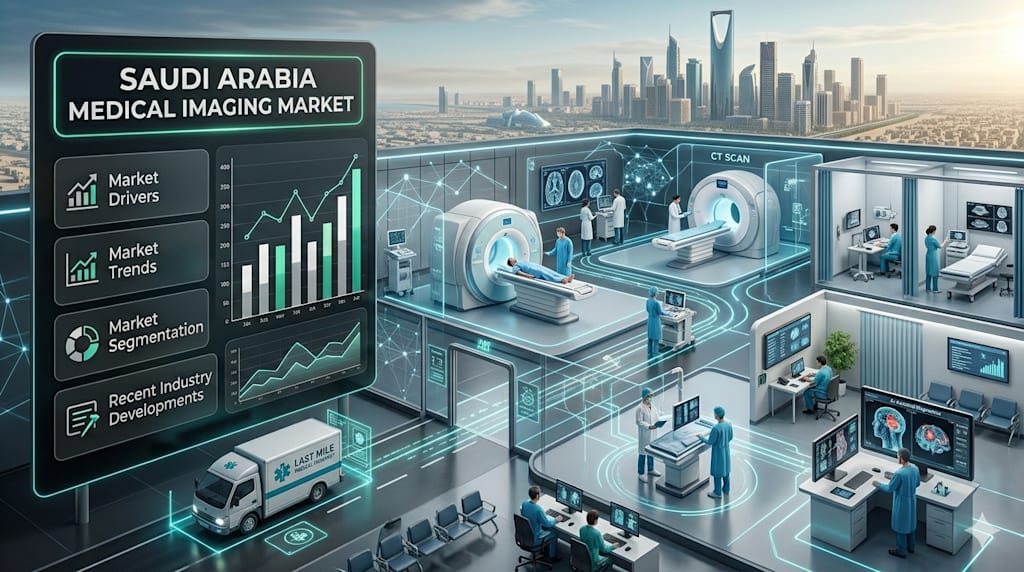
Rising rates of chronic disease, an aging population, accelerating adoption of AI-driven diagnostic tools, and strong government investment in healthcare infrastructure modernization are all working together to drive sustained momentum in Saudi Arabia's medical imaging sector. According to IMARC Group's latest data, the Saudi Arabia medical imaging market size was valued at USD 443.7 Million in 2025. Looking forward, IMARC Group estimates the market to reach USD 736.7 Million by 2034, exhibiting a CAGR of 5.80% from 2026-2034.
Saudi Arabia's medical imaging market covers a broad and growing range of diagnostic technologies, including CT scanners, X-ray imaging systems, MRI systems, ultrasound imaging systems, nuclear imaging systems, and mammography systems. These are applied across clinical areas including obstetrics and gynecology, orthopedics, neuro and spine, cardiovascular and thoracic, breast health, and general imaging. End users span both public and private healthcare institutions, with the market benefiting from a steady pipeline of public-private partnerships that are expanding access to advanced imaging equipment across the Kingdom.
Saudi Arabia Medical Imaging Market Growth Drivers:
- High and Growing Burden of Chronic Disease
Chronic conditions are the primary clinical driver behind medical imaging demand in Saudi Arabia. Cardiovascular disease affects 1.6% of Saudis aged 15 and above, with prevalence jumping sharply to 11% among those aged 65 and above, and Makkah region recording the highest regional rate at 1.9%. Diabetes and cancer rates are similarly elevated and growing. Each of these conditions requires repeated, high-quality imaging for initial diagnosis, treatment planning, and ongoing monitoring. For hospitals and diagnostic centers, this translates into a consistent, non-discretionary demand stream that underpins long-term equipment investment decisions and service expansion plans across both public and private facilities.
- Government Investment in Healthcare Infrastructure and Vision 2030
Saudi Arabia's Vision 2030 health transformation agenda is directly expanding the physical and technological infrastructure available for medical imaging across the Kingdom. A clear example is the October 2024 collaboration between Hayat National Hospitals and GE Healthcare, which saw advanced diagnostic imaging technologies deployed across three new hospitals in Muhayl Aseer, Baysh, and Buraida. This partnership supports Hayat's target of scaling its bed capacity to 3,000, and it reflects the broader government-backed push to ensure that modern imaging capabilities are not confined to Riyadh and Jeddah but reach secondary cities and underserved regions with growing healthcare needs.
- Medical Tourism Growth and International Patient Volumes
Saudi Arabia's ambition to attract 150 million tourists by 2030 includes a deliberate strategy to develop the Kingdom as a regional medical tourism hub. International patients seeking high-quality diagnostic services are pushing hospitals to invest in the latest imaging modalities, including PET-CT, hybrid imaging, and 3D and 4D systems, to meet global clinical standards. The Kingdom has also signed a Memorandum of Understanding with Thailand focused on healthcare cooperation and expertise exchange, signaling an intent to compete for health tourism flows that currently favor destinations like Thailand, India, and Turkey. Upgrading imaging infrastructure is central to making that competitive case to international patients.
Saudi Arabia Medical Imaging Market Trends:
- AI Integration Transforming Diagnostic Speed and Accuracy
Artificial intelligence is quickly moving from an experimental technology to an operational standard across Saudi Arabia's medical imaging landscape. AI-powered imaging tools can process scan data faster and flag abnormalities with greater consistency than manual review alone, making them particularly valuable in high-volume diagnostic environments. In November 2024, Recursive Inc. and King Abdullah International Medical Research Center (KAIMRC) signed an MoU at the Riyadh Global Medical Biotechnology Summit to develop an AI-based early screening system for tuberculosis, directly aligned with Vision 2030's digital health priorities. As more institutions integrate AI into imaging workflows, turnaround times for complex diagnoses are shrinking and the margin for human error is narrowing.
- Expansion of Tele-Radiology Across Underserved Regions
Tele-radiology is addressing one of Saudi Arabia's most persistent healthcare challenges: the concentration of specialist diagnostic expertise in major urban centers while large parts of the country have limited local access. By enabling radiologists to remotely interpret imaging scans in real time, tele-radiology is extending the effective reach of diagnostic services without requiring proportional investment in physical infrastructure across every location. In December 2024, PaxeraHealth and Saudi German Health extended their partnership to launch an AI-powered tele-radiology project covering 22 facilities across the MENA region, integrating real-time decision support and AI-enabled imaging to accelerate diagnostic speed and improve accuracy at scale for distributed patient populations.
- Adoption of Advanced and Hybrid Imaging Modalities
Saudi hospitals and diagnostic centers are moving beyond standard imaging equipment and investing in more advanced modalities that deliver richer clinical information. Technologies such as 3T MRI, PET-CT, and hybrid imaging systems are gaining traction for their capacity to provide simultaneous anatomical and functional insights, which is particularly valuable in oncology, cardiology, and complex neurological cases. Innovations like AI-integrated MRI and low-dose CT scanning are also improving both diagnostic quality and patient experience by reducing scan times and radiation exposure. Government funding for equipment modernization and the aspirations of Vision 2030 around healthcare quality are providing the financial and policy framework for these investments to accelerate.
Recent News and Developments in Saudi Arabia Medical Imaging Market
- April 2026: Johns Hopkins Aramco Healthcare launches Agfa Enterprise Imaging platform, unifying radiology and dental scans across facilities for faster clinician access and streamlined diagnostics.
- March 2026: King Faisal Specialist Hospital advances AI applications in medical imaging, developing over 20 tools that enhance diagnostic accuracy and enable early interventions in complex cases.
- February 2026: PaxeraHealth extends AI teleradiology with Saudi German Health to 22 sites, delivering real-time imaging analysis that boosts diagnostic speed and workflow efficiency.
- January 2026: RapidAI partners with Health Holdings Company to deploy deep clinical AI across 20 hospital clusters, improving stroke and aneurysm detection through intelligent imaging workflows.
- December 2025: Saudi hospitals integrate advanced AI algorithms in radiology, reducing image interpretation times by 40 percent while increasing diagnostic precision in oncology and cardiology.
Note: If you require specific details, data, or insights that are not currently included in the scope of this report, we are happy to accommodate your request. As part of our customization service, we will gather and provide the additional information you need, tailored to your specific requirements. Please let us know your exact needs, and we will ensure the report is updated accordingly to meet your expectations.
About the Creator
Kishan Kumar
My name is Kishan Roy and I am a market analyst having 5 years of experience and a skilled researcher with a keen eye for consumer trends and data-driven insights.
Enjoyed the story? Support the Creator.
Subscribe for free to receive all their stories in your feed.
Comments
There are no comments for this story
Be the first to respond and start the conversation.