
Saudi Arabia Major Home Appliances Market: Smart Living, Premium Appliances & Growth Outlook
How rising disposable incomes, rapid urbanization, and increasing demand for smart, energy-efficient household solutions are driving innovation in connected appliances, premium product adoption, and sustainable technologies across the Saudi Arabia Major Home Appliances Market.

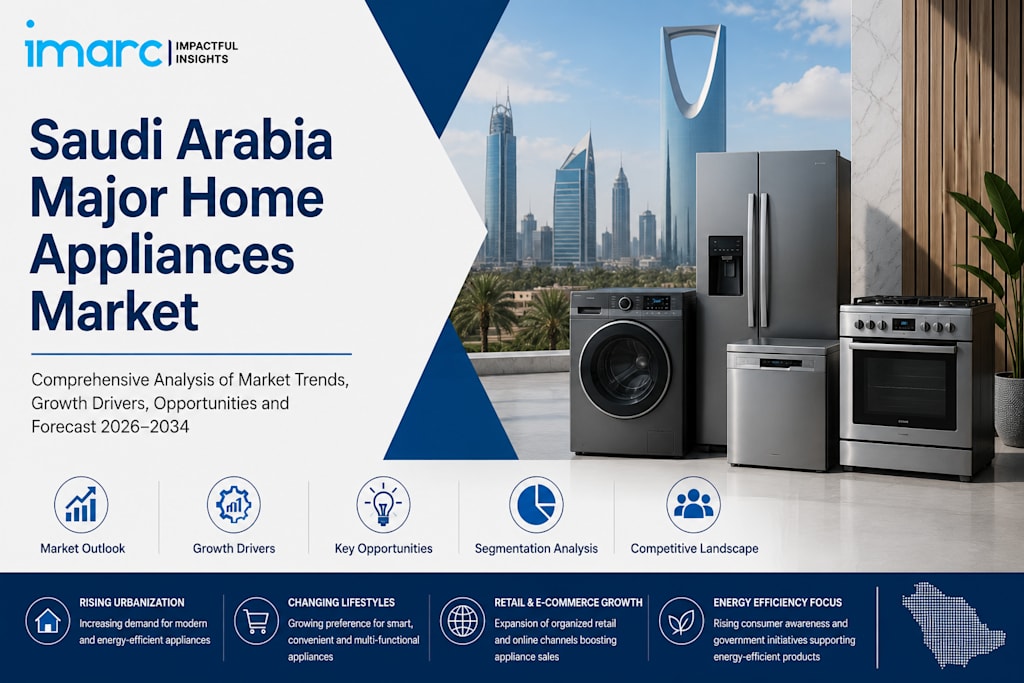
Saudi Arabia’s major home appliances market sits at the intersection of several powerful forces a young, urbanizing population that’s moving into new homes in record numbers, a government-driven push to raise living standards under Vision 2030, and a technology wave that’s making smart, energy-efficient appliances the new baseline expectation rather than a luxury add-on. The result is a market that’s both large and structurally supported for continued expansion. According to IMARC Group’s latest data, The Saudi Arabia major home appliances market size reached USD 6,949.6 Million in 2025. Looking forward, IMARC Group expects the market to reach USD 9,554.3 Million by 2034, exhibiting a growth rate (CAGR) of 3.60% during 2026-2034.
What makes this market particularly resilient is how broad the demand base has become. National homeownership climbed to 65.4% in 2024 and every new home requires a full suite of appliances. ROSHN, the government-backed residential developer, is delivering master-planned communities at scale, each of which generates fresh demand for refrigerators, washing machines, air conditioners, ovens, and dishwashers. At the same time, replacement cycles are accelerating as SASO energy efficiency standards push consumers and retailers away from non-compliant models over 50,000 non-compliant air conditioners have already been removed from Saudi retail shelves since enforcement intensified. The market is segmented by product across refrigerators, freezers, dishwashing machines, washing machines, ovens, air conditioners, and others, distributed through supermarkets and hypermarkets, specialty stores, online platforms, and other channels, spanning the Northern and Central, Western, Eastern, and Southern regions of the Kingdom.
Saudi Arabia Major Home Appliances Market Growth Drivers:
- Urbanization and Residential Construction Driving Baseline Demand
With over 84% of Saudi Arabia’s population now living in urban areas, residential construction activity is operating at an exceptional pace. The Sakani housing program has facilitated more than 800,000 subsidized housing contracts, generating direct, predictable demand for refrigerators, washing machines, air conditioners, and ovens with each new unit handed over. ROSHN alone is delivering thousands of homes annually across master-planned communities. Riyadh faces a projected shortfall of 305,000 units through the coming decade even after accounting for ongoing supply. Each home delivered creates an immediate appliance requirement making construction pipelines one of the most reliable demand signals in the sector.
- Rising Disposable Income and Premiumization Trend
Saudi households reported an average monthly disposable income of approximately USD 3,153 in 2024, and female workforce participation now at its highest levels in the Kingdom’s history is creating more dual-income households with stronger purchasing power. The result is a visible shift toward premium appliances: built-in kitchen suites, inverter-grade air conditioners, and smart washing machines are among the fastest-growing sub-segments. Unemployment fell to 7.7% in 2024, and retail credit remains accessible through bank installment schemes, enabling trade-up decisions that might otherwise be deferred. eXtra, Saudi Arabia’s largest appliance retailer, reported 2024 revenue of SAR 6,781.2 million and net profit of SAR 534.4 million, signaling strong consumer spending on large appliances.
- Energy Efficiency Regulations Accelerating Replacement Cycles
Saudi Arabia’s energy efficiency framework is doing something unusual for a market driver: it’s simultaneously creating new demand while raising product quality standards across the board. SASO mandates and SEEC dishwasher labeling enforcement effective from early 2025 are pushing older, non-compliant inventory off shelves and steering consumers toward certified, energy-rated models. More than 50,000 non-compliant air conditioners have already been removed from retail channels since enforcement intensified, directly stimulating replacement purchases. For manufacturers and retailers, compliance readiness especially for inverter-grade air conditioners and A-rated refrigerators has become a genuine competitive advantage in the Saudi market.
Saudi Arabia Major Home Appliances Market Trends:
- Smart and IoT-Connected Appliances Becoming the New Standard
Saudi consumers particularly tech-savvy urban millennials are increasingly selecting appliances based on connectivity features, not just specifications. Smart refrigerators with app controls, washing machines with remote diagnostics, and voice-activated ovens are moving from niche to mainstream across Riyadh, Jeddah, and Dammam. LG Electronics partnered with Microsoft in January 2025 to embed Copilot AI agents into its smart TVs and home appliances, enhancing device autonomy and energy optimization in real time. BSH debuted the Matter-ready Bosch 100 Series French-door refrigerator, enabling cross-brand home-network integration via Alexa. Saudi Arabia’s AI spending is projected to reach USD 1.9 billion by 2027, with smart home applications among the priority use cases.
- Local Manufacturing and Distribution Partnerships Reshaping the Market
Vision 2030’s localization drive is encouraging global brands to build genuine in-Kingdom presence rather than simply import and distribute. Zamil Air Conditioners operates four factories in Dammam with annual capacity above 1.1 million units. Daikin announced the construction of a new manufacturing facility in Jeddah focused on localized chillers and hydronic heat pumps. These local production moves aren’t just about compliance they deliver shorter lead times for giga-project schedules, faster service response, and stronger pricing competitiveness. MODON industrial city incentives, including land allocation and utility discounts, are making Saudi manufacturing viable for international appliance brands that previously relied entirely on imports.
- E-Commerce and Retail Expansion Widening Consumer Access
Online appliance sales are growing rapidly as Saudi consumers become increasingly comfortable purchasing large-ticket items through digital channels. With 33.6 million e-commerce users in 2024 a 42% increase since 2019 retailers are investing in logistics infrastructure to support major appliance delivery and installation services nationwide. BinDawood committed USD 390 million to new delivery hubs specifically to strengthen last-mile logistics for large-format products including appliances. eXtra opened its 50th branch in 2024, targeting 25% national market share, while Abdul Latif Jameel Electronics launched its largest-ever store in Riyadh in 2025. Together, these moves are bringing more SKUs and after-sales support closer to consumers across the Kingdom.
- Recent News and Developments in Saudi Arabia Major Home Appliances Market
- May 2025: Panasonic Marketing Middle East & Africa (PMMAF) formally announced a landmark distribution partnership with Alessa (Hamad A. Alessa and Sons Co.), appointing Alessa as the official distributor of Panasonic’s premium large home appliances including washing machines and refrigerators across Saudi Arabia. The partnership combines Panasonic’s Japanese engineering with Alessa’s extensive nationwide distribution network and local market expertise, with botxshdkhdxjhh companies citing Vision 2030 alignment as a key strategic objective.
- February 2025: ROSHN and Johnson Controls Arabia signed a strategic agreement to introduce variable refrigerant flow (VRF) cooling technology across ROSHN’s upcoming residential communities. The partnership targets 90% local content by end of the agreement period and includes joint training initiatives to upskill Saudi technicians in VRF installation and maintenance directly supporting the Kingdom’s push for energy-efficient, locally supported home comfort systems.
- January 2025: LG Electronics partnered with Microsoft to embed Copilot AI agents into its 2025 smart TV and home appliance lineup, enabling advanced device autonomy, real-time energy optimization, and predictive maintenance alerts. The development represents a significant leap in how connected appliances function in Saudi homes, moving intelligence from simple scheduling features toward genuinely responsive, AI-driven household management.
- November 2025: Daikin announced the construction of a new manufacturing facility in Jeddah focused on producing localized chillers and hydronic heat pumps designed specifically for the Saudi climate and giga-project supply chains. The facility aligns directly with Vision 2030’s local content targets and is expected to deliver shorter lead times for major infrastructure developments including NEOM, Red Sea Project, and Diriyah, while supporting stricter SASO energy efficiency requirements.
Note: If you require specific details, data, or insights that are not currently included in the scope of this report, we are happy to accommodate your request. As part of our customization service, we will gather and provide the additional information you need, tailored to your specific requirements. Please let us know your exact needs, and we will ensure the report is updated accordingly to meet your expectations.
About the Creator
Faisal Al-Harbi
Market research professional based in Saudi Arabia (KSA), focused on industry trends, market growth, and economic insights.
Writing data-driven articles on Saudi markets, business outlook, and Vision 2030–driven sectors.
Enjoyed the story? Support the Creator.
Subscribe for free to receive all their stories in your feed.
Comments
There are no comments for this story
Be the first to respond and start the conversation.