
Saudi Arabia Luxury Residential Real Estate Market: Elite Living, Branded Residences & Growth Outlook
How rising investments from high-net-worth individuals, large-scale smart city and giga-project developments under Vision 2030, and growing demand for premium waterfront, branded, and sustainable residences are driving innovation, luxury lifestyle offerings, and long-term value creation across the Saudi Arabia Luxury Residential Real Estate Market.

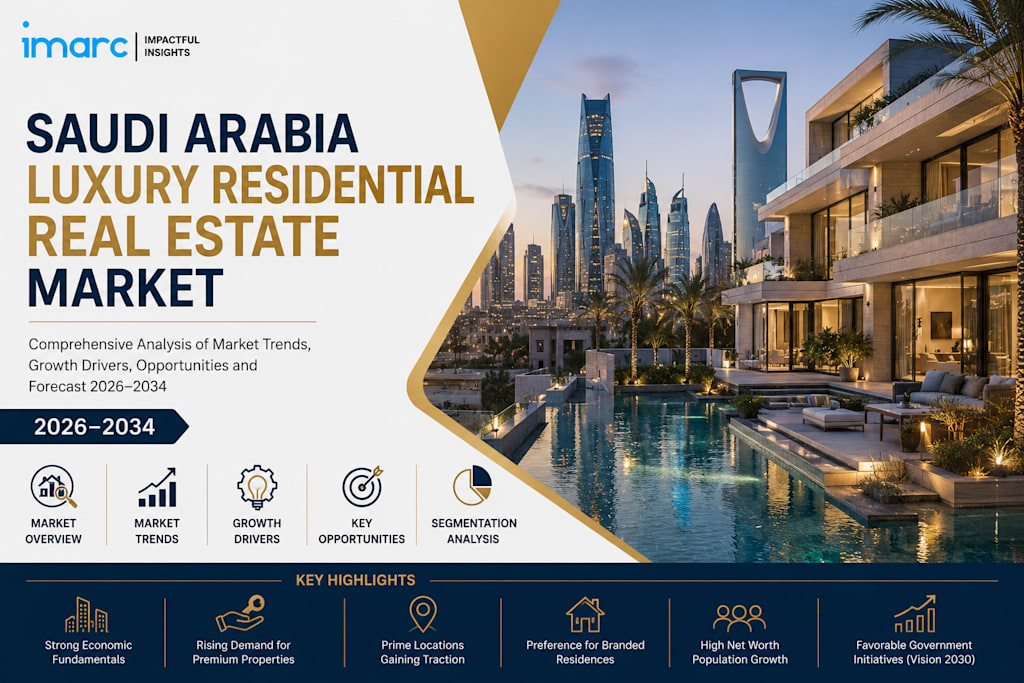
Vision 2030, improved geopolitical stability, favorable loan rates, and ongoing economic diversification are fueling unprecedented growth in Saudi Arabia's luxury residential real estate sector. The market has become a magnet for high-net-worth individuals, foreign investors, and international corporations seeking premium properties in one of the Middle East's most dynamic markets.
According to IMARC Group's latest market research, the Saudi Arabia luxury residential real estate market size was valued at USD 16.0 Billion in 2025. The market is projected to expand significantly, reaching USD 26.4 Billion by 2034, reflecting the Kingdom's comprehensive transformation agenda. The market encompasses two primary segments:
- Strong performance across major metropolitan areas demonstrates the sector's resilience and attractiveness. Residential transactions across Riyadh, Jeddah, and the Dammam Metropolitan Area reached
- SAR 118 billion (USD 32 billion) in 2024, representing a remarkable 50% year-on-year increase. Momentum continued into the first quarter of 2025, which generated SAR 109 billion (USD 29 billion) in transactions, underscoring the market's accelerating trajectory.
Key Market Growth Drivers
- Vision 2030 and Economic Diversification
The Kingdom's strategic pivot away from oil dependency through Vision 2030 has positioned luxury real estate as a cornerstone of economic growth. Over 200 multinational companies have already secured Regional Headquarters licenses in Riyadh, driving demand for premium residential properties among affluent executives and expatriate professionals. Government-backed initiatives targeting a 70% homeownership rate have created favorable financing conditions. In May 2025, Saudi Arabia lowered the minimum eligibility age for housing support from 25 to 20 years, enabling younger citizens to access financing earlier. These structural reforms attract both domestic investors and foreign capital seeking long-term stability in a fast-growing market.
- Growing High-Net-Worth Population
Saudi Arabia's affluent demographic has expanded dramatically, with the high-net-worth population growing by 32% since 2013. This expanding cohort actively seeks sophisticated living spaces with world-class amenities, exclusive locations, and strong investment potential. The influx of regional and international wealth has intensified competition for premium properties in coveted neighborhoods, particularly in Riyadh and Jeddah. Luxury developments now command premium valuations, with S&P Global Ratings reporting a 10% year-on-year price increase for residential units in Riyadh alone. The strong demand from this segment provides developers with confidence to launch increasingly sophisticated and amenity-rich projects.
- Foreign Ownership Liberalization
Effective January 21, 2026, the new Law on Non-Saudis' Ownership of Real Estate fundamentally reshapes market dynamics by allowing international buyers to purchase residential property in designated areas without residency requirements. Developers have already responded proactively Dar Global acquired land worth USD 234.6 million in Riyadh and Jeddah specifically to capitalize on this regulatory opening. This landmark shift is expected to unlock significant foreign capital inflows, expand the buyer pool, and create unprecedented opportunities for international investors to participate in Saudi Arabia's booming real estate sector.
Download the Sample Report to Understand Market Trends and Outlook
Current Market Trends
- Smart Homes and Sustainable Living
Today's luxury homebuyers prioritize smart home technology and environmental sustainability. Developers are integrating automated systems, energy-efficient designs, and green building certifications as standard features. Major projects like NEOM's THE LINE which began main vertical construction contracts in February 2025 showcase this commitment, with plans to deliver 9 million high-tech residences along a 170 km car-free urban spine powered entirely by renewables. These innovations appeal to environmentally conscious, tech-savvy consumers while reducing long-term operating costs. Smart features enhance security, convenience, and property value, making them increasingly non-negotiable for affluent buyers.
- Giga-Projects and Mixed-Use Developments
Saudi Arabia's ambitious mega-projects are redefining what luxury living means. New Murabba in Riyadh a USD 267 billion downtown transformation features Mukaab, one of the world's largest immersive mixed-use structures. The Diriyah Gate Development involves a SAR 190 billion investment in historic district revitalization combining luxury residences with cultural heritage. Amaala, operated entirely on renewable energy with marine conservation partnerships, exemplifies the emerging resort-living model for ultra-affluent clientele. These large-scale developments create critical mass, attract international brands and amenities, and establish new benchmarks for quality and exclusivity in the region.
- Branded Residences and Premium Positioning
International hospitality and luxury brands are increasingly entering the residential market. Raffles Residences Jeddah a 46-story waterfront luxury tower overlooking the Red Sea demonstrates how branded properties attract affluent buyers seeking lifestyle prestige and hospitality services integrated into their homes. These developments command premium pricing and appeal to buyers valuing brand heritage, design excellence, and exclusive amenities. The convergence of hospitality and residential creates new revenue streams for developers while raising quality expectations across the entire luxury segment.
Recent News and Developments
- January 2026: Saudi Arabia officially opened its real estate market to foreign buyers. The Law on Non-Saudis' Ownership of Real Estate took effect on January 21, 2026, allowing non-Saudis to purchase residential, commercial, industrial, and agricultural property in designated areas. This landmark legislation is expected to attract significant foreign capital and international developers to the Kingdom.
- Investment Opportunities
The convergence of government policy reforms, mega-project development, international corporate expansion, and growing wealth creation presents compelling opportunities for investors. Premium properties in established and emerging luxury neighborhoods command strong price appreciation. Off-plan developments by reputable developers offer entry points with attractive payment terms. The residential rental market benefits from expatriate demand driven by the Regional Headquarters program, delivering stable income streams alongside capital appreciation.
- Looking Forward
Saudi Arabia's luxury residential real estate market stands at an inflection point. Vision 2030 infrastructure investments, foreign ownership liberalization, a 32% increase in high-net-worth individuals since 2013, and multi-billion-dollar giga-projects create a rare confluence of favorable conditions. Developers and investors who understand regional preferences, secure prime locations, and deliver world-class quality will capture outsized returns as the market matures.
About IMARC Group
IMARC Group is a leading market research company providing comprehensive quantitative analysis, forecasts, and actionable insights across global industries. Our research supports strategic decision-making for Fortune 500 corporations, investment firms, government organizations, and growth-stage enterprises.
About the Creator
Faisal Al-Harbi
Market research professional based in Saudi Arabia (KSA), focused on industry trends, market growth, and economic insights.
Writing data-driven articles on Saudi markets, business outlook, and Vision 2030–driven sectors.
Enjoyed the story? Support the Creator.
Subscribe for free to receive all their stories in your feed.
Comments
There are no comments for this story
Be the first to respond and start the conversation.