
Saudi Arabia Logistics Market: Supply Chain Transformation, Trade Connectivity & Growth Outlook
How strategic investments in transport infrastructure under Vision 2030, rapid growth of e-commerce, and Saudi Arabia’s emergence as a regional trade and logistics hub are driving digital transformation, warehouse automation, and multimodal supply chain optimization across the Saudi Arabia Logistics Market.

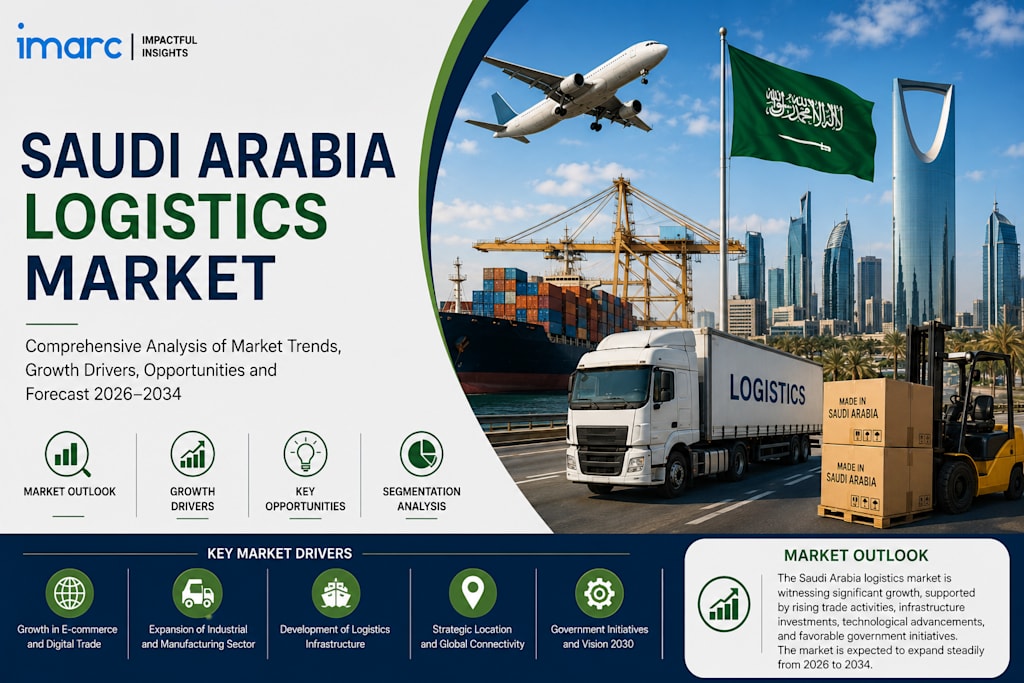
Vision 2030 infrastructure investments, rapid e-commerce growth, and Saudi Arabia's unique geographic position at the crossroads of three continents are fueling strong demand across the logistics sector, supported by expanding free trade zones, digital adoption, and a fast-growing manufacturing base. According to IMARC Group's latest data, The Saudi Arabia logistics market size was valued at USD 55.29 Billion in 2025. Looking forward, IMARC Group estimates the market to reach USD 83.41 Billion by 2034, exhibiting a CAGR of 4.67% from 2026-2034. The 3PL segment currently dominates the market, holding a share of 46.12% in 2025.
Saudi Arabia's logistics sector is going through a genuine transformation right now. It is not just about moving goods faster it is about repositioning the entire Kingdom as a global trade hub that links Asia, Europe, and Africa. With the government targeting an increase in the transport and logistics sector's GDP contribution from 6% to 10%, the scale of investment and reform is hard to ignore. Ports are being expanded, rail corridors extended, and special economic zones activated with tax incentives that are pulling in global operators. The combination of a young, connected population, soaring e-commerce demand, and Vision 2030-led industrial diversification means this market has both immediate momentum and long runway ahead.
Saudi Arabia Logistics Market Growth Drivers:
• Vision 2030 Infrastructure Development Programs
The Saudi government's commitment to raising the logistics sector's share of GDP from 6% to 10% is translating into real, large-scale infrastructure projects. Port expansions are boosting cargo handling capacity and turnaround speeds, while new rail corridors such as Alstom's SAR 300 Million agreement with Saudi Railway Company to upgrade the east-west freight corridor are linking industrial centers to gateway ports. These investments are not just improving connectivity; they are fundamentally redefining Saudi Arabia's position in global supply chains as a competitive multimodal trade corridor between three continents.
• E-Commerce Expansion and Digital Retail Growth
With 34.4 million internet users in the Kingdom, online retail is no longer a niche channel it is a core driver of logistics demand. Consumers increasingly expect same-day or next-day delivery, which is pushing logistics providers to establish micro-fulfillment centers, expand last-mile delivery fleets, and adopt advanced route optimization tools. Cross-border e-commerce is adding another layer of complexity, driving demand for specialized customs clearance and international parcel management. Providers that can offer integrated, tech-enabled fulfillment solutions are gaining a clear edge as order volumes continue to climb.
• Strategic Geographic Positioning and Trade Facilitation
Few countries enjoy the natural logistics advantage that Saudi Arabia does. Access to the Red Sea, Arabian Gulf, and Indian Ocean connects the Kingdom to virtually every major global market, and the government is capitalizing on this through cabotage relaxation, streamlined customs procedures, and new shipping services linking Saudi ports to Singapore, Shanghai, and Colombo. The Special Integrated Logistics Zone near Riyadh offers a 50-year tax holiday and a 4-hour customs clearance system, making it one of the most attractive logistics destinations in the region for international operators looking to establish regional distribution hubs.
Saudi Arabia Logistics Market Trends:
• Digital Transformation and Technology Integration
AI, IoT sensors, and blockchain-based tracking are moving from pilot projects to everyday operations across Saudi logistics networks. The Saudi Arabia AI market was valued at USD 1,242.5 Million in 2025, and a meaningful share of that investment is flowing into logistics platforms. Warehouse management systems with real-time inventory visibility, AI-driven route optimization, and automated sortation are helping providers reduce operational costs while handling higher volumes. Companies that have deployed these systems are reporting measurable improvements in delivery accuracy and cash flow a compelling case for wider adoption across the sector.
• Expansion of Free Trade Zones and Special Economic Areas
The proliferation of specialized logistics zones is one of the most tangible shifts reshaping the Saudi logistics landscape. The SILZ near Riyadh's King Khalid International Airport stands out as a marquee example, offering a 50-year tax holiday and a 4-hour customs clearance system that is already attracting global operators. DHL Supply Chain's EUR 130 Million investment in a 78,000 square meter hub at the SILZ featuring 53,000 square meters of advanced warehouse space signals just how seriously international players are taking these zones as long-term strategic assets for regional distribution.
• Sustainability Initiatives and Green Logistics Adoption
Saudi Arabia's net-zero emissions target for 2060 is creating real pressure on logistics operators to clean up their supply chains. The Saudi Green Initiative is directing investment toward electric delivery vehicles, solar-powered warehouses, and carbon-neutral fleet operations. This is not just about regulatory compliance sustainability credentials are increasingly influencing procurement decisions by multinationals choosing regional logistics partners. Companies that move early on green logistics will be better positioned to win contracts with large international manufacturers and retailers, many of whom are now applying ESG criteria to their supplier selection processes.
Recent News and Developments in Saudi Arabia Logistics Market
• November 2025: DHL Supply Chain announced a EUR 130 Million investment to establish a 78,000 square meter regional logistics hub at Saudi Arabia's SILZ in Riyadh. The facility will feature 53,000 square meters of advanced multi-user warehouse space serving the technology, retail, automotive, energy, and e-commerce sectors under a 26-year lease agreement.
• August 2025: DHL eCommerce completed its minority stake acquisition in AJEX Logistics Services, a leading Saudi parcel delivery company. The strategic partnership positions both companies to capitalize on anticipated double-digit growth in Saudi Arabia's e-commerce sector while expanding last-mile delivery capabilities across the Middle East region.
• November 2024: Alstom signed an SAR 300 Million agreement with Saudi Railway Company to enhance the east-west freight corridor. The deal highlights continued government and private sector commitment to strengthening multimodal transport connectivity and improving rail-based logistics efficiency between the Kingdom's key industrial and port regions.
Note: If you require specific details, data, or insights that are not currently included in the scope of this report, we are happy to accommodate your request. As part of our customization service, we will gather and provide the additional information you need, tailored to your specific requirements. Please let us know your exact needs, and we will ensure the report is updated accordingly to meet your expectations.
About the Creator
Shubham Sharma
Market research enthusiast sharing insights on global industries, emerging trends, growth opportunities, and data-driven analysis across diverse markets.
Enjoyed the story? Support the Creator.
Subscribe for free to receive all their stories in your feed.
Comments
There are no comments for this story
Be the first to respond and start the conversation.