
Saudi Arabia Lightweight Building Materials Market to Reach USD 5,314.50 Million by 2034, Growing at 3.08% CAGR
Saudi Arabia lightweight building materials market expands with rising construction, urbanization, and demand for sustainable, cost-efficient building solutions.

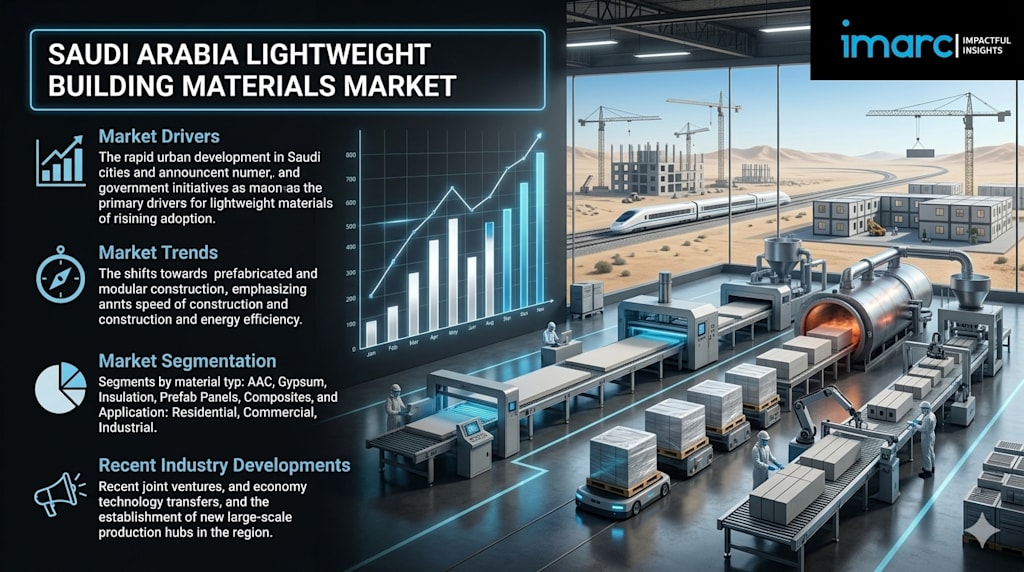
Rising urbanization, large-scale infrastructure investments, and government-led sustainability mandates are driving demand for lightweight building materials in Saudi Arabia, supported by Vision 2030 mega-projects, green building regulations, prefabrication trends, and expanding domestic manufacturing capabilities. According to IMARC Group's latest data, The Saudi Arabia lightweight building materials market size was valued at USD 4,044.19 Million in 2025 and is projected to reach USD 5,314.50 Million by 2034, growing at a compound annual growth rate of 3.08% from 2026-2034. Lightweight concrete currently dominates the market, holding a material share of over 34% in 2025.
The Saudi Arabia lightweight building materials market is witnessing strong growth momentum driven by Vision 2030's USD 1.3 Trillion investment pipeline spanning real estate, infrastructure, and transportation. With nearly 18,000 projects anticipated for execution under the national program, demand for fast, efficient, and sustainable construction solutions continues to accelerate. Commercial construction leads application segments with a 32% share, while construction companies represent the largest end-user group at 33%. Medium-density materials command 38% of the market owing to their versatility across diverse project types, from high-rise towers to large residential communities. The country's push for green building certifications, combined with rapid population growth reaching nearly 38 Million people, is positioning lightweight building materials as a cornerstone of modern Saudi construction.
Saudi Arabia Lightweight Building Materials Market Growth Drivers:
- Vision 2030 Mega-Project Investment Pipeline
Saudi Arabia's ambition under Vision 2030 is generating unmatched construction activity, with USD 164 Billion in real estate contracts already issued and flagship projects such as NEOM commanding USD 28.7 Billion in commitments. Nearly 18,000 projects are anticipated for execution through the end of the decade, creating sustained demand for lightweight concrete, structural insulated panels, and composite materials. In October 2024, NEOM revealed a collaboration with Asas Al-Mohileb to develop and manage a SAR 700 Million ready-mix concrete plant primarily supporting the construction of THE LINE. Lightweight materials support accelerated timelines and reduced structural loads across giga-scale developments, making them essential specifications for developers racing against ambitious completion schedules.
- Stringent Energy Efficiency Regulations and Green Building Mandates
Government-mandated sustainability standards are reshaping material selection across the Kingdom's construction sector. The Ministry of Municipalities and Housing's Building Sustainability Assessment System evaluated 75 projects covering approximately 47 Million square meters in a recent full-year cycle, with momentum continuing as an additional 7 Million square meters were assessed in early subsequent months. In October 2024, City Cement's subsidiary Nizak Mining Company partnered with Next Generation SCM to establish the Kingdom's first calcined clay supplementary cementitious material plant, with an initial production capacity of 350,000 Tons per annum. Lightweight insulation systems and eco-panels help builders meet thermal performance benchmarks, qualify for certifications, and satisfy regulatory approvals that are increasingly tied to project financing and permitting.
- Rapid Urbanization and Population Expansion
Saudi Arabia's total projected population reached approximately 37,989,969, reflecting a 1.38% growth rate that continues to generate sustained demand for housing, commercial space, hospitals, and schools across major cities. Urban expansion is driving preference for scalable, fast-to-install building materials that enable vertical growth while keeping structural loads manageable. Projects such as ROSHN's Sedra community, a 30,000-unit housing development spanning 20 Million square meters, illustrate the scale at which medium-density lightweight solutions are being deployed to meet residential demand. The government's issuance of 3,800 construction licenses in a recent annual period reflects the breadth of active development underway across the Kingdom.
Saudi Arabia Lightweight Building Materials Market Trends:
- Accelerated Adoption of Prefabricated and Modular Construction
Prefabrication is fundamentally transforming how Saudi mega-projects are built, with lightweight materials enabling factory-produced components that arrive site-ready for rapid assembly. In March 2025, China Harbour Engineering Company commenced operations at its 200,000 square meter modular production facility in Riyadh, employing robotics and digital technologies to support large-scale housing projects with enhanced construction efficiency. Developers are increasingly mandating prefabrication across their pipelines to achieve carbon-neutral operations while meeting compressed delivery schedules. The commercial construction segment, which holds a 32% market share, is particularly reliant on this approach, with retail, hospitality, and office projects requiring fast-track construction to meet occupancy targets under Vision 2030 timelines.
- Digital Transformation and Smart Manufacturing Technologies
Advanced technologies are reshaping lightweight materials production and installation across Saudi Arabia's construction landscape. In December 2024, NEOM entered into a joint venture agreement with Samsung C&T Corporation targeting an initial investment exceeding SAR 1.3 Billion in construction robotics, aimed at advancing automation in building component manufacturing and site assembly. Building Information Modeling integration and AI-powered project management tools are enabling real-time quality tracking and predictive maintenance, transforming how lightweight building systems are coordinated across complex mega-projects. These innovations are reducing installation errors, lowering rework costs, and improving consistency across large development pipelines requiring sophisticated quality assurance.
- Integration of Sustainable and Low-Carbon Materials
Sustainability imperatives are driving a broad industry shift toward materials with reduced carbon footprints and enhanced environmental profiles. Lightweight concrete, which currently holds a 34% market share, is favored for its lower carbon footprint relative to conventional concrete while maintaining structural integrity suitable for the Kingdom's extreme climate. Its thermal insulation properties are particularly critical for reducing cooling loads, a key cost driver in Saudi Arabia's desert environment. Projects such as the Red Sea Development and Qiddiya Entertainment City are increasingly specifying lightweight concrete for its faster curing times and prefabrication compatibility, enabling developers to meet ambitious completion schedules while adhering to green building certification requirements.
Recent News and Developments in Saudi Arabia Lightweight Building Materials Market
- April 2026: Foam concrete innovations advance sustainability through better fire resistance, lower energy consumption, and integration of industrial by-products.
- March 2026: Owens Corning expands lightweight insulating material production capacity while Saint-Gobain introduces advanced fiber-reinforced polymer systems for durability.
- February 2026: Green building sector achieves record performance with over 1.03 million square meters certified, driving demand for lightweight sustainable materials.
- March 2025: China Harbour Engineering Company's 200,000 square meter modular production facility in Riyadh commenced full operations, employing robotics and digital technologies to support large-scale housing projects and enhance modular construction efficiency.
- December 2024: NEOM entered into a joint venture agreement with Samsung C&T Corporation targeting an initial investment exceeding SAR 1.3 Billion in construction robotics, aimed at accelerating the advancement and implementation of innovative construction automation technology across the Kingdom.
Note: If you require specific details, data, or insights that are not currently included in the scope of this report, we are happy to accommodate your request. As part of our customization service, we will gather and provide the additional information you need, tailored to your specific requirements. Please let us know your exact needs, and we will ensure the report is updated accordingly to meet your expectations.
About the Creator
Kishan Kumar
My name is Kishan Roy and I am a market analyst having 5 years of experience and a skilled researcher with a keen eye for consumer trends and data-driven insights.
Enjoyed the story? Support the Creator.
Subscribe for free to receive all their stories in your feed.
Comments
There are no comments for this story
Be the first to respond and start the conversation.