
Saudi Arabia Inland Cargo Shipping Market: Logistics Expansion, Trade Connectivity & Growth Outlook
How expanding trade corridors, rising investments in multimodal transport infrastructure under Vision 2030, and growing demand for efficient domestic freight movement are driving modernization, digital logistics integration, and operational efficiency across the Saudi Arabia Inland Cargo Shipping Market.

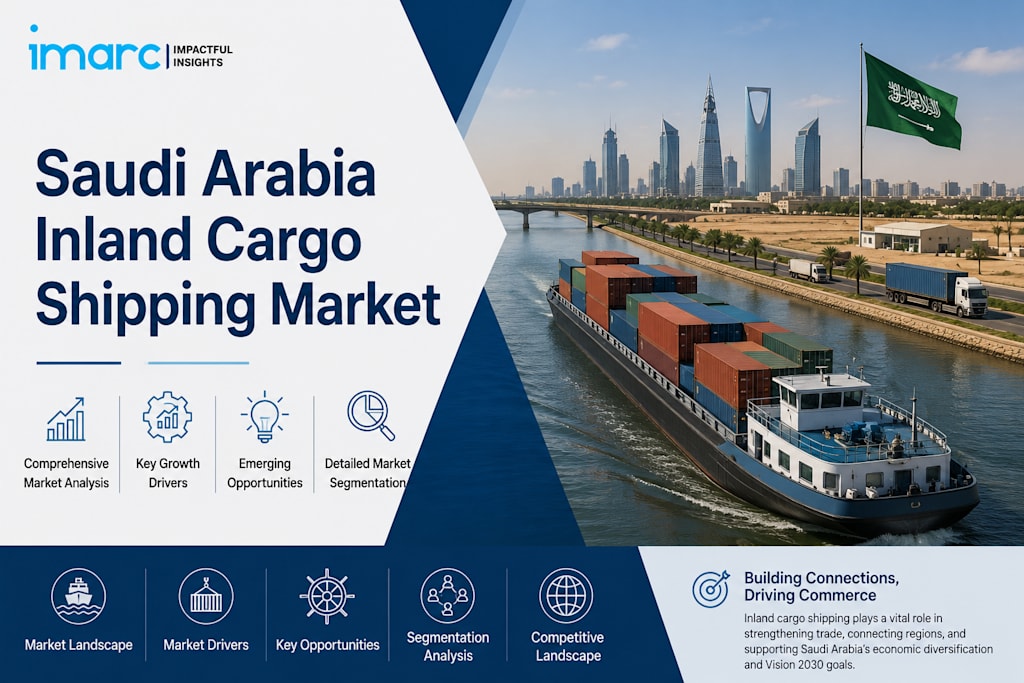
Saudi Arabia’s inland cargo shipping sector is no longer just a support function for the country’s energy trade it’s fast becoming a strategic pillar of the national economy. Backed by Vision 2030 infrastructure spending, a booming e-commerce user base, and smart logistics investments, the market is expanding steadily and drawing both domestic and international operators. According to IMARC Group’s latest data, The Saudi Arabia inland cargo shipping market size reached USD 173.4 Million in 2025. Looking forward, IMARC Group expects the market to reach USD 252.7 Million by 2034, exhibiting a growth rate (CAGR) of 4.28% during 2026-2034.
Saudi Arabia’s inland cargo shipping landscape is undergoing a genuine structural shift. The Kingdom is investing heavily in transport networks, dry ports, and logistics corridors as part of its National Transport and Logistics Strategy with a stated goal to climb from 55th to the top 10 of the Global Logistics Performance Index by 2030. Meanwhile, e-commerce penetration is rising fast, with over 33.6 million internet users actively shopping online as of 2024, a jump of 42% since 2019. Demand for efficient last-mile delivery and regional distribution is growing accordingly. With key segments including containerized cargo, bulk cargo, liquid cargo, and Ro-Ro cargo, and end-use industries spanning automotive, FMCG, chemicals, pharmaceuticals, and electronics, the market is diversifying well beyond its traditional oil and gas roots.
Saudi Arabia Inland Cargo Shipping Market Growth Drivers:
- Vision 2030 Infrastructure Push
The Saudi government is pouring serious capital into logistics infrastructure. The Saudi Landbridge Railway project designed to connect Jeddah to Riyadh is a flagship effort to cut inland transit times and ease road congestion. Beyond rail, OPAZ issued a tender in 2025 to develop a new dry port at Al-Dhahira near the Saudi-Omani border to streamline bilateral trade. These are part of a wider framework of 59 planned inland logistics centers covering 100 million square meters, supported by 30-year concessions and tax incentives to attract private operators. The government’s goal is to cut national logistics costs to 6% of GDP by 2030.
- E-Commerce Expansion Driving Last-Mile Demand
Online retail is changing how cargo moves inside Saudi Arabia. With 33.6 million e-commerce users recorded in 2024 up 42% since 2019 the volume and geographic spread of shipments has grown significantly. Deliveries are no longer concentrated in Riyadh and Jeddah; smaller cities now expect fast, reliable fulfillment. Logistics players are responding with hub-and-spoke models, real-time route optimization, and integrated tracking. Saudi Post Logistics (SPL) has been piloting electric cargo bikes and AI-powered delivery bots in urban zones, while startups like BARQ are trialing autonomous pods in tech parks, showing how last-mile innovation is accelerating across the sector.
- Industrial Diversification and Growing Non-Oil Trade
Saudi Arabia recorded over USD 137 billion in non-oil export logistics activity in 2024, reflecting how far the cargo base has expanded beyond hydrocarbons. Mega-projects like NEOM and Qiddiya are injecting heavy-lift and oversized freight volumes suited to specialist inland carriers. FMCG and chemicals sectors are increasingly relying on inland routes to connect Jubail petrochemical sites to Dammam port and retail centers nationwide. In the broader Saudi freight and logistics market, wholesale and retail trade leads end-user demand with a 39.35% market share a clear signal that diverse cargo categories, not just oil, are driving inland shipping growth.
Saudi Arabia Inland Cargo Shipping Market Trends:
- Multimodal Integration Gaining Serious Momentum
Rail is finally entering the inland cargo equation in a meaningful way. In 2024, a container shipment was successfully moved by rail from Jubail Commercial Port to Riyadh Dry Port through the Eastern Network a first-of-its-kind milestone. A planned logistics zone in Dammam’s Second Industrial City covering 1 million square meters will connect directly to the North and East railway networks, unlocking access to multiple major ports. The USD 100 billion Gulf Railway project will eventually link Dammam port and Ras Al Khair to UAE and Oman, trimming transit times on key international lanes by up to eight days.
- Technology-Led Freight Operations
Digital platforms are changing how inland cargo is managed, tracked, and cleared. The Petroleum Products Movement Monitoring Platform already provides real-time truck tracking via live digital maps, improving compliance and decision-making across the supply chain. Integrated port community systems have reduced dwell times at Saudi gateways, with crane automation lifting container moves per hour by 18%. AI spending in the Kingdom is forecast to reach USD 1.9 billion by 2027, with a significant share directed at logistics applications from smart routing to predictive freight analytics enabling operators to handle higher volumes with greater efficiency.
- Sustainability and Green Logistics Entering the Mix
Environmental considerations are starting to shape investment decisions across the inland cargo sector. In May 2025, DHL Global Forwarding signed an MoU with Hyperview Saudi to operate hydrogen-powered trucks in the Kingdom one of the first partnerships of this kind in the Gulf. Road electrification pilots on key corridors are already showing emissions reductions of around 20% per ton-kilometer. DHL Group has committed over EUR 500 million in Middle East investment through 2030, with electric trucks included in the fleet expansion. For operators, moving toward greener inland freight aligns directly with Vision 2030’s sustainability mandates and growing shipper expectations around carbon accountability.
Recent News and Developments in Saudi Arabia Inland Cargo Shipping Market
- January 2025: Roll Group, a heavy transport and logistics company, significantly expanded its Saudi footprint with the opening of a new 15,000-square-meter facility in Jubail. The move placed Roll Group Middle East among the largest inland transport operators in the Kingdom, reinforcing growing private-sector confidence in the domestic cargo market.
- May 2025: DHL Global Forwarding signed a Memorandum of Understanding with Hyperview Saudi to deploy hydrogen-powered trucks across the Kingdom. The partnership is positioned as a milestone step toward decarbonizing road freight and advancing future-proof logistics innovation in support of Saudi Vision 2030.
- June 2025: DHL Group announced plans to invest over EUR 500 million across the Middle East through 2030, with a concentrated focus on Saudi Arabia and the UAE. The investment covers fleet expansion including electric trucks, joint ventures such as the Etihad Rail partnership, and new logistics infrastructure to support the region’s growing trade activity.
Note: If you require specific details, data, or insights that are not currently included in the scope of this report, we are happy to accommodate your request. As part of our customization service, we will gather and provide the additional information you need, tailored to your specific requirements. Please let us know your exact needs, and we will ensure the report is updated accordingly to meet your expectations.
About the Creator
Shubham Sharma
Market research enthusiast sharing insights on global industries, emerging trends, growth opportunities, and data-driven analysis across diverse markets.
Enjoyed the story? Support the Creator.
Subscribe for free to receive all their stories in your feed.
Comments
There are no comments for this story
Be the first to respond and start the conversation.