
Saudi Arabia Food Processing Machinery Market: Automation, Smart Manufacturing & Growth Outlook
How expanding food manufacturing capacity, increasing demand for processed and packaged foods, and government initiatives to strengthen domestic food production under Vision 2030 are driving investments in automated processing equipment, smart manufacturing technologies, and energy-efficient machinery across the Saudi Arabia Food Processing Machinery Market.

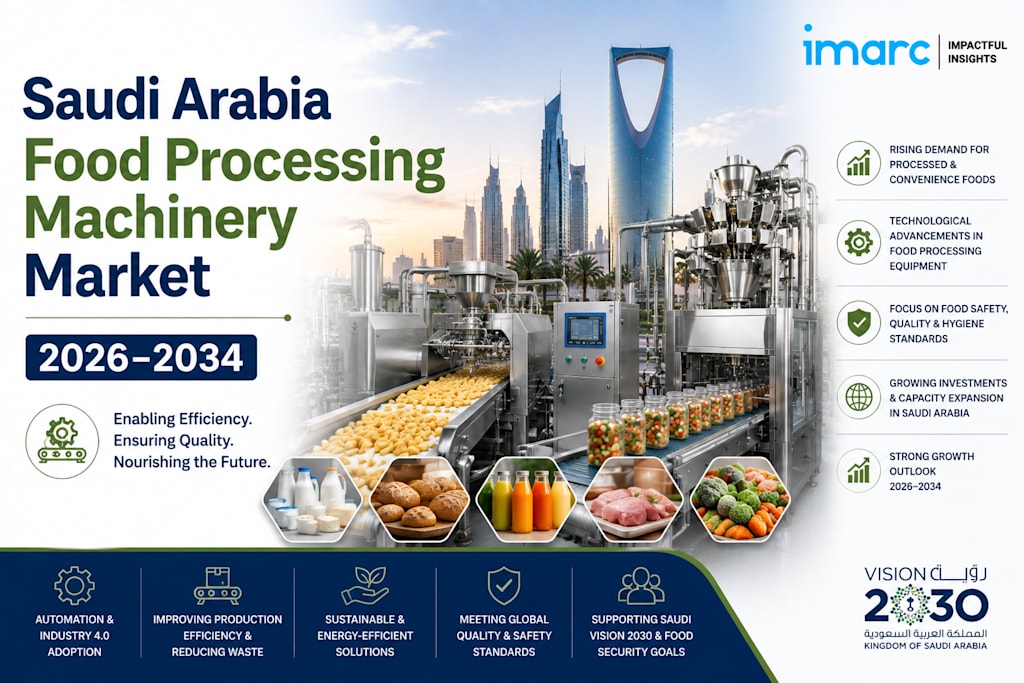
Rising demand for processed foods, Vision 2030-led industrialization, and a growing focus on food security are accelerating investment in food processing machinery across Saudi Arabia, supported by government incentives, expanding export ambitions, and the Kingdom's need to reduce reliance on imported food products. According to IMARC Group's latest data, The Saudi Arabia food processing machinery market size was valued at USD 670.0 Million in 2025. Looking forward, IMARC Group estimates the market to reach USD 960.0 Million by 2034, exhibiting a CAGR of 4.03% from 2026-2034.
Saudi Arabia's food processing machinery sector is undergoing a meaningful transformation. Driven by urbanization, a rapidly changing consumer palate, and the government's strategic push to build a self-sufficient food industry, the market is seeing real momentum on the ground. Manufacturers are upgrading from basic processing lines to sophisticated, automated systems that can handle everything from dairy and bakery to plant-based proteins and ready-to-eat meals. With the Kingdom positioned as the GCC's largest importer of processed foods bringing in over USD 533.8 Million in U.S. processed food products alone the case for localizing production capacity has never been stronger.
Saudi Arabia Food Processing Machinery Market Growth Drivers:
- Rising Demand for Processed and Packaged Foods
Saudi Arabia is the GCC's biggest market for processed food imports, pulling in roughly USD 533.8 Million worth of U.S. products alone a figure that jumped 16% in a single year. Behind this demand is a fast-urbanizing, time-pressed population that increasingly relies on ready-to-eat meals, frozen foods, and packaged snacks. For local manufacturers, this translates directly into pressure to scale up and automate. Advanced processing and packaging machinery is no longer a luxury it's the baseline requirement for any producer serious about meeting volumes, maintaining quality, and competing effectively in this market.
- Government Support and Vision 2030 Industrial Push
The Saudi government isn't just talking about food security it's funding it. Vision 2030's industrial diversification agenda has channeled real capital into the food manufacturing sector, with investments in CNC manufacturing and automation infrastructure gaining visible traction. A recent example: Simplex secured USD 13 Million to build a 20,000-square-meter CNC manufacturing facility in Riyadh, designed to boost domestic machinery output. These moves directly reduce Saudi Arabia's dependency on machinery imports while strengthening the backbone of its food processing industry a strategic alignment that benefits both public policy goals and private sector growth.
- Growing Emphasis on Health and Wellness Products
Saudi consumers are shifting toward organic, low-fat, low-sugar, and plant-based foods at a meaningful pace, and food manufacturers are feeling the pressure to keep up. This shift requires specialized equipment cold-press systems, high-pressure processors, and lines built for alternative protein ingredients that standard machinery simply can't accommodate. LT Foods recently committed SAR 185 Million over five years to expand its rice and organic food presence in Riyadh, with local manufacturing partnerships in the pipeline. Where health-driven product lines grow, dedicated processing equipment follows and that's driving demand across the machinery market.
Saudi Arabia Food Processing Machinery Market Trends:
- Automation and Smart Manufacturing Integration
Food processors across Saudi Arabia are increasingly turning to automated production lines to tackle labor cost pressures, reduce waste, and meet tightening food safety standards. IoT-enabled monitoring, predictive maintenance systems, and AI-driven quality control are entering facilities that previously ran manual operations. This isn't just about efficiency it's about competitiveness. Producers who automate can hit consistent quality benchmarks, scale faster, and meet export requirements that manual lines often can't guarantee. The shift toward smart manufacturing is reshaping procurement decisions and creating strong demand for next-generation processing and packaging equipment across the Kingdom.
- Expanding Export Opportunities for Processed Goods
Saudi Arabia is actively positioning itself as a regional food export hub, not just a consumer market. Government trade initiatives under Vision 2030 are helping local processors access GCC and broader MENA markets with value-added food products. To compete on quality and shelf life in export markets, producers need machinery that can handle precision processing, hygienic packaging, and extended preservation techniques. This export ambition is translating into tangible capital expenditure on upgraded processing lines particularly in dairy, bakery, and beverages sectors where Saudi producers have competitive raw material advantages and room to scale internationally.
- Strategic Industry Partnerships and Market Expansion
International machinery suppliers are taking Saudi Arabia seriously as a long-term growth market, and the deals reflect that. In July 2025, DC Norris a global leader in food processing equipment entered a formal strategic partnership with Zakka Multitec KSA to distribute and support its solutions across the Kingdom. The move gives Saudi food manufacturers direct access to advanced food and beverage processing technology, while DC Norris builds a stable foothold in the Middle East. These types of alliances are becoming more common as the market matures, creating better access to specialized equipment and after-sales technical support that was previously difficult to source locally.
Recent News and Developments in Saudi Arabia Food Processing Machinery Market
- July 2025: DC Norris, a global leader in food processing equipment manufacturing, announced a new strategic partnership with Zakka Multitec KSA, appointing them as official agents in Saudi Arabia. The partnership aims to expand DC Norris's footprint in the Middle Eastern market and deliver advanced food and beverage processing solutions to a wider client base across the region.
- November 2025: LT Foods established a new office in Riyadh, Saudi Arabia, committing an investment of SAR 185 Million over the next five years to enhance its presence in the rice and organic food sectors. The company targets a revenue of SAR 435 Million and plans to pursue local manufacturing in collaboration with SALIC as a strategic partner, signaling strong confidence in Saudi Arabia's food processing growth trajectory.
- January 2025: Simplex successfully secured USD 13 Million in funding to establish a CNC manufacturing facility spanning 20,000 square meters in Riyadh, aligned with Vision 2030's industrial growth objectives. The facility, scheduled to commence operations in 2026, is designed to strengthen domestic machinery production capacity and reduce reliance on imported processing equipment across key manufacturing sectors.
Note: If you require specific details, data, or insights that are not currently included in the scope of this report, we are happy to accommodate your request. As part of our customization service, we will gather and provide the additional information you need, tailored to your specific requirements. Please let us know your exact needs, and we will ensure the report is updated accordingly to meet your expectations.
About the Creator
Shubham Sharma
Market research enthusiast sharing insights on global industries, emerging trends, growth opportunities, and data-driven analysis across diverse markets.
Enjoyed the story? Support the Creator.
Subscribe for free to receive all their stories in your feed.
Comments
There are no comments for this story
Be the first to respond and start the conversation.