
Saudi Arabia Food Enzymes Market: Clean Label Innovation, Processing Efficiency & Functional Food Growth
How clean label demand, enzyme innovation, and advanced food processing technologies are enhancing product quality, improving shelf life, and transforming production efficiency across the Saudi Arabia food enzymes market.

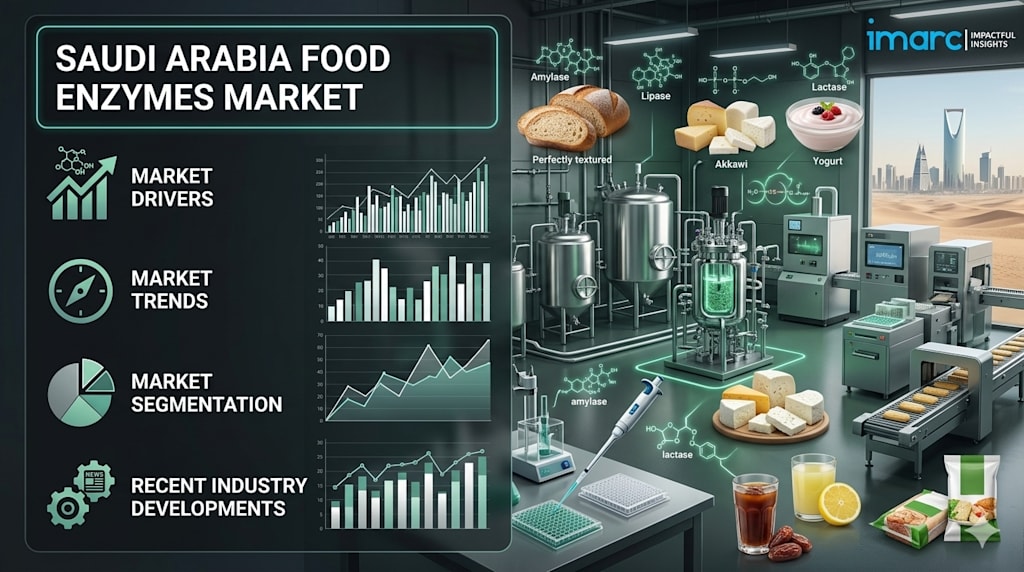
Growing emphasis on food security, a rapidly expanding retail landscape, and rising consumer preference for high-quality processed and dairy products are collectively reshaping demand patterns in the Saudi Arabia Food Enzymes Market. According to IMARC Group's latest data, the The Saudi Arabia water pipeline leak detection system market size reached USD 25.5 Million in 2025. Looking forward, IMARC Group expects the market to reach USD 40.3 Million by 2034, exhibiting a growth rate (CAGR) of 5.23% during 2026-2034, driven by the growing focus on self-sufficiency in dairy production, expansion of organized retail, and widespread adoption of enzyme technologies across multiple food processing applications.
The market is driven by the growing government investments in water infrastructure under its Vision 2030 plan, increasing concerns about water resource depletion, and technological advancements in leak detection technology like acoustic sensors, fiber-optic cables, and intelligent monitoring systems.
Saudi Arabia Food Enzymes Market Growth Drivers:
- Rising Preferences for High-Quality Dairy Products
Consumers across Saudi Arabia are placing greater importance on the nutritional value, texture, and digestibility of dairy products such as cheese, yogurt, and milk. This shift in purchasing behavior is prompting manufacturers to integrate advanced food enzyme technologies into production processes to improve product quality and extend shelf life. Enzymes like rennet and lactase are now routinely used to enhance consistency, taste, and digestibility, particularly for lactose-intolerant consumers who make up a significant portion of the population. The growing influence of Western dietary habits and an expanding expatriate community are further broadening the addressable market for enzyme-treated dairy items. Reinforcing this trend, the Saudi Arabia dairy market is projected to reach USD 8.4 Billion, reflecting the scale of opportunity that food enzyme suppliers can tap through the dairy segment alone. Government-driven food security programs are also motivating local dairy manufacturers to adopt enzyme technologies to comply with rising quality benchmarks.
- Expansion of Retail Outlets Driving Product Accessibility
The rapid proliferation of supermarkets, hypermarkets, and convenience stores across urban and semi-urban areas is creating a highly favorable distribution environment for enzyme-enhanced food products. According to industry data, wholesale and retail commerce along with restaurants and hotels recorded the highest annual growth rate of 6.4% in 2024, reflecting the speed at which modern retail formats are taking root across the Kingdom. As organized retail chains continue to grow in number and geographic reach, consumers are increasingly exposed to a wider assortment of processed and packaged food products that depend on food enzymes for improved texture, taste, and shelf stability. Cold storage infrastructure within organized retail also plays a practical role in preserving the integrity of enzyme-treated items, supporting repeat purchases. Promotions, product sampling, and in-store health awareness campaigns are simultaneously educating consumers on the functional benefits of enzyme-enhanced foods, driving trial and adoption across multiple categories including bakery, meat, and confectionery.
- Government Focus on Food Security and Self-Sufficiency
Saudi Arabia's Vision 2030 agenda places significant weight on reducing dependence on food imports and building a robust domestic food processing ecosystem. This national priority is directly influencing the adoption of enzyme technologies among local food manufacturers, who are under pressure to raise product quality, improve processing efficiency, and meet international standards. Enzymes such as amylase, protease, and lipase are central to achieving these objectives across bakery, beverages, and dairy production lines. As the government channels investment into local food production capacity, the demand for specialized food-grade enzymes is expected to grow in tandem, making regulatory and policy alignment a key structural driver for the Saudi Arabia Food Enzymes Market.
Saudi Arabia Food Enzymes Market Trends:
- Growing Adoption of Carbohydrase Enzymes in Bakery and Beverage Applications
Carbohydrase enzymes, including amylase, cellulase, lactase, and pectinase, are gaining significant traction across the bakery and beverage sectors. Amylase is widely used in bread production to improve dough handling and loaf volume, while pectinase is a staple in fruit juice processing to enhance clarity, yield, and filtration efficiency. As Saudi Arabia's food processing industry modernizes its production methods, the shift from traditional processing techniques to enzyme-assisted workflows is becoming more pronounced. This transition is particularly visible among mid-size and large-scale bakeries and beverage manufacturers seeking to improve throughput and product consistency at lower operational costs.
- Research-Driven Innovation in Enzyme Applications
Scientific research within Saudi Arabia is actively expanding the applied potential of food enzymes beyond conventional uses. In September 2024, a research team investigated the dissolution of coagulated blood from slaughtered cattle using alkaline protease generated by Streptomyces violaceoruber sourced from saline soil in Saudi Arabia. The study confirmed that alkaline protease functioned as a fibrinolytic enzyme with applications in cardiovascular treatment and blood clot breakdown, underscoring the multi-sector utility of protease enzymes. In March 2024, another Saudi research team developed a new technique using waste cooking oil to produce biodiesel through an immobilized thermostable lipase. This lipase retained 80% of its activity after the first reuse cycle and 68% after the second, demonstrating both the economic viability and reusability of enzyme-based solutions in industrial processes. These developments highlight a growing domestic research ecosystem that is broadening the commercial relevance of enzyme technologies across food and adjacent industries.
- Shift Toward Microbial-Source Enzymes for Scalability and Consistency
Microorganism-derived enzymes are increasingly preferred over plant and animal sources due to their superior scalability, consistency, and cost-effectiveness in large-scale food production. Microbial fermentation allows for controlled, high-volume enzyme production that is less susceptible to seasonal supply variability compared to plant-based alternatives. As Saudi Arabia's food manufacturers scale up operations to meet rising domestic and export demand, the preference for microbial-source enzymes across applications including dairy processing, bakery production, and beverage manufacturing is strengthening, creating a reliable and growing demand channel within the market.
Recent News and Developments in the Saudi Arabia Food Enzymes Market:
- April 2026: SFDA advances biotechnology framework for novel foods, strengthening risk assessment guidelines and regulatory pathways to accelerate enzyme-enabled sustainable food processing innovations.
- March 2026: Major dairy producers expand use of microbial lactase enzymes in lactose-free yogurt and milk lines, improving digestibility and meeting rising consumer demand for low-lactose products.
- February 2026: Local research teams optimize thermostable lipase applications from Saudi isolates, enhancing efficiency in fat modification for bakery and confectionery processing under high-temperature conditions.
- January 2026: KAUST explores extremophile-derived enzymes through algae and microbial platforms, supporting cleaner-label ingredient production and waste valorization in food manufacturing.
- December 2025: Carbohydrase and protease enzyme adoption rises in baking and beverage sectors, enabling improved texture, flavor enhancement, and reduced synthetic additive reliance in processed foods.
Note: If you require specific details, data, or insights that are not currently included in the scope of this report, we are happy to accommodate your request. As part of our customization service, we will gather and provide the additional information you need, tailored to your specific requirements. Please let us know your exact needs, and we will ensure the report is updated accordingly to meet your expectations.
About the Creator
Kishan Kumar
My name is Kishan Roy and I am a market analyst having 5 years of experience and a skilled researcher with a keen eye for consumer trends and data-driven insights.
Enjoyed the story? Support the Creator.
Subscribe for free to receive all their stories in your feed.
Comments
There are no comments for this story
Be the first to respond and start the conversation.