
Saudi Arabia Factory Ventilation Systems Market: Industrial Safety, Air Quality & Growth Outlook
How stringent industrial safety regulations, rising energy efficiency requirements, and rapid expansion of manufacturing facilities are driving adoption of advanced ventilation technologies, smart airflow control systems, and improved workplace air quality in the Saudi Arabia factory ventilation systems market

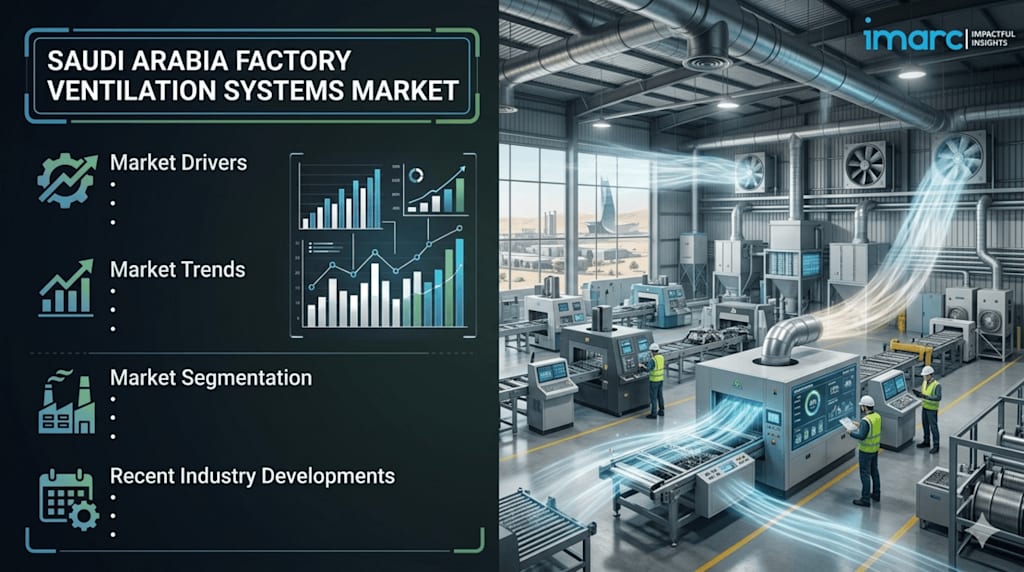
The Saudi Arabia factory ventilation systems market size reached USD 59.5 Million in 2025. Looking forward, IMARC Group expects the market to reach USD 162.2 Million by 2034, exhibiting a growth rate (CAGR) of 11.79% during 2026-2034. The market is driven by stringent industrial safety regulations, compelling factories to adopt advanced ventilation systems for compliance, while rising energy costs are accelerating demand for energy-efficient solutions. The expansion of manufacturing sectors, including automotive and food processing, further enhances the need for high-performance ventilation to maintain air quality and operational efficiency. Additionally, the growing integration of IoT and smart automation are further augmenting the Saudi Arabia factory ventilation systems market share.
Saudi Arabia Factory Ventilation Systems Market Growth Drivers:
- Vision 2030 Industrial Expansion Creating Mass Demand
Saudi Arabia's National Industrial Strategy is targeting the modernization of 4,000 factories, and every one of those facilities needs compliant, efficient ventilation. The Jeddah Food Industry Cluster alone attracted USD 5.3 billion in foreign investment and houses 75 factories, each requiring strict temperature control and air quality management. Al-Kharj's dairy cluster generates USD 1.28 billion in annual exports and relies on specialized HVAC systems for refrigeration and processing environments. Daikin broke ground on a new HVAC manufacturing facility in Jeddah in November 2025, specifically to service the localized production needs driven by mega-projects like NEOM and Red Sea developments. The pipeline of industrial projects is simply too large to ignore.
- Tightening Industrial Safety Regulations Forcing Upgrades
Regulatory compliance is no longer optional in Saudi factories. The Saudi government enforces occupational health and safety standards that require adequate ventilation across manufacturing, petrochemical, and food processing facilities, and non-compliance carries real financial risk. Saudi Arabia held a 27.89% revenue share of the Middle East commercial HVAC market in 2024, the largest in the region, partly because industrial facilities here face higher inspection frequency and stricter enforcement than neighboring markets. The Kingdom's energy data shows total industrial energy consumption at 280 Mtoe annually, which underscores how critical airflow management is in keeping both equipment and workers operating safely under these conditions.
- Soaring Energy Costs Pushing Factories Toward Efficient Systems
Factory operators across Saudi Arabia are under real pressure to cut electricity bills, and ventilation is one of the largest power draws in any industrial facility. The government's commitment to achieving a 50% renewable energy share by 2030 is paired with plans to reduce CO2 emissions by 278 MtCO2eq, pushing factories to replace legacy exhaust systems with heat recovery ventilation (HRV) and demand-controlled ventilation (DCV) setups. Alat and Carrier formalized a partnership to build an advanced HVAC manufacturing and R&D center in Saudi Arabia, projecting over 5,000 jobs and targeting a regional HVAC market the pair estimate will reach USD 10 billion by 2030.
Saudi Arabia Factory Ventilation Systems Market Trends:
- Smart and IoT-Enabled Systems Taking Over Factory Floors
The days of manually adjusting dampers and fans are largely over for mid-to-large Saudi factories. AI-driven and IoT-based ventilation systems now optimize airflow, humidity, and temperature automatically, flagging anomalies before they become shutdowns. Saudi Vision 2030 has committed over USD 20 billion to artificial intelligence by 2030, and that investment is flowing into smart factory infrastructure, including next-generation HVAC and ventilation controls. HUMAIN, PIF's AI company, began constructing its first data center batch in August 2025, each requiring dense thermal management systems.
- Localized Manufacturing Reducing Import Dependence
Saudi Arabia is actively building a domestic HVAC and ventilation manufacturing base rather than relying entirely on imports. Daikin's November 2025 Jeddah facility targets localized chiller and heat pump production aligned with Vision 2030's industrial localization goals. The Alat-Carrier R&D center adds engineering depth to this local supply chain. Prime Focus Group, which manufactures air handling units and fan coil units across UAE and Saudi Arabia facilities, hit its highest-ever production in 2025, manufacturing 5,600 Air Handling Units.
- Sector-Specific Ventilation Demand Growing Across Niche Industries
Factory ventilation is not a one-size-fits-all product, and Saudi Arabia's industrial diversification is generating demand across highly specialized segments. Pharmaceutical facilities require cleanroom-grade filtration and controlled airflows. Electronics and semiconductor plants need humidity-controlled environments with contamination prevention. The aerospace cluster in King Abdullah Economic City demands advanced ventilation for paint booths, hangars, and assembly areas.
Recent News and Developments in Saudi Arabia Factory Ventilation Systems Market
- November 2025: Daikin broke ground on a new HVAC-R manufacturing facility in Jeddah, focused on localized production of chillers and hydronic heat pumps. The facility directly supports Vision 2030 industrial localization goals and is designed to serve major Saudi projects including NEOM and the Red Sea development.
- August 2025: HUMAIN, the AI company established under Saudi Arabia's Public Investment Fund, began constructing its first batch of data centers in the Kingdom, planned for operation in early 2026. Each facility requires large-scale thermal management and industrial ventilation infrastructure to support AI computing loads.
Note: If you require specific details, data, or insights that are not currently included in the scope of this report, we are happy to accommodate your request. As part of our customization service, we will gather and provide the additional information you need, tailored to your specific requirements. Please let us know your exact needs, and we will ensure the report is updated accordingly to meet your expectations.
About the Creator
Faisal Al-Harbi
Market research professional based in Saudi Arabia (KSA), focused on industry trends, market growth, and economic insights.
Writing data-driven articles on Saudi markets, business outlook, and Vision 2030–driven sectors.
Enjoyed the story? Support the Creator.
Subscribe for free to receive all their stories in your feed.
Comments
There are no comments for this story
Be the first to respond and start the conversation.