
Saudi Arabia Endoscopy Devices Industry: Growth Driven by Rising GI Disorders, Early Diagnosis & Technological Innovations
How advanced imaging technologies, minimally invasive procedures, and AI-powered diagnostics are enhancing precision, early detection, and clinical decision-making across the Saudi Arabia endoscopy devices market.

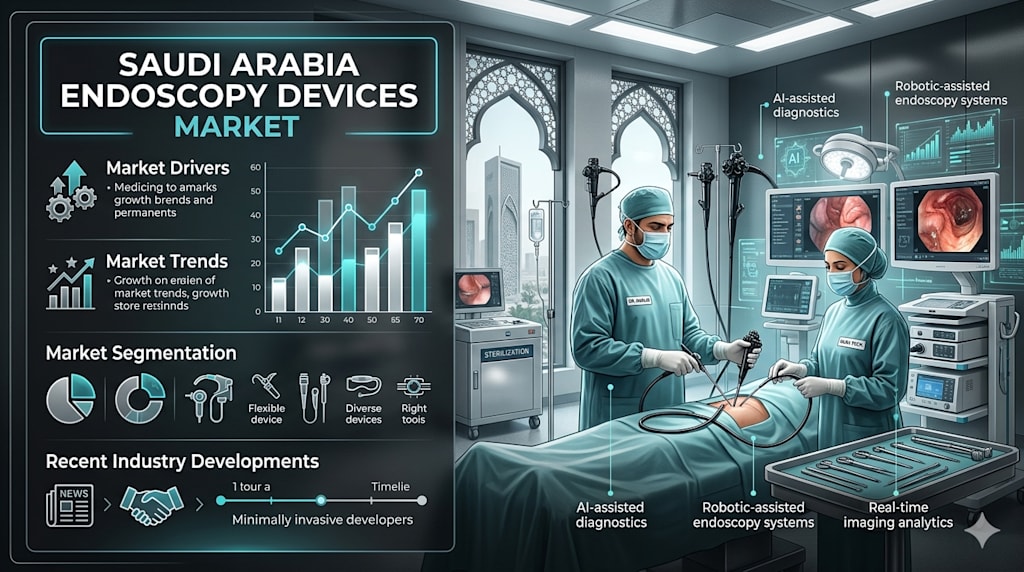
Saudi Arabia's healthcare sector is undergoing a genuine transformation, and nowhere is that more visible than in the endoscopy devices space. A combination of rising gastrointestinal disease burden, a government pushing hard on healthcare modernization, and a fast-growing appetite for minimally invasive procedures is creating serious momentum in this market. According to IMARC Group's latest research, the Saudi Arabia endoscopy devices market size was valued at USD 497.5 Million in 2025. Looking forward, IMARC Group estimates the market to reach USD 903.0 Million by 2034, exhibiting a CAGR of 6.85% from 2026-2034. The Northern and Central Region currently leads the market, anchored by Riyadh's concentration of specialized hospitals and regulatory bodies.
What is driving this from a demand standpoint? A pediatric clinics survey published in the Saudi Journal of Gastroenterology found that 47.7% of infants and toddlers in the Kingdom showed signs of functional gastrointestinal disorders. That kind of prevalence data, combined with Vision 2030's target to raise private healthcare expenditure from 25% to 35% of total healthcare spending, sets the stage for sustained investment in advanced diagnostic equipment like endoscopy systems.
Saudi Arabia Endoscopy Devices Market Growth Drivers:
- Surging Gastrointestinal Disease Prevalence and Early Screening Push
Gastrointestinal conditions, colorectal cancer, and obesity-related disorders are increasingly common in Saudi Arabia, and the healthcare system is responding with a stronger emphasis on early detection. Research published in April 2024 highlighted that nearly one-third of colorectal cancer patients across the Kingdom are diagnosed at late stages, which significantly worsens outcomes. That finding has accelerated government interest in organized screening programs and hospital investment in next-generation endoscopic imaging. With gastroenterology already commanding the largest share of the applications segment, demand for flexible endoscopes, capsule endoscopy, and AI-enhanced diagnostic tools continues to climb steadily across both public and private facilities.
- Vision 2030 Healthcare Investment and Private Sector Expansion
The Saudi government's Vision 2030 agenda is directly reshaping how the Kingdom procures and deploys medical technologies. By targeting a near-doubling of the private sector's share in total healthcare expenditure, the policy is unlocking fresh capital for advanced diagnostic equipment, including endoscopy systems. The government invested over USD 50 Billion into digital health services, with projections suggesting this could contribute between USD 15 Billion and USD 27 Billion to the healthcare ecosystem. Hospitals are using these funds to upgrade imaging infrastructure, modernize operating theatres, and expand specialist clinical capacity. The flow of investment into endoscopy is a direct result of this broader policy push, not a coincidence.
- Medical Tourism Growth Driving Premium Diagnostic Demand
Saudi Arabia's Western region, home to Jeddah and Makkah, attracts a significant volume of international patients, creating consistent demand for high-precision diagnostic and therapeutic endoscopic procedures. Hospitals catering to both domestic and international populations need equipment that meets global quality benchmarks, which is pushing procurement toward high-definition visualization systems, robotic-assisted endoscopes, and AI-integrated platforms. The government's parallel goal of reducing outbound medical tourism is prompting local hospitals to invest in state-of-the-art solutions that can match or exceed standards available abroad, creating a dual pull on advanced endoscopy device adoption.
Saudi Arabia Endoscopy Devices Market Trends:
- AI-Integrated Endoscopy Systems Gaining Real Clinical Traction
Artificial intelligence is moving from concept to clinical practice in Saudi Arabia's endoscopy units. Hospitals are deploying AI-powered platforms for lesion detection, polyp classification, and procedural guidance, reducing operator dependency and improving diagnostic consistency. A concrete example: in February 2024, Waycen signed an agreement with Saudi-based MegaMind to launch WAYMED Endo, its AI-driven gastrointestinal endoscopy software, specifically targeting the Middle East market. This kind of commercial activity signals that AI endoscopy is not a future aspiration here; it is actively being deployed. Government investment in smart hospitals and digital health infrastructure under Vision 2030 is adding institutional support to what is already a clinically motivated trend.
- Local Manufacturing and Strategic Partnerships Reshaping Supply
Saudi Arabia is actively working to reduce its dependence on imported medical devices, and endoscopy equipment is part of that effort. The National Industrial Development and Logistics Program is incentivizing global manufacturers to establish local production and form partnerships with domestic companies. In November 2024, Fujifilm Middle East and Africa signed multiple MoUs aligned with Vision 2030, including a key alliance with Flow Medical to train biomedical engineers and establish a dedicated endoscopy service center. Fujifilm also deepened its partnership with King Faisal Specialist Hospital to integrate ultrasound with diagnostic endoscopy services, a practical example of how these collaborations are translating into real capability building on the ground.
- Minimally Invasive Procedures Expanding Across Specialties
Patient preference for faster recovery and lower complication risk is reshaping how hospitals across Saudi Arabia structure their procedure offerings. Bariatric surgeries including endoscopic sleeve gastroplasty are expanding as the Kingdom addresses high obesity rates. Orthopedic arthroscopy is gaining ground with rising sports injury rates and an aging population. In cardiology, procedures like transesophageal echocardiography and endoscopic vein harvesting are seeing growing adoption in specialized heart centers. In November 2024, Medtronic announced its acquisition of Fortimedix Surgical to strategically strengthen its endoscopy and surgical product portfolio, a move that signals how global manufacturers are positioning themselves for this broadening, multi-specialty demand curve.
Saudi Arabia Endoscopy Devices Market Segmentation:
The market is segmented by Type of Device, Application, and Region.
By Type of Device:
- Endoscopes (Rigid Endoscope, Flexible Endoscope, Capsule Endoscope, Robot-assisted Endoscope)
- Endoscopic Operative Devices (Irrigation/Suction System, Access Device, Wound Protector, Insufflation Device, Operative Manual Instrument, Others)
- Visualization Equipment (Endoscopic Camera, SD Visualization System, HD Visualization System)
By Application:
- Gastroenterology (largest segment, driven by GI disease prevalence and screening programs)
- Orthopedic Surgery
- Cardiology
- Gynecology
- Neurology
- Urology
- Others
By Region:
- Northern and Central Region (largest, led by Riyadh's hospital infrastructure and regulatory concentration)
- Western Region (significant share driven by medical tourism in Jeddah and Makkah)
- Eastern Region (steady growth with rising private sector healthcare investment)
- Southern Region (emerging, supported by government hospital upgrades and mobile endoscopy access)
Recent News and Developments in Saudi Arabia Endoscopy Devices Market
- April 2026: Saudi Journal of Gastroenterology highlights AI in endoscopy, delivering 5-10 percent higher adenoma detection rates and over 80 percent faster capsule endoscopy processing.
- March 2026: SFDA introduces Talaia fast-track framework, reducing AI-powered endoscopy device approval times to 90 days while requiring real-world performance data.
- February 2026: Riyadh and Jeddah private hospitals adopt 4K endoscopy systems, providing sharper visualization and improved outcomes in complex gastrointestinal procedures.
- January 2026: Healthcare facilities expand AI-powered endoscopy adoption, achieving up to 96 percent polyp detection accuracy compared to 85 percent with traditional methods.
- December 2025: Leading Saudi hospitals integrate AI-assisted imaging, driving significant gains in early cancer detection and overall diagnostic precision nationwide.
Note: If you require specific details, data, or insights that are not currently included in the scope of this report, we are happy to accommodate your request. As part of our customization service, we will gather and provide the additional information you need, tailored to your specific requirements. Please let us know your exact needs, and we will ensure the report is updated accordingly to meet your expectations.
About the Creator
Kishan Kumar
My name is Kishan Roy and I am a market analyst having 5 years of experience and a skilled researcher with a keen eye for consumer trends and data-driven insights.
Enjoyed the story? Support the Creator.
Subscribe for free to receive all their stories in your feed.
Comments
There are no comments for this story
Be the first to respond and start the conversation.