
Saudi Arabia Electric Vehicle Battery Market: EV Adoption, Energy Storage & Growth Outlook
How rapid EV adoption, government-backed localization of battery manufacturing, and rising investments in lithium supply chains and energy storage technologies are driving capacity expansion, innovation, and supply chain development in the Saudi Arabia electric vehicle battery market

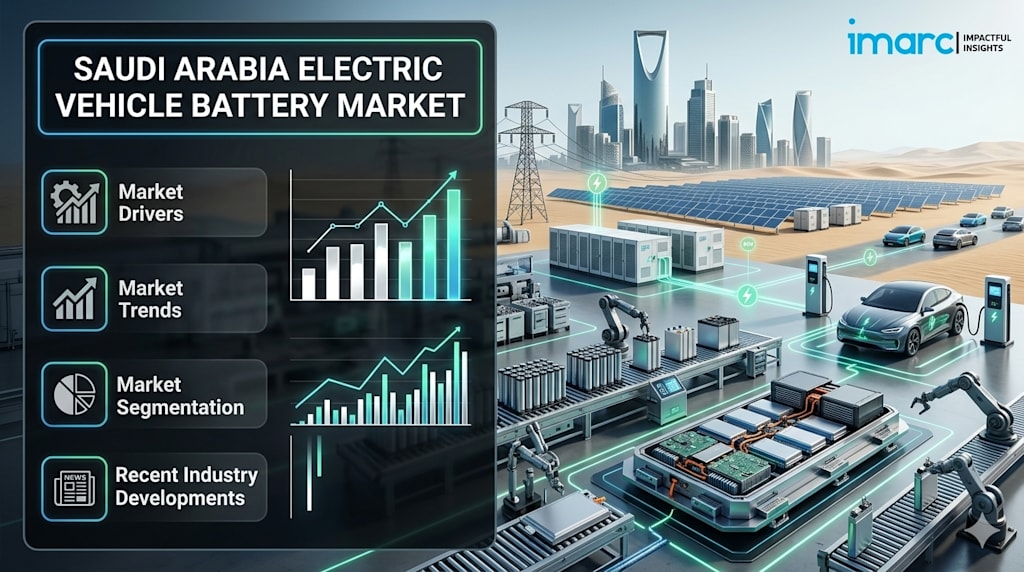
According to IMARC Group's latest research publication, Saudi Arabia electric vehicle battery market size reached USD 895.8 Million in 2025. The market is projected to reach USD 6,540.3 Million by 2034, exhibiting a growth rate (CAGR) of 24.72% during 2026-2034.
How AI is Reshaping the Future of Saudi Arabia Electric Vehicle Battery Market
- Predictive Battery Health Monitoring: AI algorithms analyze real-time performance data, predicting battery degradation patterns and extending lifespan by up to 25%, enabling proactive maintenance across Saudi EV fleets.
- Smart Thermal Management: Machine learning optimizes cooling systems in extreme desert heat, preventing thermal runaway and maintaining consistent performance in temperatures exceeding 50°C common across the Kingdom.
- Intelligent Charging Optimization: AI-powered charging stations adjust power delivery based on grid demand, battery state, and weather conditions, reducing charging time by 30% while minimizing stress on batteries.
- Quality Assurance in Manufacturing: Computer vision and machine learning detect microscopic defects in battery cell production, ensuring higher safety standards and reducing warranty claims for locally manufactured batteries.
- Energy Density Enhancement: AI accelerates research into next-generation battery chemistries like lithium-sulfur, potentially tripling energy storage capacity while leveraging Saudi Arabia's abundant sulfur reserves from oil refining.
How Vision 2030 is Revolutionizing Saudi Arabia Electric Vehicle Battery Industry
Vision 2030's economic diversification blueprint is transforming Saudi Arabia into a regional battery manufacturing powerhouse. The Public Investment Fund has committed over USD 50 billion toward building an integrated EV ecosystem, with battery production as the cornerstone. Major developments include the King Salman Automotive Cluster in King Abdullah Economic City, anchored by Lucid Motors' manufacturing facility capable of producing 155,000 vehicles annually and Ceer Motors launching domestic production late this year. The government's target of 500,000 EVs annually by 2030 is driving upstream investments in lithium extraction from oil field brines, with Aramco and Ma'aden pioneering direct lithium extraction technology. Strategic partnerships with Pure Lithium, Theion, and international battery suppliers are establishing local manufacturing of cells, battery management systems, and thermal components. Infrastructure expansion through EVIQ aims to deploy 5,000 fast chargers nationwide, creating sustained demand for high-capacity battery systems while positioning the Kingdom as a regional export hub.
Saudi Arabia Electric Vehicle Battery Market Trends & Drivers:
Government policy frameworks are supercharging battery demand through comprehensive incentive structures and localization mandates. Customs duty exemptions and reduced registration fees for EVs have sparked consumer interest, while Riyadh's ambitious goal of 30% electric vehicle penetration is driving public fleet electrification, including 560 electric buses already operational. The National Industrial Strategy's 40% local content target for EV manufacturing is attracting tier-one battery suppliers to co-locate with assemblers in special economic zones offering zero-percent tax incentives. Investment commitments exceeding SAR 39 billion specifically target battery metals plants and cell assembly facilities, with companies like Obeikan Investment Group establishing a 3,160-tonne lithium hydroxide refinery. These policy-driven investments are creating a self-sustaining ecosystem where battery production, vehicle assembly, and charging infrastructure advance in parallel.
Urban expansion and changing mobility preferences are reshaping consumer behavior toward electric powertrains. Major cities like Riyadh, Jeddah, and Dammam are experiencing rapid population growth and worsening congestion, making the operational cost advantages of EVs increasingly attractive. Younger demographics demonstrate strong preference for connected, tech-forward vehicles, with surveys indicating 35% of consumers actively considering EVs for their next purchase. Rising disposable incomes and expanded financing options are making battery electric vehicles accessible beyond luxury segments, with mid-priced models now capturing nearly 67% of market share. The deployment of 1,200 public charging points across 400 locations is alleviating range anxiety, while partnerships between companies like Jeddah Transport Co. and Petromin's Electromin are expanding urban charging footprints. Consumer education campaigns highlighting total cost of ownership advantages are accelerating adoption rates beyond early enthusiasts.
Technological breakthroughs in battery chemistry and manufacturing are dramatically improving performance and economics. Researchers at King Abdullah University of Science and Technology achieved breakthroughs incorporating nylon additives into lithium-metal batteries, improving efficiency and lifespan. Theion's lithium-sulfur technology promises to triple energy density while utilizing sulfur byproducts from Saudi refineries, creating circular economy synergies. The Kingdom's battery energy storage capacity is projected to exceed 1.2 GW, with facilities like the 500 MW/2,000 MWh system in Bisha demonstrating scalability of lithium iron phosphate solutions. BYD's deployment of 15.1 GWh storage systems using Cell-to-System technology across five Saudi sites is establishing operational benchmarks for desert climates. Local manufacturing capabilities are expanding rapidly, with Ceer signing SAR 5.5 billion in supply agreements, 80% with Saudi firms, to build localized battery component production ahead of its vehicle launch.
Saudi Arabia Electric Vehicle Battery Market Industry Segmentation:
The report has segmented the market into the following categories:
Battery Type Insights:
- Lithium-Ion Battery
- Nickel-Metal Hydride Battery
- Lead-Acid Battery
- Others
Propulsion Type Insights:
- Battery Electric Vehicles
- Plug-in Hybrid Electric Vehicles
- Hybrid Electric Vehicles
Vehicle Type Insights:
- Passenger Car
- Commercial Vehicles
- Two-Wheeler
Regional Insights:
- Northern and Central Region
- Western Region
- Eastern Region
- Southern Region
Competitive Landscape:
The competitive landscape of the industry has also been examined along with the profiles of the key players.
Recent News and Developments in Saudi Arabia Electric Vehicle Battery Market
- January 2026: Lucid Motors announced preparations for full-scale battery-inclusive vehicle manufacturing at its King Abdullah Economic City facility, moving beyond assembly to complete production with targeted capacity of 150,000 units annually.
- March 2026: Pure Lithium secured Saudi patent for vertically integrated lithium metal battery technology, combining extraction, anode production, and manufacturing to reduce supply chain dependencies and leverage Kingdom's brine resources.
- February 2026: Sungrow and Algihaz connected 7.8 GWh lithium-ion battery energy storage system across three sites to the grid, demonstrating large-scale deployment capabilities essential for supporting EV infrastructure expansion.
Note: If you require specific details, data, or insights that are not currently included in the scope of this report, we are happy to accommodate your request. As part of our customization service, we will gather and provide the additional information you need, tailored to your specific requirements. Please let us know your exact needs, and we will ensure the report is updated accordingly to meet your expectations.
About the Creator
Shubham Sharma
Market research enthusiast sharing insights on global industries, emerging trends, growth opportunities, and data-driven analysis across diverse markets.
Enjoyed the story? Support the Creator.
Subscribe for free to receive all their stories in your feed.
Comments
There are no comments for this story
Be the first to respond and start the conversation.