
Saudi Arabia Electric Car Market: EV Adoption, Charging Infrastructure & Growth Outlook
How government incentives, growing charging infrastructure, and rising environmental awareness are accelerating adoption, technological innovation, and sustainable mobility in the Saudi Arabia electric car market
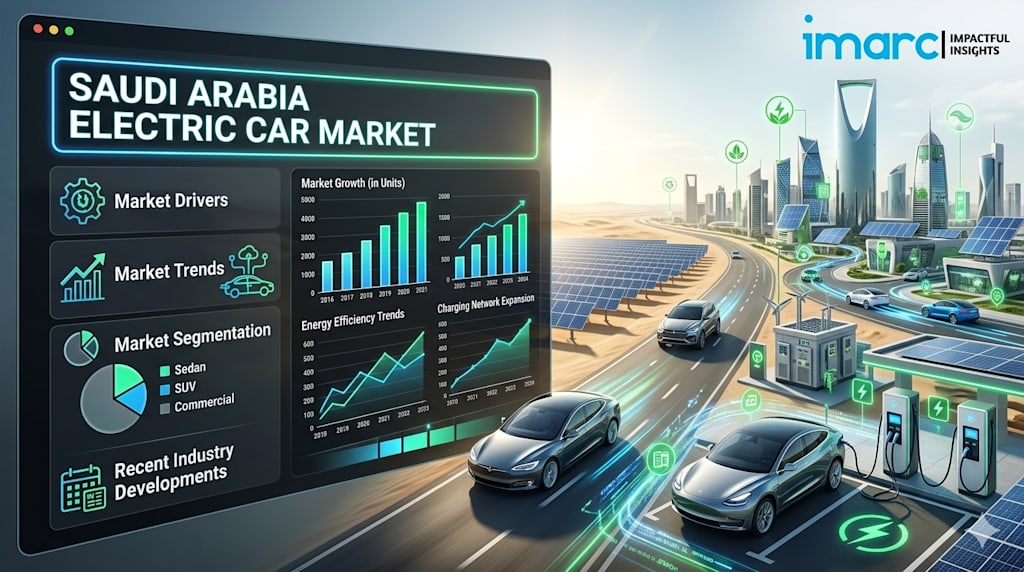
Saudi Arabia's push toward clean mobility, anchored by its Vision 2030 agenda, is rapidly reshaping the country's automotive landscape. Growing investments in charging infrastructure, government incentives for zero-emission vehicles, and rising consumer interest in advanced technology are fuelling electric car adoption across the Kingdom. According to IMARC Group's latest data, the Saudi Arabia electric car market size was valued at USD 1.81 Billion in 2025. Looking forward, IMARC Group estimates the market to reach USD 5.52 Billion by 2034, exhibiting a CAGR of 13.18% from 2026-2034. The Northern and Central Region currently dominates the market, holding a market share of over 28% in 2025.
Saudi Arabia's electric car sector is no longer just a government ambition it's becoming a real, commercially active market. Battery electric vehicles lead with a 57.9% market share in 2025, driven by expanding urban charging networks and declining battery costs. Mid-priced models dominate vehicle class preferences at 66.95%, reflecting a growing middle-income buyer segment attracted to affordable EV options. Front-wheel drive configurations lead drive type with 49.9% share, owing to their cost-efficiency and suitability for city commuting. With the Public Investment Fund (PIF) actively financing infrastructure and domestic brands like Ceer Motors entering production, the market is building real depth not just policy ambition. International automakers including Tesla, Lucid, and BMW are already staking their positions, while Riyadh's target to make 30% of its vehicles electric by 2030 is fast becoming a concrete commercial benchmark.
Saudi Arabia Electric Car Market Growth Drivers:
Vision 2030 Policy Support and Government Investment
Saudi Arabia's Vision 2030 is the single biggest driver behind EV adoption in the Kingdom. The government has committed over USD 50 billion toward EV manufacturing and infrastructure through 2030, with the Public Investment Fund (PIF) leading landmark investments in companies like Lucid Motors and domestic brand Ceer. Customs duty exemptions, green mobility incentives, and a national target of 30% EV penetration in Riyadh by 2030 are pushing both consumers and fleet operators toward electric vehicles. Riyadh's fleet electrification program alone, which includes 560 electric buses, demonstrates that policy intent is now translating into tangible investment and procurement action.
- Rapid Expansion of Charging Infrastructure
Range anxiety has long been the biggest psychological barrier to EV ownership, and Saudi Arabia is tackling it head-on. The PIF-backed Electric Vehicle Infrastructure Company (EVIQ) is targeting 5,000 fast chargers across 1,000 locations by 2030. In Jeddah, a partnership between Jeddah Transport Co. and Petromin's Electromin is already expanding the city's charging footprint. The Saudi EV charging station market itself was valued at USD 191 million in 2025, reflecting real capital flowing into infrastructure. As charging points spread across urban centres, shopping malls, and residential complexes, practical EV ownership becomes a reality for a much broader range of buyers.
- Localization of EV Manufacturing and Domestic Capability Building
Saudi Arabia isn't just buying EVs it's building them. Ceer, the Kingdom's first homegrown EV brand backed by PIF and partnered with BMW and Foxconn, announced its first model launch for Q4 2026, with production beginning in late 2025. Lucid Group's manufacturing plant in King Abdullah Economic City marks another milestone, while King Abdulaziz City for Science and Technology (KACST) partnered with Lucid to launch the Middle East's first Electric Vehicle Innovation Center in 2025. The government's 40% local content target for EV manufacturing is creating jobs, building technical talent, and reducing import dependency setting the Kingdom up as a regional EV hub rather than just a consumer market.
Saudi Arabia Electric Car Market Trends:
- Autonomous and AI-Enabled Vehicle Technologies Gaining Ground
Saudi Arabia is positioning itself at the forefront of smart mobility, not just clean mobility. In 2025, Saudi-backed Lucid Group partnered with Nvidia to develop EVs featuring Level 4 autonomy using Nvidia's Drive AV platform meaning near-total self-driving capability. This isn't just a tech showpiece; it signals a clear intent to combine electrification with intelligent transportation systems. For a country building NEOM from scratch and reimagining its urban infrastructure, AI-enabled EVs fit naturally into long-term smart city planning. Technology appeal is cited by 48% of Saudi EV buyers as their top purchase motivation, confirming that advanced features are a genuine market driver not just a luxury add-on.
- Subscription-Based and Flexible EV Ownership Models Emerging
Affordability remains a real barrier for many Saudi households, but the market is finding creative solutions. In 2025, E-FILL launched the Kingdom's first subscription-based EV charging model, offering Basic, Standard, and Business plans with transparent, predictable pricing across its fast-charging network. When paired with vehicle leasing and installment programmes that are now more widely available, these models significantly reduce the total cost of EV ownership. Mid-priced vehicles dominate with a 66.95% share precisely because value-conscious buyers are responding to these more accessible financial structures a clear sign that the market is maturing beyond early adopters into mainstream consumer segments.
- Growing International Manufacturer Interest and Model Diversity
The Saudi EV market is attracting a wave of global manufacturers, and the model range available to buyers is expanding quickly. Tesla launched its most affordable Model 3 Standard in the Kingdom in early 2026, priced at SAR 154,990. GAC Motors debuted its Aion and Hyptec series at the Riyadh Motor Show in December 2025, while Ford entered with the Mustang Mach-E. The EV Auto Show Riyadh 2025, which drew 120 exhibitors from 35 countries, illustrated just how seriously global brands are taking this market. More model options across price points means more buyers can find something that fits and that diversity is a critical ingredient for reaching mainstream adoption.
Recent News and Developments in Saudi Arabia Electric Car Market
• January 2026: Tesla introduced its most affordable electric vehicle in the Kingdom the Model 3 Standard, priced at SAR 154,990 making electric mobility more accessible to a broader consumer base. Deliveries are scheduled to begin in June 2026, marking a significant step toward mainstream EV adoption in Saudi Arabia.
• December 2025: GAC Motors made its Saudi debut at the Riyadh Motor Show, launching its Aion and Hyptec electric vehicle series including the Aion V, Aion ES, and Hyptec HT models in alignment with Vision 2030's clean mobility ambitions. GAC committed to strong after-sales warranties and a reliable parts supply chain to build long-term consumer confidence.
• 2025: Saudi-backed Lucid Group partnered with Nvidia to develop Level 4 autonomous EVs using Nvidia's Drive AV platform, targeting near-total self-driving capabilities and reinforcing Saudi Arabia's ambition to lead in smart mobility solutions across the region.
• 2025: King Abdulaziz City for Science and Technology (KACST) and Lucid Group jointly launched the Middle East's first Electric Vehicle Innovation Center in Saudi Arabia, focused on next-generation EV technologies, battery systems, and smart mobility research directly supporting Vision 2030's goal of anchoring technology development within the Kingdom.
• 2025: Ceer, Saudi Arabia's first domestically produced EV brand backed by PIF and partnered with BMW and Foxconn announced plans to launch its initial models in Q4 2026 with production commencing in late 2025. The initiative is expected to support significant job creation, skills development, and technology transfer within the Kingdom's automotive sector.
• February 2025: EVIQ signed a Memorandum of Understanding with Riyadh Development Company to strengthen EV charging infrastructure across the capital, part of a broader drive to ensure Riyadh meets its target of 30% electric vehicle penetration by 2030 in line with national sustainability goals.
Note: If you require specific details, data, or insights that are not currently included in the scope of this report, we are happy to accommodate your request. As part of our customization service, we will gather and provide the additional information you need, tailored to your specific requirements. Please let us know your exact needs, and we will ensure the report is updated accordingly to meet your expectations.
About the Creator
Shubham Sharma
Market research enthusiast sharing insights on global industries, emerging trends, growth opportunities, and data-driven analysis across diverse markets.
Enjoyed the story? Support the Creator.
Subscribe for free to receive all their stories in your feed.
Comments
There are no comments for this story
Be the first to respond and start the conversation.