
Saudi Arabia Driver Assistance Systems Market: Advanced Vehicle Safety, ADAS Innovation & Growth Outlook
How increasing demand for vehicle safety, rising adoption of connected and autonomous driving technologies, and government initiatives to improve road safety under Vision 2030 are driving the integration of advanced driver assistance technologies such as adaptive cruise control, lane departure warning, automatic emergency braking, and parking assistance across the Saudi Arabia Driver Assistance Systems Market.

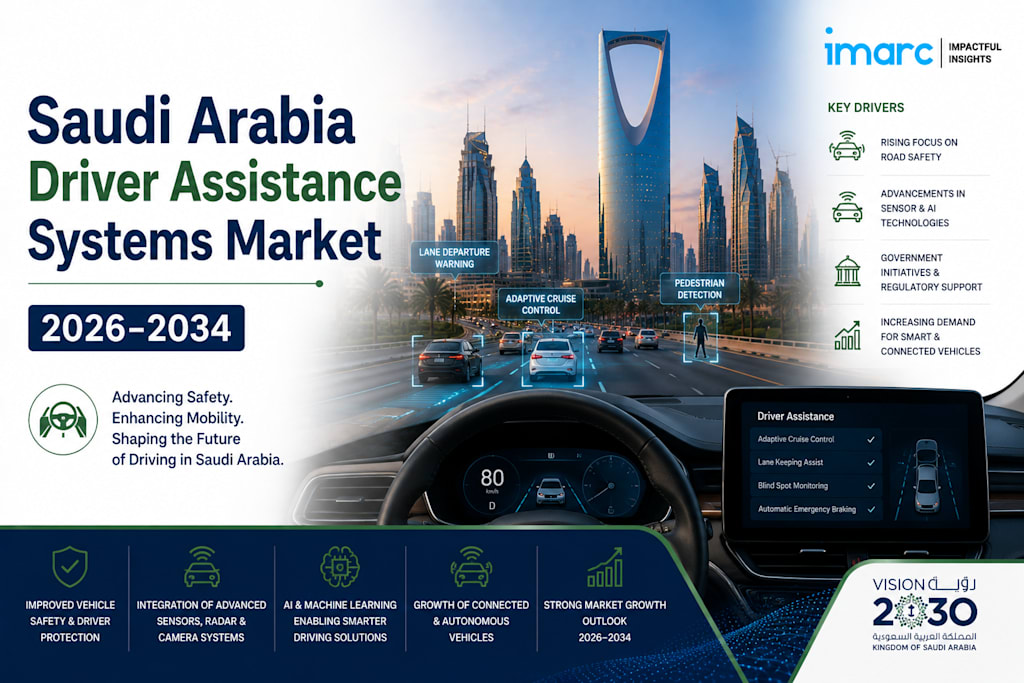
Saudi Arabia’s driver assistance systems market is gaining real momentum and it’s being pushed from multiple directions at once. Government mandates are embedding ADAS features into vehicle import requirements. A booming luxury car segment is making adaptive cruise control and lane departure warning systems standard expectations rather than optional extras. And Vision 2030’s push for localized automotive manufacturing is drawing global technology providers into the Kingdom to build and customize ADAS solutions for desert roads and urban environments alike. According to IMARC Group’s latest data, The Saudi Arabia driver assistance systems market size reached USD 312.2 Million in 2025. Looking forward, IMARC Group expects the market to reach USD 627.9 Million by 2034, exhibiting a growth rate (CAGR) of 8.08% during 2026-2034.
Saudi Arabia commanded 28.45% of the broader Middle East and Africa ADAS regional market share in 2024 the largest country share in the region underscoring how decisively the Kingdom is leading automotive technology adoption across the Gulf. The retrofit aftermarket segment is also expanding rapidly, with AI-enabled dashcams, blind-spot monitors, and collision warning devices finding growing audiences among existing vehicle owners. The market is segmented by type into blind spot detection, adaptive cruise control, lane departure warning systems, night vision, adaptive front lighting, intelligent parking assist systems, and others; by technology into ultrasonic sensor, image sensor, LiDAR sensor, and radar sensor; by vehicle type into passenger cars, light commercial vehicles, and heavy commercial vehicles; and across four regions: Northern and Central, Western, Eastern, and Southern Saudi Arabia.
Saudi Arabia Driver Assistance Systems Market Growth Drivers:
- Government Road Safety Mandates Formalizing ADAS Demand
Since 2023, Saudi regulators have mandated key ADAS features including adaptive cruise control, automatic emergency braking, lane-keep assist, and collision avoidance as requirements in all new vehicles. Vehicle import regulations now require compliance with international safety standards, pushing OEMs to embed assistance systems across their model ranges rather than treating them as premium add-ons. Saudi Arabia is also building vehicle-to-infrastructure (V2I) support capabilities through public-private partnerships, and insurance premium structures are increasingly tied to vehicle safety ratings. Research confirms ADAS systems can reduce road accidents by up to 30% a compelling case in a country with a strong policy focus on traffic fatality reduction under Vision 2030.
- Luxury Automotive Boom Setting New Consumer Expectations
Saudi Arabia’s premium vehicle segment is expanding fast, driven by rising urban incomes and lifestyle aspirations. Features like 360-degree parking cameras, traffic sign recognition, and blind-spot detection are now considered baseline expectations in the luxury segment rather than differentiators. Consumers in Riyadh and Jeddah have shown a strong preference for technology-rich vehicles that signal both status and safety. Government EV adoption incentives are reinforcing this trend indirectly most electric and hybrid models come with integrated ADAS modules by default, meaning EV uptake automatically expands the ADAS installed base. This luxury-driven standardization is steadily cascading into mid-tier models as consumer expectations evolve across income segments.
- Automotive Localization Under Vision 2030 Attracting Global Tech Partners
Vision 2030’s industrial diversification agenda is turning Saudi Arabia into a genuine automotive assembly destination, facilitated by the Ministry of Industry and Mineral Resources and the Public Investment Fund. Global Tier 1 technology providers are establishing ADAS manufacturing and R&D capacities within the Kingdom, enabling system customization for regional conditions including dust-optimized LiDAR, thermal sensors for high-heat environments above 45 degrees Celsius, and off-road detection tools. These localization efforts are improving both availability and affordability of ADAS solutions across vehicle segments, shifting the market from import dependence toward domestic innovation and creating a growing base of skilled automotive electronics engineers.
Saudi Arabia Driver Assistance Systems Market Trends:
- AI-Powered Radar Systems Tackling Desert-Specific Challenges
Standard ADAS sensors face real performance challenges in Saudi Arabia’s environment sandstorms, extreme heat, and high-glare conditions can compromise camera-based systems and LiDAR accuracy. As a result, millimeter-wave radar is emerging as the preferred sensor technology for reliable object detection under harsh conditions. In March 2026, Saudi ADAS radar systems integrating AI and millimeter-wave technology were rolled out, specifically boosting object detection accuracy and enabling dependable adaptive cruise control across desert roads. Fleet operators are also using AI-powered predictive maintenance to analyze sensor data from these systems, cutting vehicle downtime by up to 25% and lowering repair costs across commercial fleets operating in the Kingdom’s most demanding conditions.
- Autonomous Vehicle Pilots Creating Infrastructure for Next-Generation ADAS
Saudi Arabia is actively building the smart mobility infrastructure that upstream ADAS demand depends on. In July 2025, Riyadh launched its first autonomous vehicle pilot across seven locations including major highways and airport terminals through public-private partnerships with Uber, WeRide, and AiDriver. These deployments are creating real-world datasets for refining ADAS algorithms under Saudi road conditions and increasing public confidence in semi-autonomous technology. Saudi Arabia’s commanding 28.45% share of the broader MEA ADAS market signals how far ahead the Kingdom is in building this ecosystem. OEM-fit installations dominated distribution with 84.54% share, but the aftermarket segment is growing at 17.23% annually, showing demand is spreading beyond new vehicle sales.
- Aftermarket ADAS Retrofits Opening a New Mass-Market Opportunity
Not every Saudi driver is buying a new car but many still want smarter, safer vehicles. The retrofit ADAS segment is responding with AI-enabled dashcams, blind-spot monitors, lane departure alerts, and collision warning systems compatible with existing vehicles. In November 2024, Saudi developer Nasser Al-Khaldi launched an AI-driven driver-assist system using cameras and radar, compatible with over 64 car models a clear signal that ADAS is moving decisively beyond the luxury showroom. The aftermarket ADAS segment in the Middle East is now estimated at around USD 1.2 billion, demonstrating that consumer demand for safer driving technology is broad enough to support both OEM and retrofit channels simultaneously.
Recent News and Developments in Saudi Arabia Driver Assistance Systems Market
- May 2025: Lucid Group and Saudi Arabia’s King Abdullah University of Science and Technology (KAUST) announced a strategic partnership to advance EV innovation and expand autonomous driving and driver assistance systems capabilities. The collaboration gives Lucid access to KAUST’s supercomputing infrastructure to accelerate research in AI training, digital twin development, crash simulation, and advanced materials engineering. The partnership strengthens Saudi Arabia’s mobility technology ecosystem and reinforces long-term investment in ADAS research and development.
- July 2025: Riyadh launched its first autonomous vehicle pilot program across seven locations, including major highways and airport terminals, through public-private partnerships with Uber, WeRide, and AiDriver. The initiative marks a significant milestone in Saudi Arabia’s smart mobility agenda, creating real-world testing environments that generate the operational data needed to refine ADAS algorithms under Saudi-specific road and climate conditions, while boosting public confidence in semi-autonomous systems.
- November 2024: Saudi developer Nasser Al-Khaldi launched an AI-driven driver-assist retrofit system using cameras and radar, designed to be compatible with over 64 car models. The product targets existing vehicle owners who want advanced safety features without purchasing a new car, signaling that ADAS adoption is breaking into the mainstream and beyond the premium vehicle segment. The launch highlights a growing domestic innovation pipeline in automotive safety technology.
- February 2024: The Saudi Ministry of Interior partnered with Lucid Motors to unveil the Kingdom’s first AI-powered electric security vehicle, equipped with facial recognition technology and six built-in cameras. The high-profile government deployment raised the public visibility of advanced automotive safety technologies significantly, influencing both consumer expectations and fleet procurement decisions across the Kingdom’s public and private sectors
Note: If you require specific details, data, or insights that are not currently included in the scope of this report, we are happy to accommodate your request. As part of our customization service, we will gather and provide the additional information you need, tailored to your specific requirements. Please let us know your exact needs, and we will ensure the report is updated accordingly to meet your expectations.
About the Creator
Shubham Sharma
Market research enthusiast sharing insights on global industries, emerging trends, growth opportunities, and data-driven analysis across diverse markets.
Enjoyed the story? Support the Creator.
Subscribe for free to receive all their stories in your feed.
Comments
There are no comments for this story
Be the first to respond and start the conversation.