
Saudi Arabia Diethylene Glycol (DEG) Market: Petrochemical Expansion, Industrial Demand & Growth Outlook
How increasing demand from the construction, automotive, and chemical manufacturing sectors, along with rising applications in resins, antifreeze, and solvents, are driving production expansion, industrial innovation, and steady growth across the Saudi Arabia Diethylene Glycol (DEG) Market.

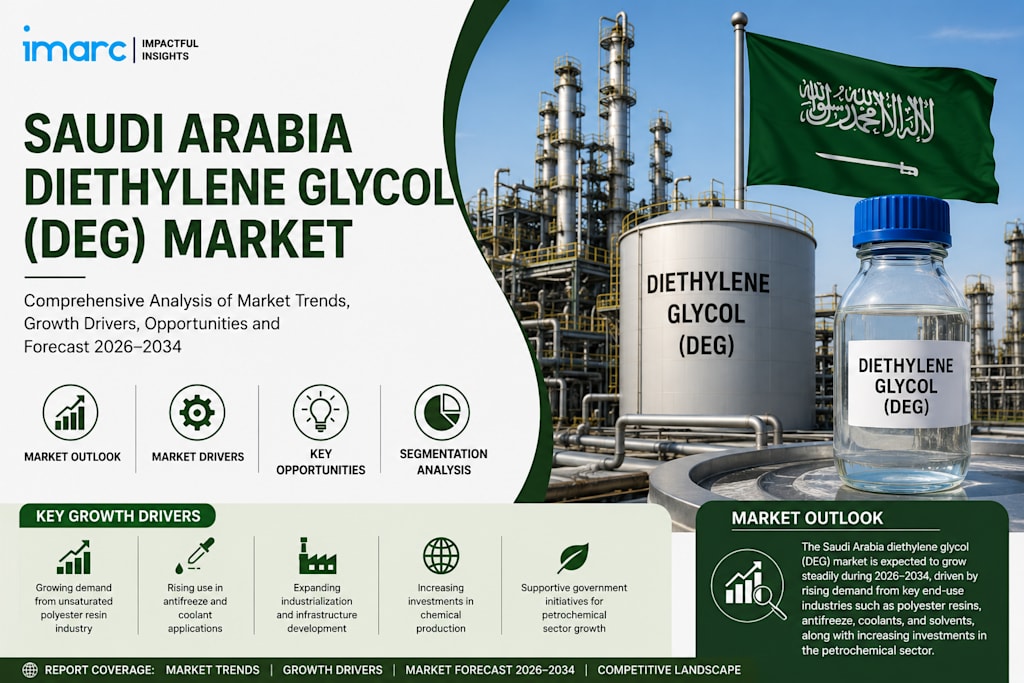
Diethylene glycol (DEG) might not be a headline chemical, but it quietly underpins a wide range of industrial processes that are central to Saudi Arabia’s economic diversification story. From polyester fiber manufacturing to antifreeze formulations, industrial solvents, and resin production, DEG is an indispensable input across several sectors that Vision 2030 is actively building up. Saudi Arabia’s position as a major ethylene oxide producer gives it a structural cost advantage in DEG supply and that advantage is now translating into sustained demand growth across domestic end-use industries. According to IMARC Group’s latest data, The Saudi Arabia diethylene glycol (DEG) market size reached 32.6 Thousand Tons in 2025. Looking forward, IMARC Group expects the market to reach 45.5 Thousand Tons by 2034, exhibiting a growth rate (CAGR) of 3.78% during 2026-2034.
Saudi Arabia’s DEG market is evolving alongside the Kingdom’s broader petrochemical ambitions. In 2024, Arthur D. Little’s principal Hector Casas noted that Saudi Arabia’s petrochemical capacity is projected to double within five years from around 75 million tons per annum to over 140 million tons per annum. A significant share of that capacity expansion directly involves ethylene glycol derivatives, including DEG. SABIC’s Jubail United Petrochemical Company (a SABIC subsidiary) already operates a DEG plant with 97,000 tons per year of annual capacity, co-located with a USD 700 million MEG complex confirming the scale of existing infrastructure. The market is segmented by application into antifreeze and coolant, solvents, humectants, polyester resins and plasticizers, emulsifiers and lubricants, and others; and by end use industry into agrochemical, automotive, cosmetic and personal care, paints and coatings, oil and gas, textiles, plastics, and others, across four key regions of the Kingdom.
Saudi Arabia Diethylene Glycol (DEG) Market Growth Drivers:
- Textile Industry Expansion Anchoring Sustained DEG Demand
DEG is an essential input for polyester fiber production, making the textile industry one of its most reliable demand anchors. Saudi Arabia’s textile market is projected to reach USD 12.9 billion by 2033, driven by a combination of domestic consumption and export ambitions that Vision 2030 is actively supporting through industrial zone development and manufacturing incentives. As Saudi textile producers invest in synthetic fiber upgrades where DEG directly contributes to fiber durability and flexibility purchase volumes are increasing predictably. The international supply chain role Saudi Arabia plays in polyester intermediates further reinforces this trajectory, creating a compounding demand pull that is unlikely to reverse.
- Petrochemical Capacity Doubling Expanding DEG Production and Applications
Saudi Arabia is on a deliberate path to double its petrochemical output, from approximately 75 million to over 140 million tons per annum within five years. DEG, as a co-product of ethylene oxide hydration alongside MEG, benefits directly from this expansion. SABIC and Aramco’s crude-to-chemicals complex at Ras Al-Khair designed to process 400,000 barrels per day and generate around 9 million tons of chemicals annually is a concrete example of the scale of capacity coming online. The Ministry of Energy’s feedstock allocation approvals for new complexes in Jubail, including a Sipchem-LyondellBasell cracker targeting 1.5 million tons per year of ethylene, further expand the upstream base from which DEG is derived.
- Automotive and Consumer Goods Sectors Creating Diversified Demand Channels
DEG’s role in antifreeze and coolant formulations makes the automotive sector a key demand channel as Saudi Arabia’s vehicle market modernizes. Rising vehicle sales, a growing fleet of commercial vehicles serving megaproject logistics, and the emergence of electric vehicle maintenance requirements are all sustaining demand for DEG-based coolant products. Beyond automotive, rising living standards are lifting consumption of paints, coatings, personal care products, and specialty resins all of which use DEG in formulation. Saudi Arabia’s consumer market is one of the largest in the MENA region, and as product quality expectations rise, manufacturers are increasing their use of DEG-enabled formulations that deliver improved performance characteristics.
Saudi Arabia Diethylene Glycol (DEG) Market Trends:
- AI-Powered Production Optimization Improving DEG Yields and Efficiency
Advanced manufacturing technology is reshaping how DEG is produced in Saudi Arabia. In October 2025, SABIC rolled out AI-powered monitoring systems across its DEG plants, achieving a 12% boost in production efficiency while significantly reducing energy consumption. These systems use machine learning to optimize temperature, pressure, and catalyst ratios in real time during ethylene oxide conversion, improving yields by 8–12% compared to conventional process control. Predictive maintenance capabilities have reduced unplanned downtime by up to 50% at SABIC and Aramco facilities. For an industry where production continuity and energy cost management are critical competitive factors, these AI-driven efficiency gains are becoming a meaningful differentiator in both domestic supply reliability and export pricing.
- Green Chemistry and Sustainability Reshaping DEG Production Standards
Environmental performance is increasingly factored into DEG production investment decisions. SABIC already operates the world’s largest carbon capture and purification plant capturing 500,000 metric tons of CO₂ annually from ethylene glycol production and reusing it as feedstock. In September 2025, a breakthrough environmentally friendly DEG purification process was developed that reduces solvent waste and energy use in refining, pointing toward a greener production pathway. Saudi Arabia’s Vision 2030 sustainability mandates and its USD 266.6 million green financing program are reinforcing these shifts, directing capital toward bio-based chemical alternatives and low-carbon production pathways that improve the long-term competitiveness of Saudi DEG in environmentally conscious export markets.
- SABIC Consolidating DEG Marketing, Strengthening Supply Chain Integration
A notable structural shift in the Saudi DEG market is SABIC’s consolidation of marketing and sales responsibilities for DEG from Saudi Aramco’s petrochemical operations. SABIC now exclusively handles the sales and marketing of DEG alongside MEG and TEG from multiple joint-venture complexes, creating a more unified and efficient supply chain from Jubail Industrial City which hosts over 150 petrochemical and chemical plants connected by an integrated pipeline network. This consolidation improves pricing consistency, logistics coordination, and customer service quality for downstream buyers. Meanwhile, SABIC’s return to profitability in 2024 posting a net profit of SAR 1.5 billion (USD 400 million) has unlocked up to USD 4 billion in committed capital expenditure on new projects, supporting further capacity and product development.
Recent News and Developments in Saudi Arabia Diethylene Glycol (DEG) Market
- October 2025: Saudi petrochemical giant SABIC deployed AI-powered monitoring systems across its DEG plants, achieving a 12% improvement in production efficiency and a meaningful reduction in energy consumption. The rollout leverages machine learning algorithms to optimize real-time process parameters during ethylene oxide conversion, with predictive maintenance capabilities cutting unplanned downtime by up to 50%. The initiative marks a significant step in SABIC’s broader digitalization strategy for its chemical manufacturing assets.
- February 2025: SABIC returned to profitability in 2024, posting a net profit of SAR 1.5 billion (USD 400 million) a significant turnaround from a SAR 2.8 billion loss in 2023. CEO Abdulrahman Al Fageeh confirmed that SABIC would commit up to USD 4 billion in capital expenditure on new projects, reinforcing the company’s long-term investment appetite and signaling sustained capital deployment into core chemical production assets including ethylene glycol derivatives.
- March 2025: Saudi Arabia’s Ministry of Energy approved feedstock allocations for two new petrochemical complexes in Jubail, including a joint Sipchem-LyondellBasell cracker targeting 1.5 million tonnes per year of ethylene. As ethylene is the primary precursor in DEG production via ethylene oxide hydration, this upstream capacity expansion directly strengthens the feedstock base for Saudi DEG output and underpins the market’s long-term supply trajectory.
- November 2025: Regional DEG prices in Saudi Arabia eased modestly due to softer export demand from Asian markets, with stable local production volumes maintaining balanced inventory levels. Supply chain flexibility and competitive feedstock costs allowed Saudi producers to sustain consistent output and absorb external market fluctuations without disruption. The pricing environment reflected the structural cost advantage that Saudi Arabia’s integrated petrochemical base provides in the global DEG supply chain.
Note: If you require specific details, data, or insights that are not currently included in the scope of this report, we are happy to accommodate your request. As part of our customization service, we will gather and provide the additional information you need, tailored to your specific requirements. Please let us know your exact needs, and we will ensure the report is updated accordingly to meet your expectations.
About the Creator
Faisal Al-Harbi
Market research professional based in Saudi Arabia (KSA), focused on industry trends, market growth, and economic insights.
Writing data-driven articles on Saudi markets, business outlook, and Vision 2030–driven sectors.
Enjoyed the story? Support the Creator.
Subscribe for free to receive all their stories in your feed.
Comments
There are no comments for this story
Be the first to respond and start the conversation.