
Saudi Arabia Data Encryption Market Witnesses Strong Growth Trend
How rapid digital transformation, increasing cybersecurity threats, and growing regulatory focus on data privacy and protection are driving demand for advanced encryption technologies, cloud security solutions, and secure data management practices across the Saudi Arabia Data Encryption Market.

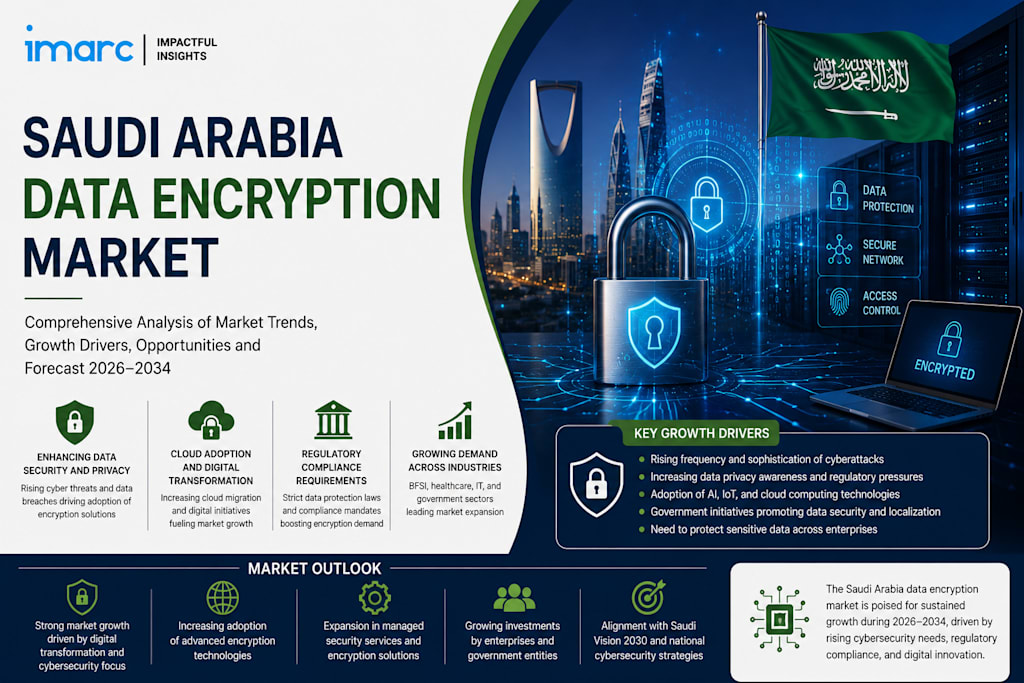
Rising cybersecurity threats, stringent data protection regulations, accelerating cloud adoption, and Saudi Arabia’s Vision 2030-led digital transformation are collectively driving strong demand for data encryption solutions. According to IMARC Group’s latest data, The Saudi Arabia data encryption market size was valued at USD 30.6 Million in 2025. Looking forward, IMARC Group estimates the market to reach USD 112.1 Million by 2034, exhibiting a CAGR of 15.52% from 2026–2034.
Saudi Arabia’s data encryption market is one of the fastest-growing cybersecurity segments in the region, fuelled by the Kingdom’s ambitious digital economy push and rising enterprise vulnerability to cyber threats. As organisations across banking, healthcare, government, and telecom sectors migrate critical workloads to the cloud, the need to secure data both in transit and at rest has become non-negotiable. Encryption solutions spanning symmetric and asymmetric methods, on-premise and cloud deployments are now considered a core pillar of enterprise security architecture. Key segments include BFSI, IT and telecom, aerospace and defence, healthcare, automotive, and manufacturing, with large enterprises leading adoption and SMEs rapidly catching up driven by regulatory pressure and affordable cloud-based encryption-as-a-service offerings.
Saudi Arabia Data Encryption Market Growth Drivers:
- Escalating Cybersecurity Threats and Enterprise Breach Risk
Saudi organisations are facing a surge in ransomware attacks, phishing campaigns, and data exfiltration attempts. The National Cybersecurity Authority (NCA) has documented a sharp uptick in incidents targeting critical infrastructure and financial institutions. In response, enterprises are deploying end-to-end encryption to protect customer records, intellectual property, and operational data. Banking and healthcare sectors are particularly proactive, mandating encryption at every data layer. Real-world incidents like high-profile breaches in GCC financial institutions have made boards treat encryption not as a compliance checkbox but as a frontline defence investment.
- Vision 2030 Digital Transformation and Government Mandates
The Saudi government’s Vision 2030 is driving a massive scale-up of digital infrastructure across smart cities, e-government services, and industrial IoT. The NCA’s Essential Cybersecurity Controls (ECC) framework explicitly requires encryption for sensitive government and private sector data. Non-compliance carries substantial financial penalties, pushing organisations across all verticals to prioritise encryption investment. Government spending on secure digital infrastructure is accelerating rapidly, with projects like NEOM and the digital public services overhaul creating large-scale demand for enterprise-grade encryption platforms, benefiting both domestic and international solution providers.
- Cloud Migration and Zero-Trust Security Adoption
As Saudi enterprises increasingly shift operations to cloud environments hosted by AWS, Microsoft Azure, and Google Cloud all of which have established local data centres in the Kingdom encryption has become the backbone of cloud security strategy. Zero-trust architecture, which assumes no implicit trust and requires verification at every access point, inherently relies on strong encryption protocols. Encryption-as-a-Service (EaaS) offerings are growing fast among SMEs that cannot build in-house infrastructure. The cloud security market in Saudi Arabia is expanding at a rapid clip, with encryption tools forming the largest functional spend category.
Saudi Arabia Data Encryption Market Trends:
- AI-Powered Encryption and Quantum-Resistant Algorithms
Encryption technology is evolving beyond traditional AES and RSA protocols. Saudi organisations and government agencies are beginning to test post-quantum cryptography standards, anticipating the eventual threat posed by quantum computing to current encryption methods. Simultaneously, AI-driven encryption management platforms are gaining traction, automating key rotation, anomaly detection, and policy enforcement across hybrid environments. Global cybersecurity vendors including Palo Alto Networks which opened a dedicated Saudi cloud data centre are integrating AI-assisted encryption into their regional product stacks, helping enterprises stay ahead of increasingly sophisticated threat actors.
- BFSI Sector Leading Encryption Deployment
Banking, financial services, and insurance remain the dominant end-user segment for encryption in Saudi Arabia, driven by SAMA (Saudi Central Bank) compliance requirements and the explosive growth of digital payments and open banking. Saudi banks are encrypting everything from mobile transaction data to inter-bank communication channels. With digital wallet usage and real-time payment volumes climbing steeply, financial institutions are deploying hardware security modules (HSMs) and end-to-end encrypted payment gateways as standard practice. This segment’s leadership is expected to continue as fintech expansion accelerates across the Kingdom.
- Data Localisation and Sovereign Encryption Infrastructure
Saudi Arabia’s Personal Data Protection Law (PDPL), enforced by the Saudi Data and Artificial Intelligence Authority (SDAIA), requires that sensitive personal data of Saudi residents be stored and processed within the Kingdom’s borders. This data localisation mandate is directly fuelling investment in sovereign encryption infrastructure local key management systems, domestic data centres with built-in encryption layers, and government-approved encryption standards. Organisations that handle health records, financial data, or government contracts are investing in on-premise and hybrid encryption deployments to ensure regulatory compliance while maintaining operational flexibility.
Recent News and Developments in Saudi Arabia Data Encryption Market
- May 2024: Palo Alto Networks, a US-based global cybersecurity leader, unveiled a new cloud data centre in Saudi Arabia. The strategic move ensures that customers across the Kingdom and the broader Gulf region gain local, high-performance access to Palo Alto’s enterprise cybersecurity suite including advanced encryption and threat prevention services while meeting strict data residency and sovereignty requirements mandated by Saudi regulators.
- March 2024: Saudi Aramco expanded its cybersecurity investment programme, partnering with multiple international encryption and data security vendors to strengthen protection of its operational technology (OT) networks and digital supply chain. The initiative reflects the energy sector’s growing recognition that critical infrastructure encryption is now essential, not optional, as industrial IoT connectivity increases across the Kingdom’s oil and gas facilities.
- January 2024: The Saudi Data and AI Authority (SDAIA) issued updated enforcement guidelines under the Personal Data Protection Law (PDPL), clarifying encryption requirements for organisations processing personal data. The updated framework specifies that encryption must be applied to data both at rest and in transit, driving a fresh wave of compliance-driven procurement across government agencies, healthcare providers, and private sector enterprises operating in the Kingdom.
Note: If you require specific details, data, or insights that are not currently included in the scope of this report, we are happy to accommodate your request. As part of our customization service, we will gather and provide the additional information you need, tailored to your specific requirements. Please let us know your exact needs, and we will ensure the report is updated accordingly to meet your expectations.
About the Creator
Faisal Al-Harbi
Market research professional based in Saudi Arabia (KSA), focused on industry trends, market growth, and economic insights.
Writing data-driven articles on Saudi markets, business outlook, and Vision 2030–driven sectors.
Enjoyed the story? Support the Creator.
Subscribe for free to receive all their stories in your feed.
Comments
There are no comments for this story
Be the first to respond and start the conversation.