
Saudi Arabia Construction Market: Mega Projects, Vision 2030 & Growth Outlook
How mega infrastructure projects, Vision 2030 initiatives, and rising investments in residential, commercial, and energy sectors are driving sustained growth, project diversification, and technological advancement in the Saudi Arabia construction market—valued at around USD 101.4 billion in 2025 and projected to reach approximately USD 140+ billion by 2034
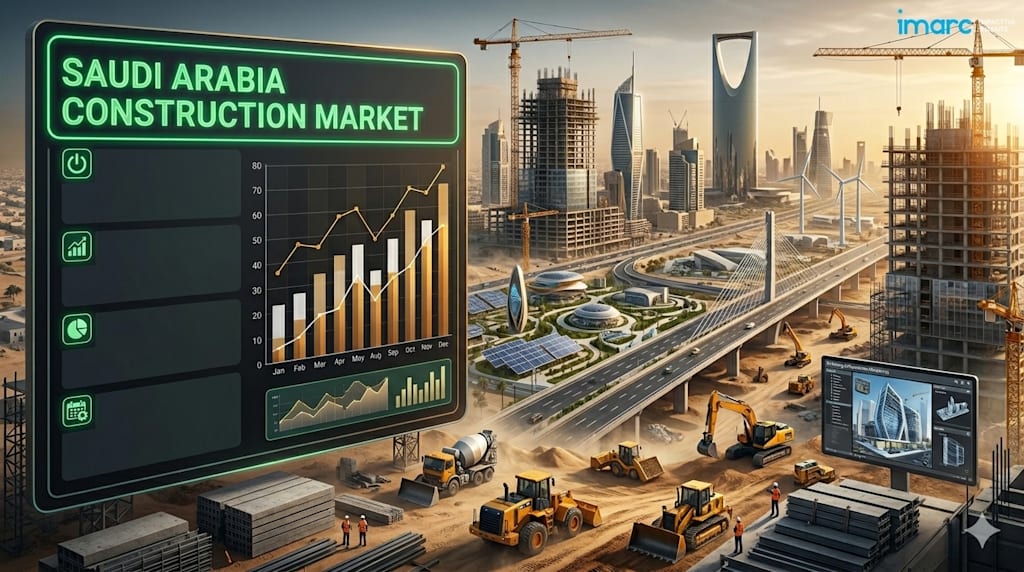
According to IMARC Group's latest research publication, Saudi Arabia construction market size reached USD 101.4 Billion in 2025. The market is projected to reach USD 140.4 Billion by 2034, exhibiting a growth rate (CAGR) of 3.6% during 2026-2034.
How AI is Reshaping the Future of Saudi Arabia Construction Market
• Smart Project Management and Digital Twins: AI-powered platforms are revolutionizing how mega-projects like NEOM and Qiddiya are managed. Digital twins create virtual replicas of construction sites, allowing teams to simulate scenarios, predict bottlenecks, and optimize resource allocation before breaking ground. Building Information Modeling integrated with AI reduces rework by up to 15%, cutting costs and timelines across billion-dollar developments throughout the Kingdom.
• Automated Quality Control and Safety Monitoring: Computer vision systems deployed on construction sites automatically inspect structural integrity, identify defects in real-time, and ensure compliance with international standards. Drone-based AI surveillance across ROSHN's housing developments and Red Sea Project sites monitors safety protocols continuously, reducing workplace accidents and improving construction quality while keeping massive projects on schedule.
• Prefabrication and Modular Construction Optimization: AI algorithms optimize the design and production of prefabricated building components, enabling faster assembly on-site. China Harbour Engineering Company's 200,000-square-meter modular facility in Riyadh uses robotics and AI to produce housing units 30% faster than traditional methods, directly supporting Vision 2030's goal of delivering 2 million homes by 2030.
How Vision 2030 is Revolutionizing Saudi Arabia Construction Industry
Vision 2030 isn't just changing Saudi Arabia's construction landscape it's creating an entirely new one from scratch. The government's commitment of roughly USD 1.3 trillion toward infrastructure expansion has turned the Kingdom into the world's largest construction site, with giga-projects that sound more like science fiction than real estate developments. NEOM alone carries a USD 500 billion price tag and envisions futuristic cities powered entirely by renewable energy. The Red Sea Project is transforming coastline into luxury tourism destinations with over 330,000 hotel rooms planned. Qiddiya promises to become the world's premier entertainment hub, while Diriyah Gate preserves cultural heritage on an unprecedented scale. What makes this remarkable is the speed of execution contract awards jumped 20% to USD 196 billion in 2025, with USD 120 billion already spent across these mega-developments. But Vision 2030 goes beyond flagship projects. ROSHN's plan to invest SAR 350 billion to house 1.5 million people addresses real housing needs while pushing homeownership toward 70%.
Saudi Arabia Construction Market Trends & Drivers:
The market is experiencing a fundamental shift from traditional building methods to tech-driven, sustainable construction. Modular and prefabricated construction is rapidly gaining ground ROSHN's USD 1.2 billion villa contracts in 2025 utilize prefabricated wall panels that cut construction cycles by 30%, addressing labor shortages while accelerating delivery. Smart city integration is becoming standard, with projects embedding IoT sensors, AI-powered building management systems, and digital infrastructure from day one. Sustainability has moved from nice-to-have to mandatory, with green building certifications like LEED and GSAS now expected on major developments. Mixed-use projects are replacing single-purpose buildings developments like Diriyah Gate and Jeddah Central combine residential, commercial, hospitality, and cultural spaces in integrated communities. PPP frameworks are maturing, attracting sophisticated international capital and expertise through standardized risk-sharing models. And there's a notable regionalization of construction activity while Riyadh and Jeddah remain dominant, giga-projects are spreading development across previously underserved areas like the Northern Region (NEOM) and Southern Region (Aseer tourism), creating balanced national growth.
Key Highlights of the Report:
Market Breakup by Sector:
• Residential
• Commercial
• Industrial
• Infrastructure (Transportation)
• Energy and Utilities Construction
Market Breakup by Region:
• Northern and Central Region
• Western Region
• Eastern Region
• Southern Region
Market Growth Drivers:
• Giga-Project Execution and USD 1 Trillion Investment Pipeline: The Kingdom's mega-project portfolio represents the world's largest construction pipeline, with NEOM (USD 500 billion), Red Sea Project (USD 15-16 billion), Qiddiya, and Diriyah Gate collectively creating sustained multi-decade demand. Contract awards reached USD 196 billion in 2025, up 20% year-over-year, with USD 120 billion already deployed across giga-projects. This massive capital deployment is supporting everything from residential communities to entertainment complexes, industrial cities, and tourism infrastructure. The Public Investment Fund alone is directing USD 40 billion into NEOM, Red Sea, and Qiddiya between 2024-2026, ensuring continuous project flow and attracting global EPC contractors to establish permanent operations in the Kingdom.
• Housing Programs and 70% Homeownership Target: The government's commitment to raising homeownership from current levels to 70% by 2030 is driving massive residential construction. ROSHN is investing SAR 350 billion to deliver 1.5 million homes across integrated communities, with USD 1.2 billion in villa contracts awarded in 2025 alone. The National Housing Company's USD 50+ billion pipeline spans 39 projects across 17 cities, while the Sakani program has already delivered over 1 million units and targets 2 million by 2030. A 200,000-square-meter modular production facility opened in Riyadh to accelerate prefabricated housing delivery. These programs combine affordable housing for middle-income Saudis with luxury developments for affluent buyers, creating diversified demand across price points while modernizing building techniques to support faster, higher-quality construction.
• Public-Private Partnerships and Foreign Investment Inflows: Saudi Arabia's enhanced PPP framework is unlocking billions in private capital and international expertise for construction projects. Nearly 200 PPP opportunities across 17 sectors have been launched with standardized guidelines and improved investor protections. The Kingdom attracted over USD 31.72 billion in foreign direct investment in 2024, much of it targeting construction-intensive sectors. Major PPP deals in 2025 included healthcare-commercial complexes in Makkah and mixed-use developments in Dammam under 30-year Build-Own-Operate-Transfer concessions. International firms like Bechtel, Fluor, and Jacobs are expanding operations while local contractors form joint ventures to access advanced construction technologies, creating a robust ecosystem that shares risk and accelerates delivery of complex mega-projects.
Recent News and Developments in Saudi Arabia Construction Market:
• May 2025: DLR Group announced its plans to expand into Saudi Arabia in response to market potential and its long-term vision of becoming a leading force in defining the regional architectural identity, reflecting the unprecedented ambition in urban development represented by giga-projects like NEOM, The Line, and Diriyah Gate.
• April 2025: International strategy consulting firm Bain & Company doubled its presence in the Saudi market by launching a new and significantly larger regional headquarters in Riyadh's King Abdullah Financial District. The new office is over twice the size of its former location, solidifying the firm's decade-long commitment to the Kingdom and reflecting strong demand for professional services tied to Vision 2030 transformation projects.
• February 2025: Saudi Arabia introduced infra-guaranteed financing and surety bonds to assist contractors in the construction sector. A surety bond operates similarly to insurance, offering a guarantee to contractors that provides financial security and enables them to take on larger, more complex projects with confidence, particularly valuable for smaller firms bidding on government mega-projects.
• January 2025: China Harbour Engineering Company (CHEC) inaugurated a 200,000 square meter modular production facility in Riyadh to support ROSHN's Sedra housing project, a significant initiative within Saudi Vision 2030. The facility employs robotics and digital technologies to improve modular construction efficiency, providing sustainable and affordable housing options while accelerating project delivery timelines.
• October 2024: Saudi Arabia announced plans to build The Mukaab, a unique cube-shaped skyscraper in Riyadh measuring 400 meters on each side. Upon completion, The Mukaab is set to become the largest building in the world and will serve as a centerpiece of New Murabba, a downtown development project covering 19 square kilometers in northwest Riyadh.
Note: If you require specific details, data, or insights that are not currently included in the scope of this report, we are happy to accommodate your request. As part of our customization service, we will gather and provide the additional information you need, tailored to your specific requirements. Please let us know your exact needs, and we will ensure the report is updated accordingly to meet your expectations.
About the Creator
Shubham Sharma
Market research enthusiast sharing insights on global industries, emerging trends, growth opportunities, and data-driven analysis across diverse markets.
Enjoyed the story? Support the Creator.
Subscribe for free to receive all their stories in your feed.
Comments
There are no comments for this story
Be the first to respond and start the conversation.