
Saudi Arabia Connected Car Market to Reach USD 9.6 Billion by 2033, Growing at 15.1% CAGR
Saudi Arabia’s connected car market is expanding rapidly, driven by smart mobility adoption, 5G connectivity, IoT integration, and growing demand for advanced vehicle technologies.

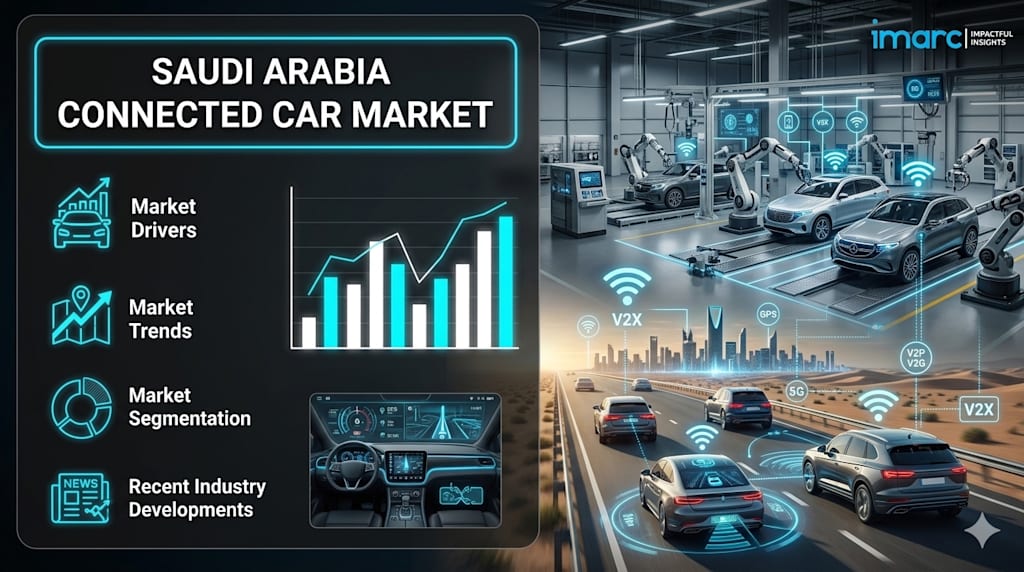
Rising demand for smart mobility solutions, rapid 5G network expansion, and the Kingdom's commitment to digital transformation under Vision 2030 are collectively accelerating the adoption of connected vehicles across Saudi Arabia. According to IMARC Group's latest research, the Saudi Arabia connected car market size reached USD 2.3 Billion in 2024. Looking forward, IMARC Group expects the market to reach USD 9.6 Billion by 2033, exhibiting a growth rate (CAGR) of 15.1% during 2025-2033. The rising need for improving overall vehicle performance and user convenience is primarily driving the Saudi Arabia Connected Car Market across the country.
Connected cars are vehicles equipped with internet connectivity and advanced communication technologies, enabling seamless exchange of information between drivers, infrastructure, and cloud-based platforms. These vehicles enhance road safety through real-time traffic alerts, available parking notifications, and emergency service integration. Beyond safety, they improve traffic management, reduce congestion, and support the development of intelligent transportation ecosystems. Saudi Arabia's youthful, tech-savvy population and robust urbanization are creating a compelling consumer base for these technologies, while government-led smart city initiatives are providing the structural backbone for long-term adoption.
Saudi Arabia Connected Car Market Growth Drivers:
- Rapid Deployment of 5G and Smart Infrastructure
The swift expansion of 5G networks across Saudi Arabia is a foundational driver of the connected car market. High-speed, low-latency connectivity enables real-time vehicle-to-everything (V2X) communication, over-the-air (OTA) software updates, live navigation, and instant traffic alerts. The Communications, Space and Technology Commission (CST) reports approximately 98% of the population is now covered by 4G, with 5G rapidly penetrating key urban centers including Riyadh, Jeddah, and Dammam. This infrastructure creates the digital backbone that makes connected car services not just possible but commercially scalable at a national level.
- Vision 2030 and Government-Led Smart Mobility Initiatives
Saudi Arabia's Vision 2030 reform agenda directly fuels the Saudi Arabia Connected Car Market by embedding digital transformation and smart city development at the heart of national policy. The government is actively facilitating regulatory frameworks, encouraging private-sector partnerships, and directing targeted investments into next-generation mobility technologies. The Public Investment Fund (PIF) has committed capital to electric and autonomous vehicle companies, including Lucid Motors, while the EVIQ joint venture between PIF and the Saudi Electricity Company is deploying thousands of fast EV charging stations nationwide, enabling the growth of telematics and remote connectivity services across the Kingdom's expanding electric vehicle fleet.
- Rising Consumer Demand for Safety, Convenience, and In-Car Connectivity
Saudi consumers are increasingly prioritizing vehicles that offer advanced driver assistance, real-time diagnostics, entertainment integration, and remote vehicle management. With more than 60% of the population under the age of 35, demand for digitally embedded automotive experiences is structurally embedded in the consumer base. Connected cars address a direct pain point in a country where road safety and urban traffic management are strategic national concerns. The ability to receive emergency alerts, monitor vehicle health remotely, and access seamless navigation directly supports daily convenience for millions of urban commuters across the Kingdom's major cities.
Saudi Arabia Connected Car Market Trends:
- Emergence of Data-Driven Services and Usage-Based Business Models
As vehicles become increasingly digitized, they generate vast volumes of data on driving behavior, location, diagnostics, and system usage. This data is being leveraged by automakers, insurers, fleet operators, and mobility service providers to deliver personalized, predictive, and efficient offerings. Insurers are actively exploring usage-based insurance (UBI) models that adjust premiums based on real driving patterns, while fleet operators are integrating telematics and AI-driven diagnostics to optimize routes and reduce unplanned downtime. These data-driven models represent a structural shift in how automotive value is created and captured beyond the point of vehicle sale.
- Localization of Automotive Manufacturing and Connected Ecosystems
A defining trend shaping the Saudi Arabia Connected Car Market is the active localization of vehicle manufacturing and technology ecosystems within the Kingdom. Saudi Arabia is no longer purely an import-dependent automotive market. The PIF-Hyundai joint venture, Hyundai Motor Manufacturing Middle East (HMMME), has broken ground at King Abdullah Economic City and targets an annual production of 50,000 vehicles. Simultaneously, Ceer Motors, the Kingdom's first homegrown EV brand, is preparing to launch domestically manufactured connected vehicles designed for the GCC market. This localization wave is creating an integrated value chain that will embed connected car capabilities into vehicles produced on Saudi soil.
- Integration of AI, IoT, and Autonomous Driving Technologies
The Saudi Arabia Connected Car Market is increasingly defined by the convergence of artificial intelligence, Internet of Things (IoT) sensors, and early-stage autonomous driving capabilities. Smart city projects such as NEOM and The Line are serving as live testbeds for intelligent transportation systems, where connected vehicles interact with infrastructure in real time. OEMs are embedding AI-powered predictive maintenance tools, enabling vehicles to self-diagnose and alert owners before breakdowns occur. Simultaneously, V2X communication protocols are being trialed in urban corridors, laying the groundwork for a future where vehicles, roads, traffic lights, and emergency systems operate as a unified, responsive network.
Recent News and Developments in the Saudi Arabia Connected Car Market
- October 2025: Saudi Arabia’s connected-car market is moving toward 5G-linked in-vehicle services, real-time diagnostics, and V2X systems that help vehicles exchange data with roads and cloud platforms for safer, faster mobility.
- November 2025: Autonomous mobility pilots are shifting from trials to service, with Riyadh’s autonomous fleet pilot serving over 1,000 users and broader plans for Level-4 robotaxi and robobus deployment across urban routes.
- December 2025: Smart-city projects such as NEOM are acting as live testbeds for connected cars, where vehicles already communicate with road infrastructure to improve traffic flow, navigation, and safety in real time.
- January 2026: The market is shifting toward software-defined ownership, with OTA updates, predictive maintenance, and app-based fleet tools becoming core features as consumers demand more digital cockpit services.
- February 2026: Cybersecurity and data-driven services are becoming bigger priorities, as connected vehicles generate continuous data streams and push automakers to strengthen secure cloud-native systems and subscription-based mobility offerings.
Note: If you require specific details, data, or insights that are not currently included in the scope of this report, we are happy to accommodate your request. As part of our customization service, we will gather and provide the additional information you need, tailored to your specific requirements. Please let us know your exact needs, and we will ensure the report is updated accordingly to meet your expectations.
About the Creator
Kishan Kumar
My name is Kishan Roy and I am a market analyst having 5 years of experience and a skilled researcher with a keen eye for consumer trends and data-driven insights.
Enjoyed the story? Support the Creator.
Subscribe for free to receive all their stories in your feed.
Comments
There are no comments for this story
Be the first to respond and start the conversation.