
Saudi Arabia Cold Chain Warehousing Market: Ensuring Food Security with Advanced Refrigeration & Smart Logistics
How advanced refrigeration technologies, IoT-enabled monitoring, and automated storage systems are transforming efficiency, compliance, and decision-making across the Saudi Arabia cold chain warehousing market.

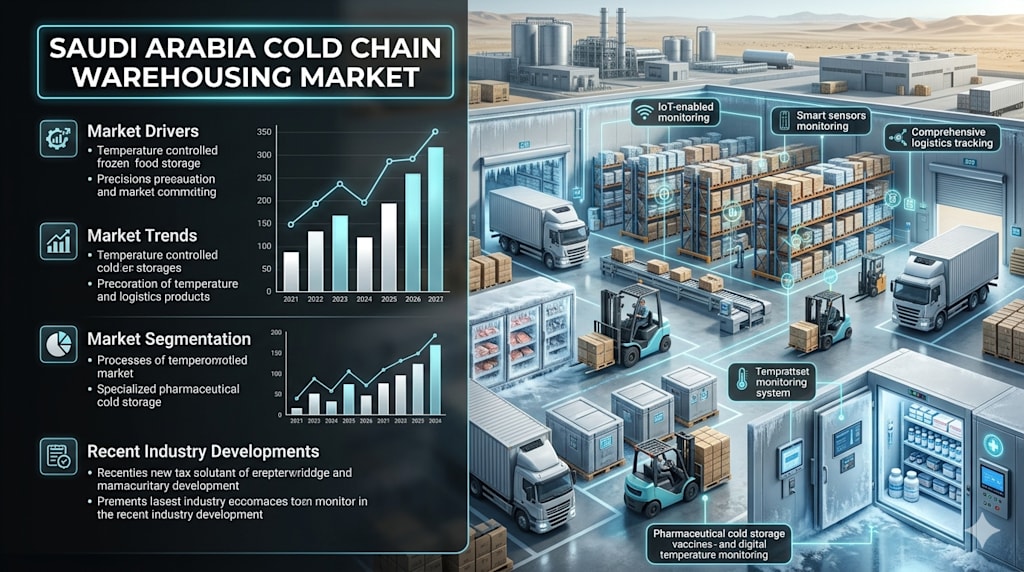
Saudi Arabia's cold chain warehousing sector is no longer a behind-the-scenes support function. It has quietly become one of the most strategically important pieces of the Kingdom's logistics puzzle, and the numbers back that up. According to IMARC Group's latest research, the Saudi Arabia cold chain warehousing market size was valued at USD 2.5 Billion in 2025. Looking forward, IMARC Group estimates the market to reach USD 6.7 Billion by 2034, exhibiting a CAGR of 11.51% from 2026-2034. The Northern and Central Region currently dominates, holding a market share of over 30% in 2025.
What is really driving this growth? A combination of pharmaceutical expansion, shifting consumer food habits, and government-led infrastructure push under Vision 2030 is creating a perfect environment for cold chain investment to accelerate.
Saudi Arabia Cold Chain Warehousing Market Growth Drivers:
- Surging Pharmaceutical and Healthcare Demand
Saudi Arabia is the largest pharmaceutical market in the Middle East and Africa, and that status comes with serious cold chain obligations. Biologics, vaccines, insulin, and specialty medicines all require precise temperature control from storage to delivery. The numbers tell a compelling story: pharmaceuticals and healthcare products account for 33% of total cold chain warehousing demand in the Kingdom. Government backing reinforces this further. In February 2025, NUPCO secured SAR 2.5 Billion in funding to upgrade healthcare logistics infrastructure, including temperature-sensitive storage and distribution systems. As Saudi Arabia cements its position as a regional clinical trials hub, demand for ultra-low-temperature facilities is only going to climb higher.
- Food Security Priorities Fueling Refrigerated Infrastructure
Saudi Arabia imports a significant share of its food supply, which makes cold chain infrastructure a national priority, not just a commercial convenience. Frozen storage alone commands 55% of the total cold chain warehousing market, driven by protein imports and domestic poultry production that require continuous sub-zero conditions. Rising urban populations are also shifting toward convenience foods and ready-to-eat meals, adding further pressure on frozen and refrigerated storage capacity. National food security programs are investing in temperature-controlled facilities to cut post-harvest losses, reduce import vulnerability, and improve shelf life for domestically produced perishables. Retail chains, hospitality operators, and e-commerce platforms are all adding to this demand consistently.
- Vision 2030 Infrastructure Investment
Vision 2030 has turned logistics infrastructure into a strategic priority, and cold chain is a key beneficiary. The National Industrial Development and Logistics Program is actively channeling investment into temperature-controlled storage facilities across major urban centers and port cities. In November 2025, DHL Supply Chain signed a strategic agreement to invest EUR 130 Million in a new logistics hub at the Special Integrated Logistics Zone in Riyadh, reinforcing the region's role as a distribution nerve center. Special economic zones with simplified regulations and financial incentives are attracting global logistics operators to establish regional operations. Public-private partnerships are speeding up facility deployment and reducing the capital burden on any single participant, making the expansion more sustainable across the board.
Saudi Arabia Cold Chain Warehousing Market Trends:
- Smart Technology Integration in Cold Storage
Operators across the Kingdom are moving beyond traditional temperature monitoring toward fully connected, data-driven warehouse environments. IoT sensors, AI-powered monitoring, and predictive analytics are now embedded in modern cold chain facilities, enabling real-time alerts before any temperature breach can compromise product integrity. Warehouse management systems integrated with enterprise resource planning platforms give operators end-to-end supply chain visibility, which is especially critical for pharmaceutical clients managing strict regulatory documentation requirements. This shift toward automation is not just about efficiency. It is becoming a baseline expectation from pharmaceutical buyers and food distributors who need consistent compliance evidence across every storage cycle.
- Strategic Partnerships and Consolidation
International logistics firms are not trying to enter the Saudi market alone. They are partnering with established local operators to combine global capabilities with regional knowledge, and the results are reshaping the competitive landscape. These joint ventures accelerate facility deployment, enable faster technology transfer, and allow both parties to serve pharmaceutical and food clients more effectively. The collaborative model also supports staff training programs that address the Kingdom's skilled workforce gap in cold chain operations, a recognized challenge across the sector. As consolidation continues, the gap between large integrated operators and smaller fragmented players is expected to widen, putting service quality and compliance certifications at the center of competitive differentiation.
- Multi-Temperature Warehousing Becoming the Standard
Single-temperature warehouses are giving way to multi-zone facilities that can handle ambient, refrigerated, frozen, and deep-frozen requirements within the same complex. This design approach is practical and commercially smart. Clients managing diverse product portfolios, think a distributor handling both fresh produce and pharmaceutical biologics, no longer need to split their inventory across multiple facilities. Refrigerated storage already leads the temperature range segment with 36% market share, and the push toward flexible infrastructure is only growing. Multi-temperature facilities reduce operational complexity, optimize storage utilization, and allow warehouse operators to serve a broader client base without proportionally increasing their real estate footprint.
Saudi Arabia Cold Chain Warehousing Market Segmentation:
- The market is segmented by Type of Storage, Temperature Range, Ownership, End Use Industry, and Region.
- By Type of Storage: Frozen Storage leads with a 55% share, followed by Chilled Storage.
- By Temperature Range: Refrigerated holds the top position at 36% share, ahead of Ambient, Frozen, and Deep-Frozen segments.
- By Ownership: Private Warehouses dominate with a 60% share, with Public and Bonded Warehouses accounting for the remainder.
- By End Use Industry: Pharmaceuticals and Healthcare Products is the largest segment at 33% share, followed by Fruits and Vegetables, Meat and Fish, and Dairy Products.
- By Region: Northern and Central Region leads with 30% share, driven by Riyadh's role as the Kingdom's primary distribution hub.
Recent News and Developments in Saudi Arabia Cold Chain Warehousing Market
- April 2026: Saudi Food and Drug Authority launches nationwide IoT cold chain compliance platform with real-time sensors, reducing pharmaceutical spoilage incidents by 35 percent.
- March 2026: Transport General Authority eases GCC refrigerated truck rules, allowing faster cross-border movement of perishable goods through ports and airports while upholding temperature standards.
- February 2026: NAQEL Express deploys AI-driven IoT monitoring for perishable transport, optimizing routes and cutting delivery times by 22 percent with full temperature stability.
- January 2026: Pilot cold storage sites integrate IoT sensors and machine learning, achieving 20 percent reductions in cooling energy use via real-time monitoring.
- December 2025: SFDA advances food innovation and biotechnology, strengthening cold chain frameworks for biologics and temperature-sensitive healthcare products nationwide.
Note: If you require specific details, data, or insights that are not currently included in the scope of this report, we are happy to accommodate your request. As part of our customization service, we will gather and provide the additional information you need, tailored to your specific requirements. Please let us know your exact needs, and we will ensure the report is updated accordingly to meet your expectations.
About the Creator
Kishan Kumar
My name is Kishan Roy and I am a market analyst having 5 years of experience and a skilled researcher with a keen eye for consumer trends and data-driven insights.
Enjoyed the story? Support the Creator.
Subscribe for free to receive all their stories in your feed.
Comments
There are no comments for this story
Be the first to respond and start the conversation.