
Saudi Arabia Casting and Forging Market: Industrial Manufacturing, Heavy Engineering & Growth Outlook
How increasing industrialization, infrastructure expansion, and growing demand from the automotive, oil & gas, and construction sectors are driving transformation across the Saudi Arabia casting and forging market encouraging the adoption of advanced manufacturing technologies, precision engineering, and sustainable production practices to improve efficiency and product quality.
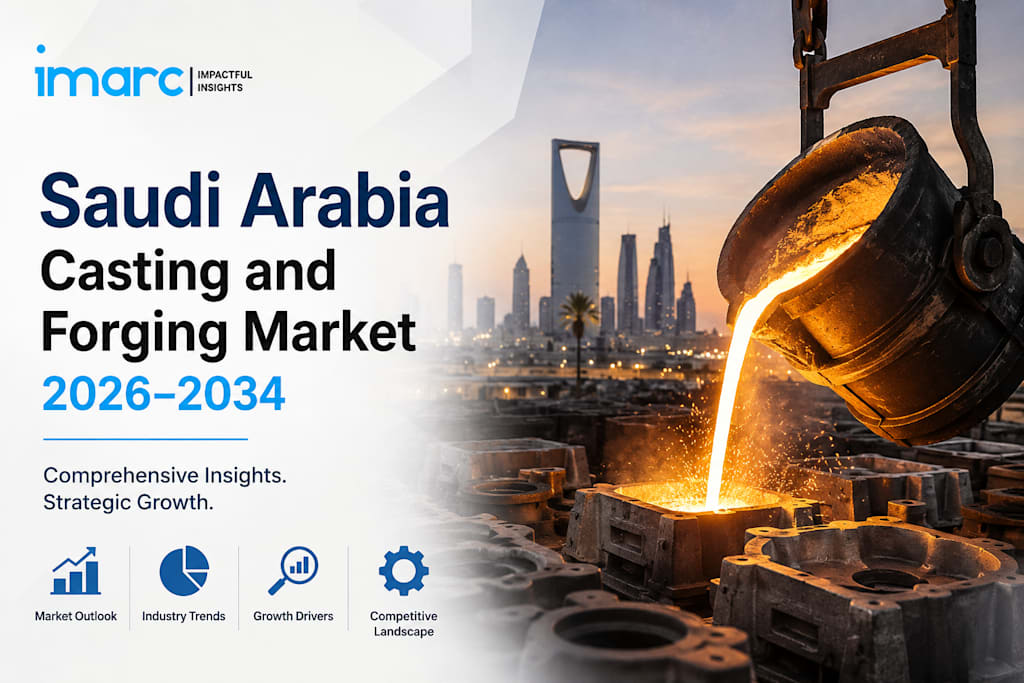
Saudi Arabia’s casting and forging market is quietly becoming one of the most strategically important industrial sectors in the Kingdom. For decades, the inability to manufacture high-stress metal components locally forced energy giants like Aramco and SABIC to rely on imports for critical equipment valves, flanges, turbine parts, ship components. That gap is now closing fast, backed by billion-dollar joint ventures, Vision 2030 industrial localization mandates, and a wave of new megaproject demand. According to IMARC Group’s latest data, The Saudi Arabia casting and forging market size reached USD 92.8 Million in 2025. Looking forward, IMARC Group expects the market to reach USD 144.5 Million by 2034, exhibiting a growth rate (CAGR) of 5.04% during 2026-2034.
The backdrop here matters. Saudi Arabia’s industrial facilities surged 60% between 2016 and 2023 rising from 7,206 to 11,549 establishments with 165 licenses specifically issued for formed metal production. This manufacturing expansion is feeding direct demand for precision-cast and forged components across the oil and gas, defense, automotive, construction, and power sectors. The market is segmented by component type (such as engine parts, valves, structural components, and others), material type (including steel, aluminum, cast iron, and others), manufacturing process (covering sand casting, investment casting, die casting, open-die forging, closed-die forging, and others), and sales channel (direct sales and distributor channels), spanning the Kingdom’s four key regions: Northern and Central, Western, Eastern, and Southern.
Saudi Arabia Casting and Forging Market Growth Drivers:
- Oil, Gas, and Petrochemical Sector Driving Baseline Component Demand
Saudi Arabia’s position as the world’s largest oil exporter creates a non-negotiable baseline demand for high-performance cast and forged components. Refineries, petrochemical plants, and gas processing facilities require forged valves, flanges, pump casings, pressure vessels, and drill bits that withstand extreme temperatures and pressures. These aren’t off-the-shelf products they’re precision-engineered, high-tolerance components where material failure is not an option. With Aramco operating over 100 oil and gas fields and SABIC running 50+ manufacturing complexes across the Kingdom, the captive demand for locally produced metal components is substantial and recurring, with procurement cycles tied directly to plant maintenance, expansion, and replacement schedules.
- Vision 2030 Infrastructure and Megaproject Wave Requiring Forged Steel
NEOM, the Red Sea Project, Qiddiya, and dozens of industrial city expansions all require structural forged steel, cast components for heavy machinery, and fabricated parts for construction equipment at a scale that Saudi Arabia has never previously attempted to manufacture domestically. The government’s National Industrial Development and Logistics Program (NIDLP) specifically targets reducing import dependence for industrial components, with more than SAR 1.7 trillion committed to industrial and infrastructure investments through the Vision 2030 framework. Essar Group’s USD 4 billion commitment to build a low-carbon steel plant in Ras Al-Khair, targeting 4 million tons of annual production, is a direct response to this structural demand shift.
- Automotive and Defense Sectors Emerging as New Demand Pillars
Two sectors that historically had minimal casting and forging footprints in Saudi Arabia are now creating meaningful new demand. The defense sector, backed by a national goal of sourcing 50% of military equipment locally by 2030, requires forged armor plates, weapon components, and vehicle chassis parts. In the automotive space, Ceer Saudi Arabia’s first electric vehicle brand secured SAR 5.5 billion in supply agreements including direct partnerships with Saudi Aluminum Casting Co. and CTR to localize aluminum casting and forging. This signals a structural shift: for the first time, domestic automakers are anchoring local casting and forging capacity as part of their supply chain strategy.
Saudi Arabia Casting and Forging Market Trends:
- World-Class Heavy Forging Capacity Coming Online for the First Time
Until recently, Saudi Arabia simply lacked the industrial infrastructure to produce large, high-stress forged components domestically. The Tuwaiq Casting & Forging Facility near Jubail a joint venture between Doosan, Dussur, and Saudi Aramco Development Company is changing that. Equipped with two high-speed open-die forging presses from Germany’s SMS Group, including a 40/45 MN press capable of processing billets up to 55 tons, the facility produces components for petrochemical plants, shipbuilding, wind farms, and power stations. With commercial operations expected in 2025, it is expected to create around 1,400 direct jobs and, for the first time, gives end users like Aramco and SABIC a local supply option for heavy fabricated components.
- Green Steel and Low-Carbon Manufacturing Entering the Investment Agenda
Sustainability is reshaping how new casting and forging capacity is being planned and financed in Saudi Arabia. Essar Group’s USD 4 billion Ras Al-Khair plant is specifically designed as a low-carbon facility, using cleaner production methods to target 4 million tons of annual steel output. This aligns with Saudi Arabia’s commitment to reach net-zero emissions by 2060 and produce 50% of its energy from renewables by 2030. For major buyers like Aramco and SABIC, the ability to source domestically produced forged components from low-carbon facilities is increasingly important for meeting supply chain sustainability targets, making green manufacturing credentials a commercial differentiator, not just a regulatory checkbox.
- Automation and Digital Process Control Lifting Precision and Productivity
Advanced automation and robotics are being built into Saudi Arabia’s newest casting and forging facilities from day one, rather than retrofitted later. The SMS Group’s digital package installed at the Tuwaiq facility provides real-time process transparency, predictive maintenance alerts, and production optimization tools that reduce labor costs and improve component consistency. Saudi Arabia’s broader industrial automation push, supported by the NIDLP program and the “Made in Saudi” initiative, is accelerating the adoption of CNC machining, digital twin modeling, and smart quality inspection across the metal fabrication sector capabilities that are pulling the local casting and forging industry toward export-grade production standards.
Recent News and Developments in Saudi Arabia Casting and Forging Market
- February 2025: Ceer, Saudi Arabia’s first electric vehicle manufacturer, secured supply agreements worth SAR 5.5 billion, including strategic partnerships with Saudi Aluminum Casting Co. and CTR to localize aluminum casting and forging operations within the Kingdom. The deals are designed to reduce automotive component import dependence and build a domestic supply chain capable of supporting Ceer’s vehicle production targets, directly in line with Vision 2030’s manufacturing localization objectives.
- 2024: Essar Group committed USD 4 billion to establish a low-carbon steel plant in Ras Al-Khair, Saudi Arabia. The facility targets annual production of 4 million tons of steel, specifically designed to meet the growing domestic demand from large-scale infrastructure and industrial projects. The investment represents one of the largest private commitments to green steel manufacturing in the Middle East to date.
Note: If you require specific details, data, or insights that are not currently included in the scope of this report, we are happy to accommodate your request. As part of our customization service, we will gather and provide the additional information you need, tailored to your specific requirements. Please let us know your exact needs, and we will ensure the report is updated accordingly to meet your expectations.
About the Creator
Shubham Sharma
Market research enthusiast sharing insights on global industries, emerging trends, growth opportunities, and data-driven analysis across diverse markets.
Enjoyed the story? Support the Creator.
Subscribe for free to receive all their stories in your feed.
Comments
There are no comments for this story
Be the first to respond and start the conversation.