
Saudi Arabia Carbon Capture and Storage Market: Decarbonization Goals, Clean Energy Transition & Growth Outlook
How ambitious net-zero and decarbonization initiatives under Vision 2030, increasing investments in industrial emissions reduction, and growing deployment of advanced carbon capture technologies are driving innovation, large-scale infrastructure development, and sustainable energy transition efforts across the Saudi Arabia Carbon Capture and Storage Market.
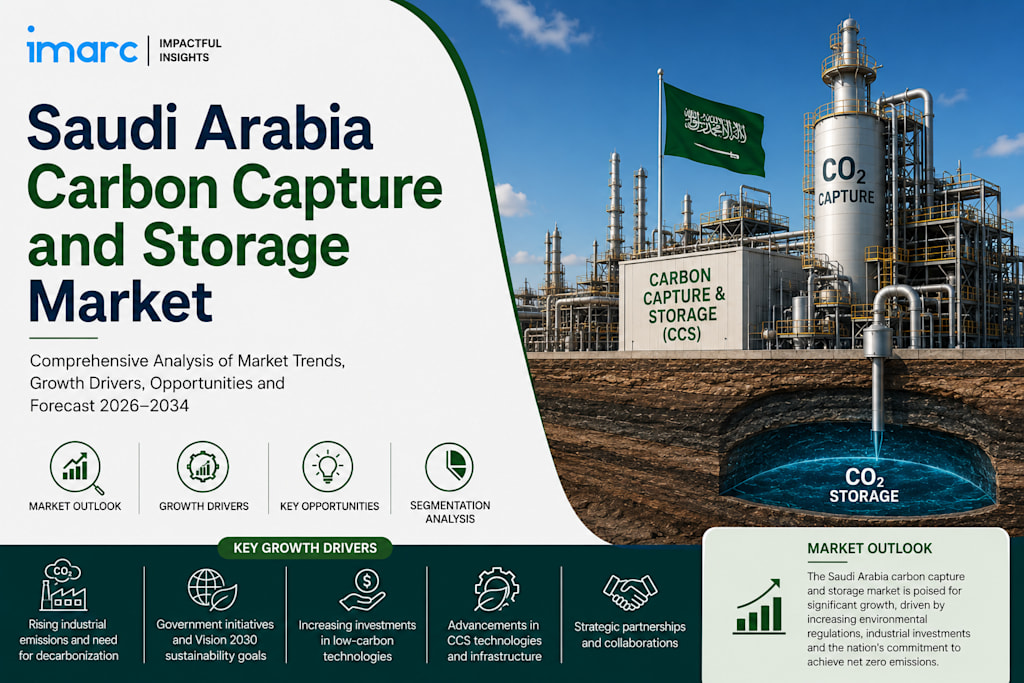
According to IMARC Group's latest research publication, Saudi Arabia carbon capture and storage market size was valued at USD 29.8 Million in 2025 and is projected to reach USD 57.9 Million by 2034, exhibiting a growth rate during 2026-2034.
How AI is Reshaping the Future of Saudi Arabia Carbon Capture and Storage Market
- Real-Time Reservoir Monitoring and Prediction: AI algorithms analyze seismic data and geological formations to predict reservoir stability and optimize CO2 injection processes, improving site selection accuracy by 10-15% while reducing storage risks and ensuring long-term sequestration integrity.
- Solvent Optimization and Capture Efficiency: Machine learning accelerates development of advanced solvents and sorbent materials, achieving 15-25% improvements in CO2 selectivity while reducing operational costs by 10-20% across capture facilities and enhancing system performance.
- Process Parameter Optimization: Deep reinforcement learning optimizes capture system variables including temperature, pressure, and flow rates, delivering 30% efficiency gains in absorption and adsorption systems while reducing energy consumption through intelligent automation and real-time adjustments.
- Predictive Maintenance and Asset Management: AI-driven monitoring systems predict equipment failures before occurrence, reducing maintenance costs and downtime in CCS facilities while enabling proactive equipment replacement and maximizing operational uptime across Jubail hub infrastructure.
- Digital Twin Technologies and System Integration: AI creates digital replicas of CCS facilities for simulation testing, accelerating design optimization and reducing capital expenditure by enabling virtual testing of configuration changes before physical implementation at massive industrial-scale operations.
How Vision 2030 is Revolutionizing Saudi Arabia Carbon Capture and Storage Industry
Vision 2030's commitment to achieving net-zero emissions by 2060 has positioned carbon capture and storage as a cornerstone technology for decarbonizing Saudi Arabia's energy-intensive industries. The Kingdom has designated carbon management as a strategic priority under its Circular Carbon Economy Initiative, deploying CCS across oil, gas, power, cement, and mining sectors. Saudi Aramco spearheaded the region's largest CCS hub in Jubail Industrial City, targeting 9 million tons annual capacity by 2027 and 44 million tons by 2035, representing a transformational shift in emissions management. In February 2025, Saudi Aramco awarded a USD 1.5 billion engineering, procurement, and construction contract to Larsen & Toubro, demonstrating massive capital commitment to industrial-scale implementation. KAUST's Saudi Centre for Vaccines and Protein Therapies represents integrated CCS research and development, while pilot projects across electricity, cement, and mining sectors with NUPCO, Al Safwa Cement, and Ma'aden validate technology viability. These coordinated efforts establish Saudi Arabia as the Middle East's emerging CCS leader, attracting international expertise and positioning the Kingdom for global competitiveness in decarbonized energy and industrial production.
Market Trends & Drivers:
Oil and Gas Industry Decarbonization Imperative
Saudi Arabia's refining sector faces mounting pressure to reduce carbon emissions while maintaining global competitiveness, making CCS deployment essential for industrial sustainability. The Kingdom operates nine refineries collectively responsible for approximately 49.5 million tons of CO2 emissions annually, with individual facilities generating 2.6 to 9.4 million tons per refinery per year. Refining represents one of the world's most energy-intensive industrial processes, requiring sustained high-temperature operations and carbon-intensive feedstocks that inherently produce substantial emissions. Traditional emission reduction approaches through efficiency improvements alone cannot achieve Vision 2030's aggressive decarbonization targets, making CCS technology indispensable for continued operations aligned with environmental goals. Saudi Aramco's Jubail hub directly addresses this challenge by capturing emissions from refining, gas processing, and power generation facilities, enabling the Kingdom's oil and gas sector to achieve emissions intensity reductions while preserving production capacity. Enhanced oil recovery utilizing captured CO2 creates economic value from captured emissions, improving project economics while providing secure permanent storage. Major petrochemical and refining operators increasingly view CCS as competitive necessity rather than environmental option, with regulatory frameworks tightening globally and carbon pricing mechanisms expanding.
Government Incentives and Infrastructure Investment
Saudi Arabia's government has mobilized unprecedented capital to establish CCS as a foundational industry pillar through direct infrastructure development and policy support mechanisms aligned with Vision 2030 objectives. The Kingdom allocated substantial funding to establish the Jubail CCS hub as a regional flagship project, demonstrating commitment to creating specialized infrastructure supporting multiple industrial operators. International partnerships with leading technology providers including SLB, Linde, and global engineering firms ensure access to best-in-class capture and storage technologies while building domestic expertise through knowledge transfer and localized workforce development. Pilot projects across electricity generation, cement production, and mining sectors validate technology applicability across diverse industrial applications, creating demonstration projects that reduce deployment risks for new entrants and operators. Government agencies including the Ministry of Energy and Saudi Aramco have established regulatory frameworks supporting CCS development, providing clarity on long-term policy direction and enabling confident investment decisions by industrial operators. Vision 2030's strategic emphasis on circular carbon economy creates integrated policy environment where CCS, renewable energy, and industrial diversification work synergistically to achieve environmental and economic objectives simultaneously.
Technology Advancement and Cost Reduction Trajectory
Rapid innovations in capture and storage technologies are dramatically improving economics and enabling broader industrial deployment across Saudi Arabia's energy-intensive sectors. Artificial intelligence and machine learning are achieving 10-20% cost reductions across solvent-based and membrane-based capture systems, with proven applications in projects like Boundary Dam and Technology Centre Mongstad demonstrating commercial viability at scale. Advanced materials development accelerated by AI-driven research is yielding metal-organic frameworks and polymeric membranes with 15-25% improvements in CO2 selectivity, reducing sorbent requirements and enabling more compact, efficient capture units. SABIC's operational carbon recovery facility, processing 500,000 tons of CO2 annually since 2015 for utilization in agriculture, food, and chemical products, demonstrates proven business models for captured carbon monetization beyond storage applications. Deep learning applications optimize seismic monitoring and geological assessment, improving storage site selection accuracy and reducing technical risks associated with long-term CO2 sequestration. Real-time monitoring systems powered by IoT sensors and advanced analytics enable predictive maintenance and operational optimization, reducing downtime and extending facility lifespans while maintaining safety and compliance standards. These converging technological trends are creating favorable conditions for expanded CCS deployment, with improving economics increasingly making carbon capture economically attractive independent of regulatory carbon pricing.
Saudi Arabia Carbon Capture and Storage Market Industry Segmentation:
The report has segmented the market into the following categories:
Service Insights:
- Capture
- Transportation
- Storage
Technology Insights:
- Post-combustion Capture
- Pre-combustion Capture
- Oxy-fuel Combustion Capture
End Use Industry Insights:
- Oil and Gas
- Coal and Biomass Power Plant
- Iron and Steel
- Chemical
- Others
Regional Insights:
- Northern and Central Region
- Western Region
- Eastern Region
- Southern Region
Competitive Landscape:
The competitive landscape of the industry has also been examined along with the profiles of the key players.
Recent News and Developments in Saudi Arabia Carbon Capture and Storage Market
- February 2025: Saudi Aramco awarded a USD 1.5 Billion engineering, procurement, and construction (EPC) contract to Larsen & Toubro's hydrocarbon division for Phase I of its Carbon Capture & Storage (CCS) hub in Jubail, Eastern Province, accelerating implementation of the Accelerated Carbon Capture & Sequestration (ACCS) initiative.
- January 2025: Saudi Arabia formally launched the Circular Carbon Economy Initiative, integrating carbon capture and storage across oil, gas, power, cement, and mining sectors, positioning the Kingdom as the regional leader in emissions reduction technologies aligned with Vision 2030 net-zero objectives.
- October 2024: King Abdullah University of Science and Technology (KAUST) advanced its Saudi Centre for Vaccines and Protein Therapies, integrating carbon management research with industrial-scale CCS demonstrations, supporting domestic expertise development and technology innovation across the Kingdom.
- September 2024: Saudi Electricity Company, Al Safwa Cement, Ma'aden, and Gulf Cryo launched pilot CCS projects in partnership with KAUST and NEOM, validating capture and storage technologies across electricity generation, cement production, and mining sectors to de-risk full-scale commercial deployment.
- August 2024: Saudi Aramco confirmed the Jubail CCS hub would achieve 9 million tons annual CO2 capture capacity by 2027, with projected expansion to 44 million tons by 2035, establishing the region's largest integrated carbon capture, utilization, and storage facility supporting multiple industrial operators.
Note: If you require specific details, data, or insights that are not currently included in the scope of this report, we are happy to accommodate your request. As part of our customization service, we will gather and provide the additional information you need, tailored to your specific requirements. Please let us know your exact needs, and we will ensure the report is updated accordingly to meet your expectations.
About the Creator
Shubham Sharma
Market research enthusiast sharing insights on global industries, emerging trends, growth opportunities, and data-driven analysis across diverse markets.
Enjoyed the story? Support the Creator.
Subscribe for free to receive all their stories in your feed.
Comments
There are no comments for this story
Be the first to respond and start the conversation.