
Saudi Arabia Bus Market: Public Transport Expansion, Fleet Modernization & Growth Outlook
How expanding public transportation networks, increasing urban mobility needs, and government investments in sustainable transit solutions are driving fleet modernization, electrification, and market growth in the Saudi Arabia bus market
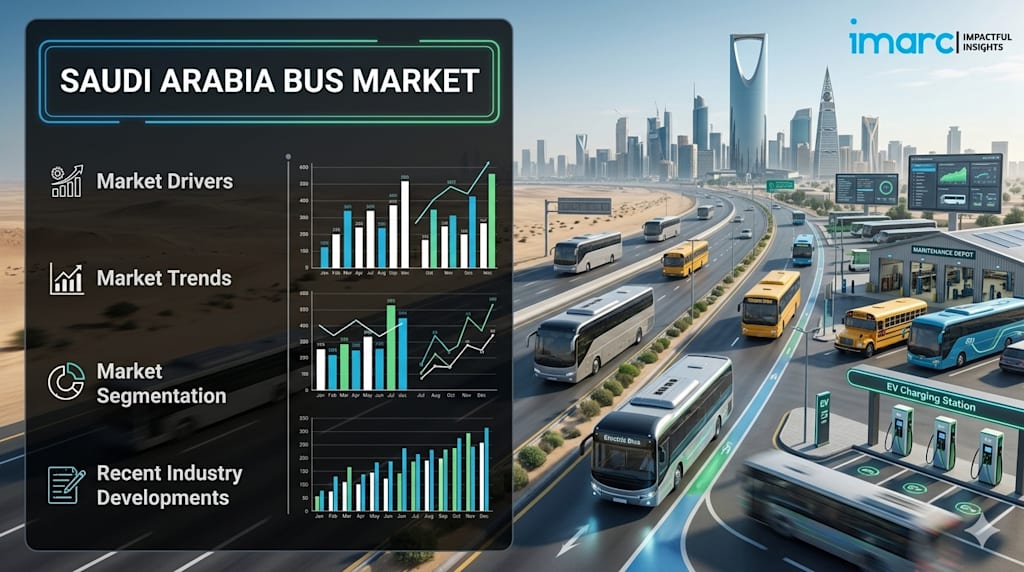
Saudi Arabia's bus market is on a strong upward trajectory, powered by a confluence of urbanization, government-led infrastructure investment, and a national push toward sustainable mobility. According to IMARC Group's latest data, The Saudi Arabia bus market size reached USD 516.0 Million in 2025. Looking forward, IMARC Group estimates the market to reach USD 976.8 Million by 2034, exhibiting a CAGR of 7.35% from 2026-2034.
The bus sector in Saudi Arabia is no longer just about moving people from point A to point B it has become a centerpiece of the Kingdom's broader economic and environmental transformation. Saudi Arabia's rapid urban growth, particularly in Riyadh, Jeddah, and Dammam, has made reliable mass transit a national priority. Cities are expanding fast, and with that comes serious pressure on roads and air quality. Buses especially electric ones are increasingly seen as the practical solution. Add to that the religious tourism factor: cities like Makkah and Madinah handle millions of Hajj and Umrah pilgrims each year, and buses remain the backbone of that movement. Operators in Jeddah, for instance, lease up to 5,000 additional buses every Ramadan season to manage the surge. That kind of recurring, high volume demand keeps the market resilient even during slower economic periods.
Saudi Arabia Bus Market Growth Drivers:
- Vision 2030 and Government Infrastructure Push
The Saudi government's Vision 2030 framework is the single biggest catalyst for bus market expansion. The plan directly ties public transport modernization to national development goals, and the numbers back it up. The Royal Commission for Riyadh City launched a USD 2.1 billion, 12-year contract with RATP Dev and SAPTCO to operate Riyadh's bus network across 103 lines with roughly 1,000 vehicles. Meanwhile, the government has allocated approximately SAR 20 billion (around USD 5.33 billion) toward public transport upgrades, with a clear mandate to shift at least 25% of urban trips to clean modes by 2030. This level of political and financial commitment is reshaping the entire market from the ground up.
- Urbanization and Population Growth Fueling Transit Demand
Saudi Arabia's urban centers are growing at a pace that private vehicles simply cannot keep up with. Riyadh alone spends an estimated SAR 21 billion annually on traffic congestion-related economic losses a figure that has made public transport investment not just an environmental choice, but a financial imperative. With Saudi Arabia's population now at approximately 38 million and climbing, cities like Jeddah and Dammam are actively scaling up bus routes and fleet sizes. City buses accounted for over 43% of all deliveries in 2024, and this is expected to grow as dense urban corridors demand frequent, high-capacity transit options that only well-run bus systems can realistically provide.
- Religious Tourism and Seasonal Demand Spikes
Saudi Arabia's role as the global center of Islamic pilgrimage creates a bus demand pattern unlike almost any other market in the world. Makkah and Madinah together receive tens of millions of visitors for Hajj and Umrah every year, and buses are the primary mode of intra-city movement for most pilgrims. SAPTCO has long operated dedicated routes to these cities, but the scale keeps growing. The government has invested in dedicated bus corridors and smart ticketing for pilgrim transport, including integrated smart-card systems that now cover the majority of trips in Riyadh. This built-in, recurring high-volume demand provides a stable revenue baseline for bus operators and keeps fleet utilization rates consistently elevated throughout the year.
Saudi Arabia Bus Market Trends:
- Electric Bus Adoption Accelerating Across Major Cities
The shift toward electric buses is moving from pilot project to mainstream procurement. SAPTCO and the Royal Commission for Riyadh City are both actively introducing EVs into their fleets, and Chinese manufacturers like BYD and Yutong are winning tenders with competitive pricing and bundled charging infrastructure. Yutong delivered its first electric bus to Jeddah in 2023, proving that high-temperature battery performance is viable in Saudi climate conditions a concern that had previously slowed electric uptake. Battery costs have fallen roughly 10% annually since 2018, and modern lithium-ion units now deliver ranges of up to 400 kilometers per charge, making electric buses genuinely practical for urban and intercity routes alike.
- Smart Technology Integration in Fleet Management
Saudi Arabia's bus operators are increasingly deploying AI and telematics to run smarter, more cost-effective fleets. Real-time tracking, predictive maintenance alerts, and AI-driven scheduling are now standard features in major urban fleet contracts. Riyadh's Intelligent Transportation System (ITS) connects buses directly with traffic signals and control centers, cutting delays and improving on-time performance. Smart card adoption has jumped to cover over four-fifths of all trips in Riyadh, making data-driven route optimization far more actionable. NEOM, the Kingdom's flagship smart city project, is designing its transit network from scratch with full digital integration setting a benchmark that other Saudi cities are expected to follow in the coming years.
- Corporate and Mandatory Employer Shuttle Market Expanding
A less-discussed but significant growth segment is the corporate shuttle market. Saudi regulations require many employers to provide staff transport, particularly in industrial and commercial zones. This has created a durable, contract-based demand stream that runs independently of public transit funding cycles. Dense clusters of petrochemical plants near Dammam and Jubail, financial hubs in Riyadh's King Abdullah Financial District, and hospitality complexes in tourism mega-projects all rely on dedicated bus fleets. Corporate shuttles are projected to grow at a compelling pace through 2030, driven by mandatory transport rules, rising employee expectations, and sustainability commitments from large organizations looking to reduce their scope 3 emissions footprint.
Recent News and Developments in Saudi Arabia Bus Market
• January 2026: Saudi Public Transport Company (SAPTCO) announced a major fleet expansion plan involving the procurement of 1,500 new buses over the next three years, including 300 electric buses for urban routes in Riyadh and Jeddah. The initiative directly supports Saudi Arabia's Vision 2030 transportation goals and represents one of the largest single fleet investment decisions in the Kingdom's public transit history.
• September 2025: The Public Transport Authority partnered with Mercedes-Benz to deploy 200 advanced intercity coaches equipped with collision avoidance systems, lane departure warnings, and driver fatigue monitoring technology. The buses are operating on key routes connecting Riyadh, Jeddah, Dammam, and other major cities, raising the bar for passenger safety and long-haul travel comfort across the Kingdom.
• August 2024: Riyadh Air introduced its first electric bus for employee transport, developed in partnership with National Transportation Solutions Co. and TAM-Europe. The zero-emission fleet now serves corporate offices and residential areas within the King Abdullah Financial District, marking an important proof of concept for electric bus operations in Saudi Arabia's demanding climate conditions.
Note: If you require specific details, data, or insights that are not currently included in the scope of this report, we are happy to accommodate your request. As part of our customization service, we will gather and provide the additional information you need, tailored to your specific requirements. Please let us know your exact needs, and we will ensure the report is updated accordingly to meet your expectations.
About the Creator
Shubham Sharma
Market research enthusiast sharing insights on global industries, emerging trends, growth opportunities, and data-driven analysis across diverse markets.
Enjoyed the story? Support the Creator.
Subscribe for free to receive all their stories in your feed.
Comments
There are no comments for this story
Be the first to respond and start the conversation.