
Saudi Arabia Building Energy Efficiency Systems Market: Smart Buildings, Sustainability Goals & Growth Outlook
How stringent sustainability goals under Vision 2030, rising energy consumption across residential and commercial buildings, and increasing adoption of smart building technologies are driving demand for advanced energy management, automation, and efficiency optimization solutions across the Saudi Arabia Building Energy Efficiency Systems Market.

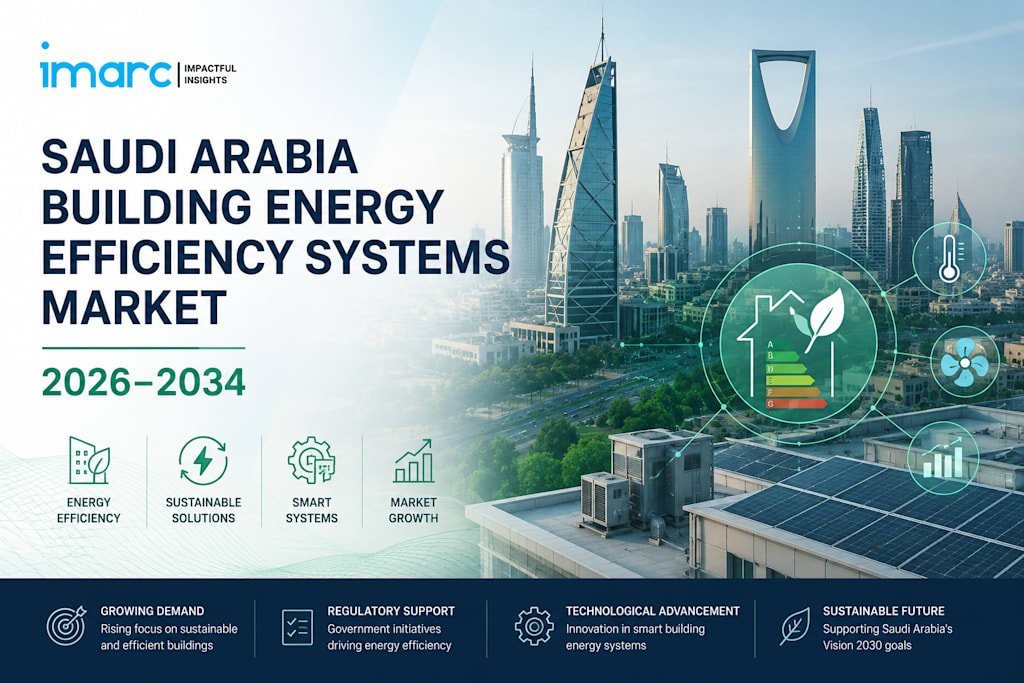
According to IMARC Group's latest research publication, Saudi Arabia building energy efficiency systems market size reached USD 3.0 Billion in 2025. The market is projected to reach USD 8.0 Billion by 2034, exhibiting a growth rate (CAGR) of 11.44% during 2026-2034.
How AI is Reshaping the Future of Saudi Arabia Building Energy Efficiency Systems Market
- AI-Powered Predictive Maintenance Systems: AI algorithms analyze real-time data from IoT sensors and building management systems to predict equipment failures before they occur, minimizing downtime by up to 40% while extending asset lifespan and reducing maintenance costs across commercial and residential facilities.
- Intelligent HVAC and Lighting Automation: Machine learning systems automatically adjust heating, ventilation, and cooling based on occupancy patterns, weather forecasts, and sensor data, reducing energy consumption by 25-30% while maintaining optimal indoor air quality and thermal comfort standards.
- Real-Time Energy Consumption Analytics: AI-driven analytics platforms monitor energy usage patterns in real-time, identifying inefficiencies and providing actionable recommendations to building managers, enabling immediate interventions that reduce electricity bills by 15-20% on average.
- Occupancy-Based Smart Controls: Advanced AI sensors detect occupancy levels throughout buildings, automatically triggering lighting adjustments, HVAC modulation, and access control systems, delivering intelligent resource allocation that cuts wasted energy in unoccupied spaces dramatically.
- Building Digital Twin Technology: AI creates virtual replicas of physical buildings enabling predictive simulation of energy performance, optimization testing, and scenario planning before implementation, accelerating energy-efficient retrofits and reducing deployment risks significantly.
How Vision 2030 is Revolutionizing Saudi Arabia Building Energy Efficiency Systems Industry
Saudi Arabia's Vision 2030 is fundamentally transforming the building energy efficiency market through transformative policy, massive infrastructure investment, and ambitious decarbonization targets. The Saudi Energy Efficiency Centre's Energy Efficiency Action Plan targets reducing power intensity by 30% by 2030, with the Saudi Building Code mandating energy-efficient technologies in all new constructions. In 2024 alone, 75 building projects covering 47 million square meters were evaluated under the Building Sustainability Assessment System—a 32% increase year-over-year—with momentum accelerating in Q1 2025 with additional 7 million square meters assessed.
Market Trends & Drivers:
- Government Incentives and Regulatory Framework Acceleration
Saudi Arabia's government initiatives are creating unprecedented momentum for building energy efficiency adoption through mandatory compliance and financial incentives. The Saudi Building Code, implemented in 2023, mandates energy-efficient design standards for all new constructions, with compliance enforced through rigorous design and construction requirements including enhanced insulation, efficient HVAC systems, and smart energy management solutions. The government provides substantial subsidies and tax credits for energy-efficient projects, making investments economically attractive for developers and building owners. The Building Sustainability Assessment System evaluated 75 projects in 2024 covering 47 million square meters, representing a 32% year-over-year increase demonstrating accelerating compliance momentum. Window air-conditioner replacement incentives offering SAR 1,000 per unit drive adoption of high-efficiency models in residential sectors. Rigorous enforcement mechanisms and transparent compliance tracking ensure consistent market participation, creating stable demand for integrated energy efficiency systems across all building categories and regions.
- Rising Demand for Sustainable and Smart Building Solutions
Market demand for sustainable and smart buildings is experiencing exponential growth driven by environmental awareness, economic benefits, and Vision 2030 commitments. Buildings account for nearly 47% of global CO₂ emissions, making energy efficiency critical for achieving Saudi Arabia's net-zero targets by 2060. Conventional buildings consume 40% of global energy while green buildings reduce energy use by approximately 50% and save around 30% of annual operating costs through optimized systems. Businesses and consumers increasingly prioritize energy-efficient structures offering lower operational expenses and enhanced comfort, reflected in growing green building certifications. Smart buildings with sophisticated IoT-integrated HVAC control, lighting automation, and building energy management systems provide enhanced operating efficiency and real-time performance monitoring. The expanding trend toward sustainable development attracts foreign investment and improves asset valuations, incentivizing property developers and facility managers to adopt advanced efficiency technologies. This shift creates sustained market expansion as stakeholders recognize both environmental responsibility and financial advantages of comprehensive energy efficiency implementations.
- Giga-Projects and Urban Development Creating Infrastructure Demand
Saudi Arabia's iconic giga-projects including NEOM, The Line, and Qiddiya are catalyzing massive demand for building energy efficiency systems through their integration of advanced smart building technologies and sustainability mandates. NEOM's 170-kilometer linear smart city incorporates digital twins for infrastructure, predictive energy management, and AI-driven building automation across all facilities. Qiddiya's entertainment, sports, and culture hub covering 334 square kilometers includes solar-integrated facades, IoT-connected HVAC systems, and real-time monitoring platforms enabling responsive, data-driven building performance. The Red Sea Project encompasses 28,000 square kilometers of sustainable tourism infrastructure requiring world-class energy efficiency systems. These coordinated developments drive procurement of building management systems, HVAC control equipment, lighting automation platforms, security and access control systems, and renewable energy integration solutions across thousands of facilities. Project timelines through 2030 create sustained investment pipelines ensuring consistent equipment demand and technology upgrades. The integration of AI-powered systems for crowd analytics, resource automation, and climate-adaptive controls establishes new standards for building efficiency that ripple across commercial, residential, and institutional sectors Kingdom-wide.
Saudi Arabia Building Energy Efficiency Systems Market Industry Segmentation:
The report has segmented the market into the following categories:
System Type Insights:
- HVAC Control Systems
- Lighting Control Systems
- Building Energy Management Systems (BEMS)
- Security and Access Control Systems
- Fire Protection Systems
- Renewable Energy Integration
Building Type Insights:
- Residential Buildings
- Commercial Buildings
- Industrial Facilities
- Government and Institutional Buildings
Deployment Mode Insights:
- On-Premises
- Cloud-Based
Technology Type Insights:
- Wired Systems
- Wireless Systems
Regional Insights:
- Northern and Central Region
- Western Region
- Eastern Region
- Southern Region
Competitive Landscape:
The competitive landscape of the industry has also been examined along with the profiles of the key players.
Recent News and Developments in Saudi Arabia Building Energy Efficiency Systems Market
- February 2025: Tarshid and King Abdulaziz Specialist Hospital launched a major energy efficiency retrofitting project in Al-Jouf covering 10 buildings with advanced upgrades including energy-efficient chillers, LED lighting, and smart controls, targeting 22% energy consumption reduction and aligning with national sustainability goals.
- April 2025: United Cement Industrial Company signed a solar energy project development agreement with Tarshid to implement a clean energy system at its factory in Al-Lith, Makkah spanning 200,000 square meters, supporting green cement production and reducing carbon emissions under Vision 2030.
- June 2025: HITEK (Farnek Group) released strategic guidance emphasizing AI-driven predictive maintenance and operations as top technology trend for Saudi FM market, highlighting how AI integration with building automation systems minimizes downtime, extends asset life, and reduces operational costs significantly.
- Q1 2025: Saudi Arabia's Building Sustainability Assessment System evaluated an additional 7 million square meters of building space, representing 64% year-on-year growth, demonstrating accelerating adoption of energy efficiency compliance and green building certifications across the Kingdom.
- December 2024: NEOM announced advancement of digital twin infrastructure and AI-driven building management systems across its 170-kilometer linear city development, integrating smart facades, IoT-connected HVAC systems, and real-time monitoring platforms enabling responsive, predictive energy management.
Note: If you require specific details, data, or insights that are not currently included in the scope of this report, we are happy to accommodate your request. As part of our customization service, we will gather and provide the additional information you need, tailored to your specific requirements. Please let us know your exact needs, and we will ensure the report is updated accordingly to meet your expectations.
About the Creator
Faisal Al-Harbi
Market research professional based in Saudi Arabia (KSA), focused on industry trends, market growth, and economic insights.
Writing data-driven articles on Saudi markets, business outlook, and Vision 2030–driven sectors.
Enjoyed the story? Support the Creator.
Subscribe for free to receive all their stories in your feed.
Comments
There are no comments for this story
Be the first to respond and start the conversation.