
Saudi Arabia Bridge Construction and Maintenance Market: Infrastructure Development, Smart Engineering & Growth Outlook
How expanding transportation infrastructure projects under Vision 2030, increasing investments in road and highway connectivity, and growing focus on the rehabilitation of aging bridge infrastructure are driving demand for advanced construction materials, smart structural monitoring systems, and sustainable maintenance solutions across the Saudi Arabia Bridge Construction and Maintenance Market.

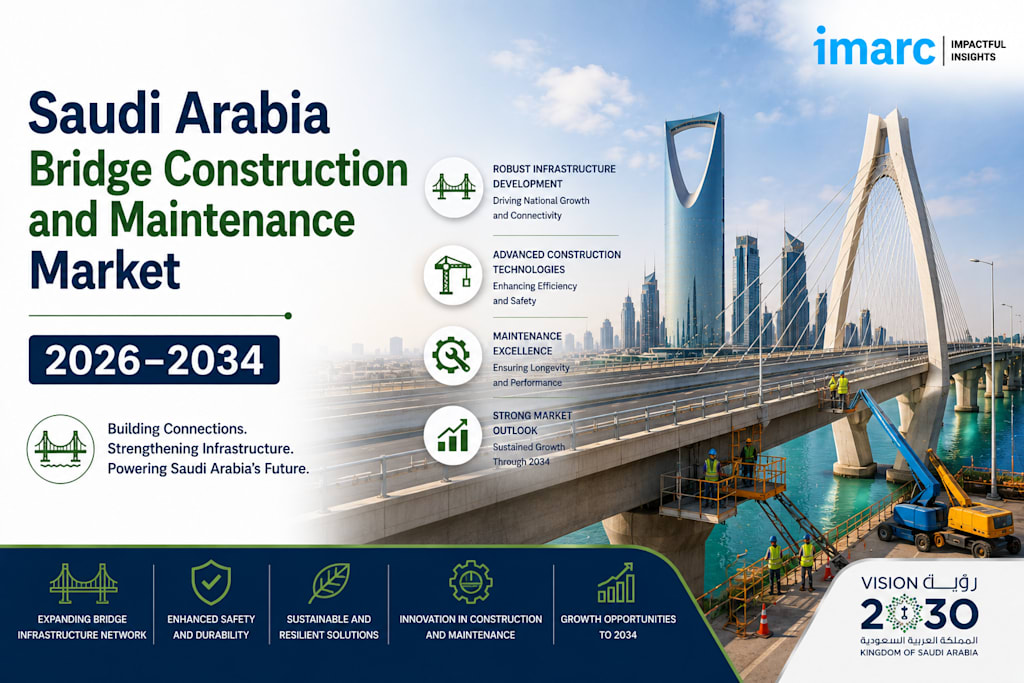
Saudi Arabia’s bridge construction and maintenance market sits at the intersection of two powerful forces: a government determined to transform the Kingdom’s physical infrastructure at unprecedented scale, and an ageing stock of existing bridges that demand systematic inspection, rehabilitation, and load-capacity upgrades. From cable-stayed crossings in Riyadh to mountainous highway corridors linking Asir to Jazan, the pipeline of work is large, complex, and growing. According to IMARC Group’s latest data, The Saudi Arabia bridge construction and maintenance market size reached USD 1,109.3 Million in 2025. Looking forward, IMARC Group expects the market to reach USD 1,670.6 Million by 2034, exhibiting a growth rate (CAGR) of 4.66% during 2026-2034.
Saudi Arabia awarded a record USD 148 billion in project contracts across its construction sector in 2024 and the total value of annual contract awards rose a further 20% to USD 196 billion in 2025. Bridge infrastructure is a direct beneficiary of this spending. The Kingdom’s market spans six bridge types beam, truss, arch, suspension, cable-stayed, and other specialized structures built with concrete, steel, composite materials, and pre-stressed structures. Applications cover roadways, railways, pedestrian bridges, and waterway crossings. Maintenance activities include structural repairs, resurfacing and coating, safety enhancements, and load capacity upgrades, distributed across four regions: Northern and Central, Western, Eastern, and Southern Saudi Arabia. Construction types are split between new bridge construction and bridge rehabilitation and retrofitting both of which are seeing active tender activity.
Saudi Arabia Bridge Construction and Maintenance Market Growth Drivers:
- Vision 2030 Megaproject Pipeline Generating Structural Bridge Demand
Saudi Arabia’s Vision 2030 infrastructure push is creating bridge construction demand that simply didn’t exist five years ago. The Asir–Jazan Highway PPP, awarded in 2025 with a 30-year DBFOM contract valued at SAR 19 billion (USD 5 billion), includes 57 bridges spanning a combined 18 kilometers across challenging mountain terrain. NEOM alone secured USD 24 billion in new contracts in 2025, with bridges integral to connectivity across THE LINE, Sindalah Island, and ENOWA. The Saudi Landbridge Railway, a USD 7 billion scheme, will require extensive viaduct and bridge structures across its 950-kilometer east-west corridor. Projects of this complexity and scale create multi-year bridge procurement cycles across new construction, structural engineering, and specialist materials supply.
- Public-Private Partnerships Unlocking Large-Scale Infrastructure Finance
Government-only procurement can’t fund the scale of bridge infrastructure Saudi Arabia needs and policymakers know it. The Kingdom is actively expanding its PPP framework to finance and deliver critical transport projects. The Asir Jazan Highway PPP attracted 69 company EOIs and saw five prequalified consortiums compete for a 30-year design-build-finance-operate-maintain contract, demonstrating deep international appetite for Saudi infrastructure. Saudi Arabia’s National Transport and Logistics Strategy targeting a top-10 Global Logistics Performance Index ranking by 2030 designates road and bridge connectivity as foundational requirements. This policy clarity gives private-sector contractors, material suppliers, and engineers the investment confidence to commit capacity for long-term project pipelines.
- Ageing Infrastructure Driving Systematic Maintenance and Rehabilitation Demand
Saudi Arabia’s existing bridge stock much of it built during rapid urbanization phases in the 1980s and 1990s is now reaching critical maintenance thresholds. The King Fahd Causeway, which carries 60,000 vehicles daily across 25 kilometers between Saudi Arabia and Bahrain, is a prime example: Egis and its partners Applus, VSL, and Trendspek were commissioned in 2024 to conduct a comprehensive structural assessment using digital twins, AI analysis, and drone-based inspection. Similar maintenance cycles are emerging for urban overpasses, highway bridges, and industrial crossings across Riyadh, Jeddah, and the Eastern Province. Load capacity upgrades to accommodate heavier freight are becoming a recurring requirement as logistics volumes grow with Vision 2030’s economic diversification.
Saudi Arabia Bridge Construction and Maintenance Market Trends:
- Digital Twin and AI-Driven Inspection Replacing Manual Assessment
The way bridges are inspected and maintained in Saudi Arabia is changing fundamentally. The Egis-led assessment of the King Fahd Causeway using AI-powered analysis, drone-based image capture, and digital twin modeling set a new benchmark for what comprehensive maintenance planning looks like in the Kingdom. Digital twins allow engineers to simulate structural behavior under load, predict failure points before they become critical, and sequence repair work to minimize traffic disruption. Saudi Arabia’s national AI spending is projected to reach USD 1.9 billion by 2027, with infrastructure and smart cities among the priority applications. This technology adoption is accelerating across both new bridge monitoring systems and the retrofitting of sensors onto existing structures.
- High-Performance and Composite Materials Gaining Adoption
Saudi Arabia’s extreme climate temperatures exceeding 45°C, salt-laden coastal air, and significant temperature differentials between day and night accelerates structural degradation and makes material specification critical. High-strength concrete, corrosion-resistant steel alloys, and fiber-reinforced polymer composite materials are increasingly being specified for new bridge projects where longevity and low maintenance cost are design priorities. Pre-stressed structures, which distribute load more efficiently across longer spans, are gaining ground in railway bridge applications as the Saudi Landbridge and Haramain High Speed Railway extensions progress. The adoption of Building Information Modeling (BIM) across major bridge contracts is also improving material optimization and reducing waste during construction.
- Railway Bridge Construction Emerging as a High-Growth Subsegment
Rail infrastructure is creating a distinct and fast-growing demand stream for bridge engineering in Saudi Arabia. The 950-kilometer Saudi Landbridge Railway connecting Jeddah to Riyadh via a mix of new and upgraded track includes multiple viaduct and bridge structures. A consortium of Italferr, Sener, and Hill International was confirmed as preferred bidder for project management services, with construction mobilization underway. In 2024, Saudi Arabia achieved a first-of-its-kind milestone by moving a container by rail from Jubail Commercial Port to Riyadh Dry Port via the Eastern Network. As rail freight volumes grow, the structural demands on railway bridges in terms of load capacity, vibration tolerance, and clearance specifications are opening specialist engineering opportunities that road bridge contracts alone cannot match.
Recent News and Developments in Saudi Arabia Bridge Construction and Maintenance Market
- May 2026: A Chinese-led consortium was confirmed as the preferred contractor for the Asir Jazan Highway PPP, one of Saudi Arabia’s most technically complex road infrastructure projects. The 136-kilometer highway includes 57 bridges totaling 18 kilometers in combined length and 11 tunnels across mountainous terrain. Structured as a 30-year DBFOM contract valued at SAR 19 billion (USD 5 billion), the project will reduce travel time between Asir and Jazan from roughly three hours to approximately 1.5 hours, strengthening logistics links to Jazan Port.
- May 2024: The Royal Commission for Riyadh City awarded a USD 1 billion (SR 4 billion) design-and-build contract to a joint venture of Turkish firm IC Ictas and Riyadh-based Al Rashid Trading & Contracting Company for upgrading the Wadi Laban cable-stayed bridge. The project also covers construction of a new intersection at Jeddah Road, aimed at easing congestion along the western ring road. The 763-meter, 35-meter-wide bridge originally built in 1997 is being expanded to accommodate Riyadh’s rapid population growth toward a projected 15–20 million residents by 2030.
- March 2024: Egis, alongside partners Applus, VSL, and Trendspek, was commissioned to conduct a comprehensive structural assessment and refurbishment planning study for the King Fahd Causeway the 25-kilometer bridge connecting Saudi Arabia to Bahrain. Built in the 1980s and carrying 60,000 vehicles daily, the causeway will be evaluated using digital twins, artificial intelligence, and drone-based inspection technology to map its condition accurately and develop a long-term maintenance plan ensuring continued safety and longevity.
Note: If you require specific details, data, or insights that are not currently included in the scope of this report, we are happy to accommodate your request. As part of our customization service, we will gather and provide the additional information you need, tailored to your specific requirements. Please let us know your exact needs, and we will ensure the report is updated accordingly to meet your expectations.
About the Creator
Shubham Sharma
Market research enthusiast sharing insights on global industries, emerging trends, growth opportunities, and data-driven analysis across diverse markets.
Enjoyed the story? Support the Creator.
Subscribe for free to receive all their stories in your feed.
Comments
There are no comments for this story
Be the first to respond and start the conversation.