
Saudi Arabia Biodegradable Packaging Market: Sustainable Materials, Eco-Friendly Solutions & Growth Outlook
How rising environmental awareness, increasing government focus on sustainable waste management, and growing demand for eco-friendly alternatives across food, retail, and consumer goods industries are driving innovation in compostable materials, recyclable solutions, and green packaging technologies across the Saudi Arabia Biodegradable Packaging Market.

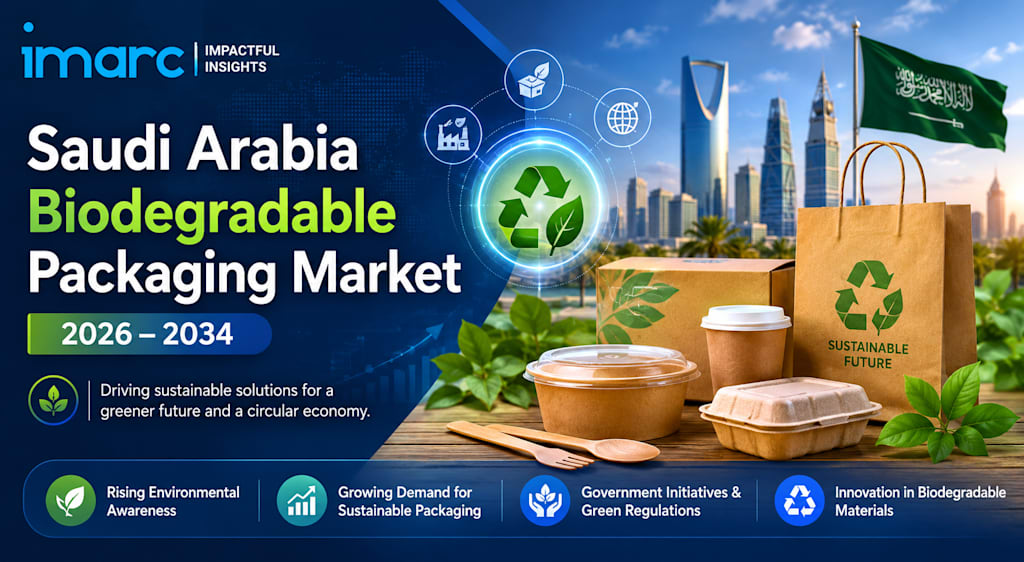
According to IMARC Group's latest research publication, Saudi Arabia biodegradable packaging market size was valued at USD 1,048.7 Million in 2025 and is projected to reach USD 1,619.9 Million by 2034, growing at a compound annual growth rate of 4.95% from 2026-2034.
How AI is Reshaping the Future of Saudi Arabia Biodegradable Packaging Market
- Automated Quality Inspection Systems: Computer vision detects packaging defects in real-time, cutting inspection time by 30% and ensuring biodegradable materials meet strict food-contact standards across Saudi manufacturing facilities.
- Smart Sorting and Recycling Optimization: Machine learning algorithms classify recyclable materials with 95% accuracy, improving waste stream separation and supporting circular economy initiatives in regional processing centers across the Kingdom.
- Predictive Material Performance Analysis: AI models test compostable packaging under varying climate conditions, predicting shelf life and durability to optimize product development specifically for Saudi Arabia's extreme temperature environment.
How Vision 2030 is Revolutionizing Saudi Arabia Biodegradable Packaging Industry
Vision 2030 is pushing a clear shift in the packaging sector, with biodegradable materials moving from niche to mainstream. The plan's focus on waste reduction, circular economy practices, and local manufacturing has tightened rules around single-use plastics and encouraged alternatives that break down naturally. The National Center for Waste Management aims to divert 94% of waste generated in Riyadh away from landfills and compost more than 1.3 million tons of biodegradable waste by 2035. The Saudi Investment Recycling Company, backed by the Public Investment Fund, is spearheading transformation with projects across 65 cities, projected to process 35 million tons per annum while reducing CO2 emissions by 4.1 million tons. The government is promoting biodegradable packaging through regulations, public procurement preferences, and extended producer responsibility programs. The Kingdom has committed investing USD 27 billion by 2035 to divert over 90% of waste from landfills and promote a sustainable future, creating 77,000 jobs and adding USD 32 billion to the national economy.
Saudi Arabia Biodegradable Packaging Market Trends & Drivers:
The market is experiencing steady growth driven by comprehensive regulatory frameworks targeting single-use plastic reduction. The Ministry of Environment, Water and Agriculture announced stringent new rules in September 2025 for packaging and labeling of fruits and vegetables, mandating food-grade, durable designs that ensure freshness while promoting environmental sustainability aligned with Vision 2030. The Saudi Standards, Metrology and Quality Organization's ongoing alignment with Gulf Cooperation Council technical regulations is establishing unified biodegradability certification protocols that facilitate cross-border trade while eliminating ambiguous green marketing claims. Extended producer responsibility schemes are being developed, where manufacturers become responsible for the lifecycle of their products. These regulatory developments align with the Kingdom's G20 commitments on marine plastic pollution and create predictable policy environments that justify capital investments in biodegradable packaging conversion equipment.
The expansion of modern retail formats and food service channels is driving standardized adoption of sustainable packaging systems aligned with corporate environmental commitments. Retailers, food service companies, and FMCG brands are responding quickly, with many replacing conventional plastic with paper-based, starch-based, and plant-derived packaging to stay aligned with new compliance norms and consumer expectations. The proliferation of international hypermarket chains, convenience store networks, and quick-service restaurant brands throughout Saudi Arabia's urban centers creates volume thresholds that improve biodegradable packaging economics through bulk purchasing while establishing consumer expectations for environmental responsibility. Public awareness campaigns tied to sustainability goals are also shaping buying habits, with shoppers paying more attention to packaging choices. The Kingdom's abundant date palm residues from its position as the world's second-largest date producer are increasingly being valorized into biodegradable packaging feedstocks through emerging biorefinery initiatives.
Mega-tourism projects, particularly The Red Sea Development and NEOM's sustainable city concepts, are establishing biodegradable packaging as a differentiating amenity within premium hospitality experiences. NEOM's Oxagon, designed as the world's largest floating industrial complex, embodies the Kingdom's vision for regenerative, closed-loop urban and industrial ecosystems, combining Industry 4.0 and advanced circular economy technologies to establish a zero-waste environment. Fairmont The Red Sea, featuring 193 rooms and six dining concepts, is planned to open in May 2026 with comprehensive sustainability credentials extending to guest-facing materials including food service ware and retail shopping bags. These developments mandate certified compostable alternatives for in-room dining and event catering applications, creating demonstration effects that influence broader consumer expectations. Smart packaging technologies reached USD 252 million, with continued momentum tied directly to Vision 2030's digital transformation push, as digital sellers embed QR-based returns labels on paperboard mailers.
Saudi Arabia Biodegradable Packaging Market Industry Segmentation:
The report has segmented the market into the following categories:
Material Type Insights:
- Plastic
- Starch-based Plastics
- Cellulose-based Plastics
- Polylactic Acid (PLA)
- Poly-3-Hydroxybutyrate (PHB)
- Polyhydroxyalkanoates (PHA)
- Others
- Paper
- Kraft Paper
- Flexible Paper
- Corrugated Fiberboard
- Boxboard
Application Insights:
- Food Packaging
- Beverage Packaging
- Pharmaceutical Packaging
- Personal/Homecare Packaging
- Others
Food packaging leads with a share of 42.93% of the total Saudi Arabia biodegradable packaging market in 2025.
Regional Insights:
- Northern and Central Region
- Western Region
- Eastern Region
- Southern Region
Northern and Central Region exhibits a clear dominance with a 28% share of the total Saudi Arabia biodegradable packaging market in 2025.
Competitive Landscape:
The competitive landscape of the industry has also been examined along with the profiles of the key players.
Recent News and Developments in Saudi Arabia Biodegradable Packaging Market
- January 2026: Polymeron, a startup from KAUST, converted date palm and agricultural waste into high-quality biodegradable plastics, supporting localized production and advancing national sustainability goals through innovative biorefinery techniques that upcycle Saudi Arabia's signature agricultural byproducts.
- September 2025: The Ministry of Environment, Water and Agriculture (MEWA) declared stringent new rules for packaging and labeling of fruits and vegetables available in local markets, bolstering national initiatives to guarantee food safety, promote environmental sustainability, and align with Vision 2030.
- August 2025: Napco National acquired Arabian Flexible Packaging, strengthening its regional footprint while advancing circular economy initiatives through Dubai-based operations, integrating expertise in rotogravure printing and diverse biodegradable substrates including polypropylene, polyester, and paper.
Note: If you require specific details, data, or insights that are not currently included in the scope of this report, we are happy to accommodate your request. As part of our customization service, we will gather and provide the additional information you need, tailored to your specific requirements. Please let us know your exact needs, and we will ensure the report is updated accordingly to meet your expectations.
About the Creator
Faisal Al-Harbi
Market research professional based in Saudi Arabia (KSA), focused on industry trends, market growth, and economic insights.
Writing data-driven articles on Saudi markets, business outlook, and Vision 2030–driven sectors.
Enjoyed the story? Support the Creator.
Subscribe for free to receive all their stories in your feed.
Comments
There are no comments for this story
Be the first to respond and start the conversation.