
Saudi Arabia Biocatalyst Market: Green Chemistry, Industrial Biotechnology & Growth Outlook
How growing demand for sustainable and eco-friendly production processes, increasing adoption of enzyme-based catalysis in pharmaceuticals and chemicals, and advancements in biotechnology are driving innovation, efficiency, and green chemistry solutions in the Saudi Arabia biocatalyst market
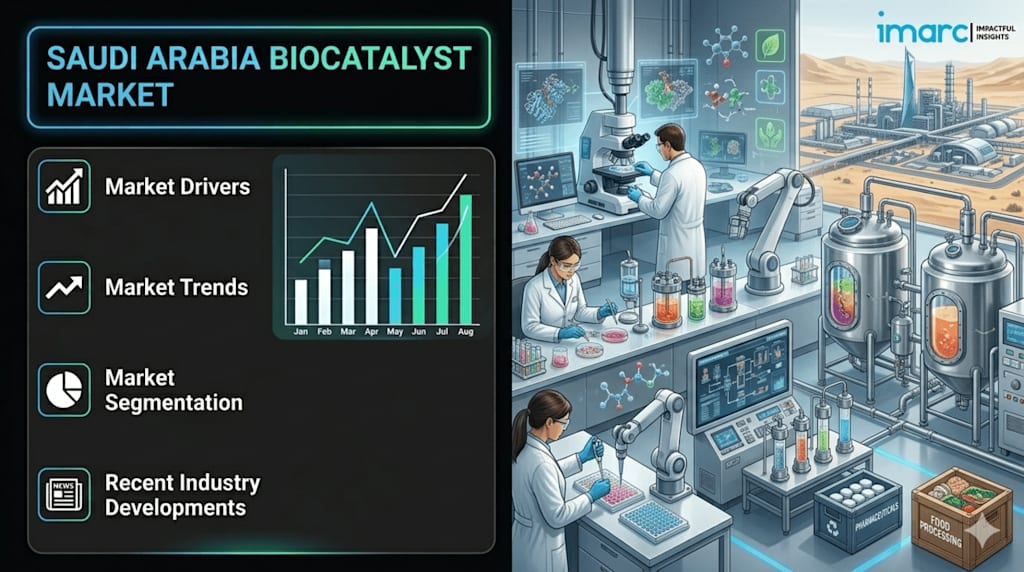
Saudi Arabia's growing biotechnology sector, backed by Vision 2030 and rising clean energy ambitions, is driving steady demand for biocatalysts across pharmaceuticals, food processing, and biofuel production. According to IMARC Group's latest data, the Saudi Arabia biocatalyst market size reached 1,507.6 Kilo Tons in 2025. Looking forward, IMARC Group expects the market to reach 2,252.0 Kilo Tons by 2034, exhibiting a growth rate (CAGR) of 4.56% during 2026-2034. Targeted investments, supportive policy, and surging demand for enzyme-based biofuels are the primary forces shaping the Saudi Arabia biocatalyst market share.
Saudi Arabia Biocatalyst Market Growth Drivers:
- National Biotechnology Strategy and Government Policy Momentum
In January 2024, Saudi Arabia launched its National Biotechnology Strategy with a clear ambition: lead the MENA biotech space by 2030 and rank globally by 2040. The strategy targets vaccines, biomanufacturing, genomics, and plant optimization, and is expected to create 11,000 jobs while contributing SAR 130 billion to non-oil GDP. The Saudi Food and Drug Authority reorganized its internal structure in September 2024 to dedicate new divisions specifically to biotechnology fields. For biocatalyst producers, this kind of top-level regulatory commitment translates directly into procurement priority, local R&D funding, and a more reliable path to commercialization across pharmaceutical and industrial applications.
- Biofuel Production Scaling Up Enzyme Demand
As Saudi Arabia pushes to diversify its energy mix, biofuels have moved from policy aspiration to active investment. Saudi Arabia's biodiesel market was valued at USD 424.1 million in 2024 and is projected to reach USD 694.4 million by 2033. Enzymes, particularly hydrolases and oxidoreductases, are essential to this process, enabling efficient biomass-to-fuel conversion at lower environmental cost than conventional chemical routes. The Saudi government's commitment to generating 50% of electricity from renewables by 2030 is also pulling investment into adjacent green chemistry processes, directly expanding the commercial case for high-performance industrial biocatalysts.
- Venture Capital Inflows and Global Biotech Partnerships
Private and international capital is flowing into Saudi biotech at a scale that directly supports biocatalyst market expansion. A standout example is the 2024 MoU between Saudi Arabia and Vertex Pharmaceuticals, targeting local gene therapy manufacturing with intended investments of up to SAR 1 billion. The Saudi biotechnology market overall was valued at USD 7,067 million in 2024, with projections pointing toward USD 11,604 million by 2033. These partnerships do more than bring money — they bring enzyme engineering know-how, biomanufacturing infrastructure, and talent development pipelines that are accelerating the practical deployment of biocatalysts across pharmaceuticals and industrial sectors.
Saudi Arabia Biocatalyst Market Trends:
- Enzyme Innovation in Food and Beverage Processing
Saudi food manufacturers are increasingly swapping synthetic additives for enzyme-based processing aids. Amylases, proteases, and lipases are being used in bakery, dairy, and juice processing to improve texture, extend shelf life, and produce cleaner labels. With food wastage in Saudi Arabia estimated at SAR 40 billion annually, Vision 2030's target of a 50% reduction in food loss by 2030 is channelling investment into enzyme-driven supply chain efficiency. The Saudi enzymes market reached USD 132.1 million in 2025, with the food and beverage segment leading application demand. Novozymes, BASF, and DSM-Firmenich are among the key international suppliers actively serving this growth.
- AI-Assisted Enzyme Engineering Reaching Industrial Scale
Enzyme performance is no longer limited by what nature produces. In July 2024, BASF, in collaboration with the University of Graz and the Austrian Research Centre of Industrial Biotechnology, developed a computer-assisted enzyme optimization model that accelerates the design of biocatalysts with improved stability and reaction efficiency. This kind of AI-driven directed evolution is directly relevant to Saudi Arabia's industrial needs, where enzymes must perform reliably under extreme temperatures. As local biotech infrastructure matures under the National Biotechnology Strategy, Saudi producers are beginning to adopt these computational tools to develop customized enzyme solutions for refining, chemical manufacturing, and wastewater treatment.
- Microorganism-Derived Biocatalysts Dominating Industrial Applications
Microbial enzymes hold the largest share of the global industrial biocatalyst market, accounting for over 62% of revenue, because of their broad substrate range, scalability, and cost efficiency relative to plant- or animal-derived alternatives. In Saudi Arabia, this trend is amplified by the country's investment in fermentation-based biomanufacturing. The Kingdom's push to build local bioproduction capacity, backed by the National Biotechnology Strategy and private-sector partnerships, is making microbial biocatalysts the default choice for large-scale food processing, biofuel production, and pharmaceutical synthesis. Companies like Advanced Enzyme Technologies and Novus International are expanding regional footprints to serve this growing microorganism-derived demand.
Recent News and Developments in Saudi Arabia Biocatalyst Market
- January 2024: Saudi Arabia formally launched its National Biotechnology Strategy, setting out a roadmap to become a MENA biotech hub by 2030 and a global leader by 2040. The strategy covers vaccines, biomanufacturing, genomics, and plant optimization, with a target of creating 11,000 jobs and contributing SAR 130 billion to non-oil GDP — directly positioning biocatalysts as a foundational technology for the Kingdom's economic transformation.
- 2024 (MoU): Saudi Arabia signed a Memorandum of Understanding with Vertex Pharmaceuticals to establish gene therapy manufacturing in the Kingdom, with investments of up to SAR 1 billion. The agreement focuses on R&D, biomanufacturing capabilities, and talent development, reinforcing Saudi Arabia's goal of becoming a world-class biotechnology hub and significantly expanding domestic demand for enzyme and biocatalyst-based processes.
- July 2024: BASF, in collaboration with the University of Graz and the Austrian Research Centre of Industrial Biotechnology, launched a computer-assisted enzyme optimization model. This AI-driven tool dramatically accelerates the design of high-performance, stable biocatalysts for industrial applications, representing a major advancement in enzyme engineering that is already influencing procurement strategies of large-scale industrial producers operating in the Saudi market.
- September 2024: The Saudi Food and Drug Authority restructured its organization to establish dedicated biotechnology divisions across food, medicine, medical devices, and research lab sectors. The restructure directly reflects the National Biotechnology Strategy's goals and is expected to streamline regulatory approvals for biocatalyst-based products, reducing time-to-market for both domestic producers and international companies seeking to expand in Saudi Arabia.
- March 2024: Novus International acquired BioResource International to develop enzyme-based feed solutions, signalling growing global corporate appetite for enzyme businesses with Middle East exposure. The deal highlights how established animal nutrition players are positioning biocatalysts as a strategic priority, with Saudi Arabia's expanding poultry and livestock sectors representing a high-growth end market for feed enzyme products.
Note: If you require specific details, data, or insights that are not currently included in the scope of this report, we are happy to accommodate your request. As part of our customization service, we will gather and provide the additional information you need, tailored to your specific requirements. Please let us know your exact needs, and we will ensure the report is updated accordingly to meet your expectations.
About the Creator
Shubham Sharma
Market research enthusiast sharing insights on global industries, emerging trends, growth opportunities, and data-driven analysis across diverse markets.
Enjoyed the story? Support the Creator.
Subscribe for free to receive all their stories in your feed.
Comments
There are no comments for this story
Be the first to respond and start the conversation.