
Saudi Arabia Automotive Windshield Glass Market: OEM Expansion, Aftermarket Demand & Technology Trends
How rising vehicle production, increasing replacement demand, and advancements in laminated safety glass are driving growth in the Saudi Arabia automotive glass for windshield market.

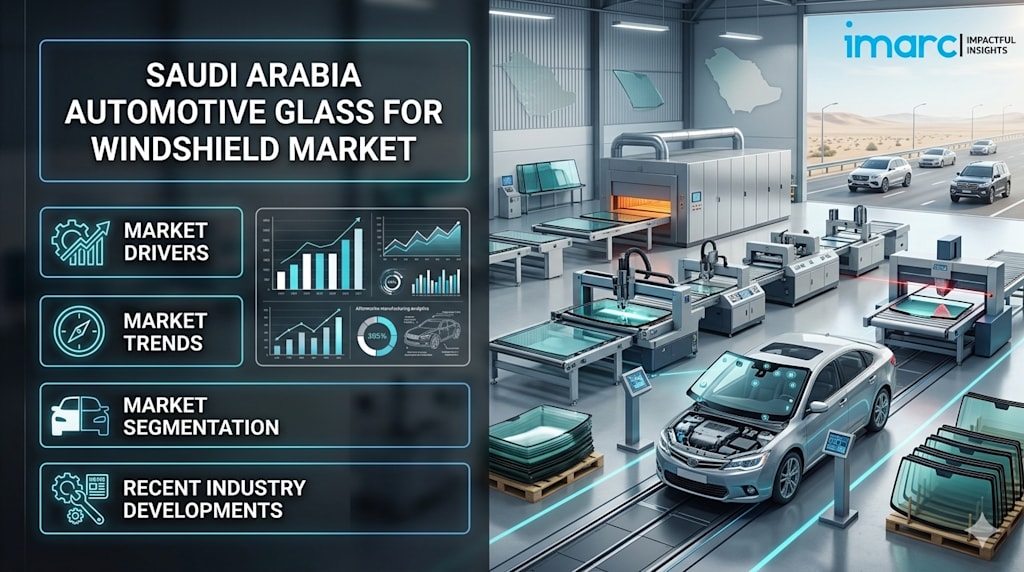
Steady growth in vehicle production and sales, accelerating adoption of advanced driver assistance systems, and rising consumer appetite for electric and luxury vehicles are together reshaping the demand landscape for high-performance windshield solutions across the Kingdom. According to IMARC Group's latest data, the Saudi Arabia automotive glass for windshield market size reached USD 319.8 Million in 2025. Looking forward, IMARC Group expects the market to reach USD 620.2 Million by 2034, exhibiting a growth rate (CAGR) of 7.64% during 2026-2034. supported by Vision 2030-aligned automotive localization programs, evolving safety regulations, and breakthrough developments in smart glass and ADAS-integrated windshield technologies.
The Saudi Arabian auto industry is becoming more concerned with the inclusion of advanced safety features, such as advanced driver assistance systems (ADAS). Moreover, the steady increase in auto production and sales is bolstering the market growth. This trend, along with the heightened interest in electric vehicles (EVs) and luxury cars, is expanding the Saudi Arabian automotive glass for windshield market share.
Saudi Arabia Automotive Glass for Windshield Market Growth Drivers:
- Steady Increase in Vehicle Production and Sales
Saudi Arabia is witnessing consistent expansion in both vehicle manufacturing capacity and consumer purchasing activity, creating a direct and proportional rise in demand for automotive windshields across OEM and aftermarket channels. The Kingdom's Vision 2030 economic diversification agenda is channeling substantial investment into automotive manufacturing plants and actively encouraging international automakers to localize production within the country. Rising urban development, improving disposable incomes across the population, and widely available vehicle financing options are simultaneously fueling car ownership rates, particularly among younger demographics in major cities such as Riyadh, Jeddah, and Dammam. Government policies including reduced import duties on automotive components are further strengthening the competitiveness of locally assembled vehicles. As new models tailored specifically to Saudi market preferences enter showrooms, both OEM windshield procurement and aftermarket replacement activity are expanding, prompting glass suppliers and distributors to extend their networks across the Kingdom to capture growing service demand.
- Growing Emphasis on Advanced Driver Assistance Systems (ADAS) Integration
The Saudi Arabian automotive industry is placing increasing priority on the inclusion of advanced safety technologies, with ADAS emerging as a central requirement in both new vehicle platforms and premium aftermarket upgrades. Systems such as lane departure warning, forward collision avoidance, automatic emergency braking, and adaptive cruise control depend on sensors, cameras, and radar units that are mounted within or directly adjacent to the windshield. This technical dependency is driving demand for high-performance laminated glass with exceptional optical clarity, structural rigidity, and precise calibration compatibility. Automakers are collaborating closely with automotive glass manufacturers to ensure that windshields can house and support these sensor arrays without compromising safety performance or driver visibility. In February 2025, Ceer, Saudi Arabia's first electric vehicle original equipment manufacturer, entered into a strategic cooperation with Isoclima, a globally recognized provider of high-performance transparent solutions for premium automotive brands. The partnership is focused on introducing new benchmarks in automotive glass innovation, including the development of the world's largest windshield, which will serve as a defining design feature in Ceer's flagship sedan and SUV lineup.
- Rising Demand for Electric Vehicles and Luxury Automobiles
The accelerating adoption of electric vehicles and the sustained appetite for luxury automobiles in Saudi Arabia are creating a distinct and high-value demand channel within the Saudi Arabia Automotive Glass for Windshield Market. Electric vehicles and premium cars place significantly more demanding specifications on windshield design, requiring features such as thermal insulation to support battery efficiency, acoustic laminated glass for enhanced cabin quietness, heads-up display compatibility, and solar-reflective coatings to manage interior temperatures in the Kingdom's extreme climate. Luxury brands are actively deepening their presence in Saudi Arabia in response to rising affluence and evolving consumer lifestyle preferences, while the government's investment in electric vehicle charging infrastructure is broadening EV accessibility across urban centers. IMARC Group projects that the Saudi Arabia luxury car market is set to reach USD 6.8 Billion, a trajectory that directly amplifies demand for bespoke, technologically advanced windshield solutions that match the engineering and aesthetic standards of high-end vehicle platforms.
Saudi Arabia Automotive Glass for Windshield Market Trends:
- Accelerating Adoption of Laminated and Smart Glass Technologies
Laminated glass is rapidly becoming the preferred windshield material across passenger cars and commercial vehicles in Saudi Arabia, driven by its superior safety profile compared to tempered alternatives. Unlike tempered glass, laminated variants hold together upon impact rather than shattering, substantially reducing injury risk in collision scenarios. Beyond passive safety, the integration of smart glass technologies including electrochromic tinting, embedded heating elements for defogging, and UV or infrared blocking coatings is gaining commercial traction among premium vehicle buyers and fleet operators. These innovations are particularly relevant in the Saudi context, where extreme heat and intense solar radiation create practical daily demand for glass solutions that actively manage cabin temperatures and protect vehicle interiors, making technologically enhanced windshields a functional necessity rather than a discretionary upgrade.
- Expansion of Aftermarket Distribution Networks
The growing vehicle parc across Saudi Arabia is generating substantial and sustained demand within the aftermarket segment of the windshield market. As the total number of registered vehicles in circulation increases, the need for replacement glass following accidents, sand abrasion, stone impact, and general wear expands proportionally. Aftermarket glass providers are responding by broadening their geographic coverage, establishing service centers in secondary cities and industrial zones beyond the traditional retail hubs. The widespread availability of roadside assistance programs, insurance-linked replacement schemes, and rapid mobile fitting services is making windshield replacement more accessible and affordable for a larger segment of vehicle owners, reinforcing aftermarket revenue streams alongside OEM procurement growth.
- Localization of Automotive Supply Chains Under Vision 2030
A structural shift is underway in the Saudi automotive components industry, with Vision 2030 placing explicit emphasis on building domestic manufacturing capabilities across the automotive value chain. The Made in Saudi initiative and related industrial localization policies are incentivizing both domestic and international automotive glass manufacturers to consider in-Kingdom production investments. This trend is reducing dependence on imported windshield glass, shortening supply chains, and creating opportunities for local value addition across glass processing, coating application, and finished product assembly. As Saudi Arabia continues to position itself as a regional automotive manufacturing hub, the localization of windshield glass production is expected to become an increasingly important competitive consideration for suppliers seeking long-term procurement contracts with automakers operating in the Kingdom.
Recent News and Developments in the Saudi Arabia Automotive Glass for Windshield Market:
- April 2026: Xinyi Glass signs agreement with MODON to build a USD 386 million flagship production base spanning over 350,000 sqm, introducing advanced float and automotive glass lines as Saudi Arabia’s first dedicated windshield manufacturer.
- March 2026: Ceer partners with Isoclima to develop record-breaking large windshields up to 1.5 meters for its EV sedans and SUVs, incorporating high-performance transparent solutions and solar-reflective coatings.
- February 2026: Leading manufacturers deploy AI-powered design software and inspection cameras, reducing new windshield development time by 16% and production defects by 20% for superior clarity and heat resistance.
- January 2026: Local producers advance acoustic laminated and HUD-compatible windshields with sensor integration for ADAS, enhancing safety, noise reduction, and compatibility with next-generation connected vehicles.
- December 2025: Ceer collaborates with global partners on smart glass technologies featuring embedded antennas and thermal management features, supporting EV battery efficiency and driver visibility in desert conditions.
Note: If you require specific details, data, or insights that are not currently included in the scope of this report, we are happy to accommodate your request. As part of our customization service, we will gather and provide the additional information you need, tailored to your specific requirements. Please let us know your exact needs, and we will ensure the report is updated accordingly to meet your expectations.
About the Creator
Kishan Kumar
My name is Kishan Roy and I am a market analyst having 5 years of experience and a skilled researcher with a keen eye for consumer trends and data-driven insights.
Enjoyed the story? Support the Creator.
Subscribe for free to receive all their stories in your feed.
Comments
There are no comments for this story
Be the first to respond and start the conversation.