
Saudi Arabia Automotive HMI Market: Connected Vehicles, Digital Cockpits & Growth Outlook
How rising adoption of connected and autonomous vehicle technologies, increasing consumer demand for enhanced in-vehicle experiences, and advancements in AI-driven infotainment and digital cockpit systems are driving innovation in touchscreens, voice recognition, and smart interface solutions across the Saudi Arabia Automotive HMI Market.

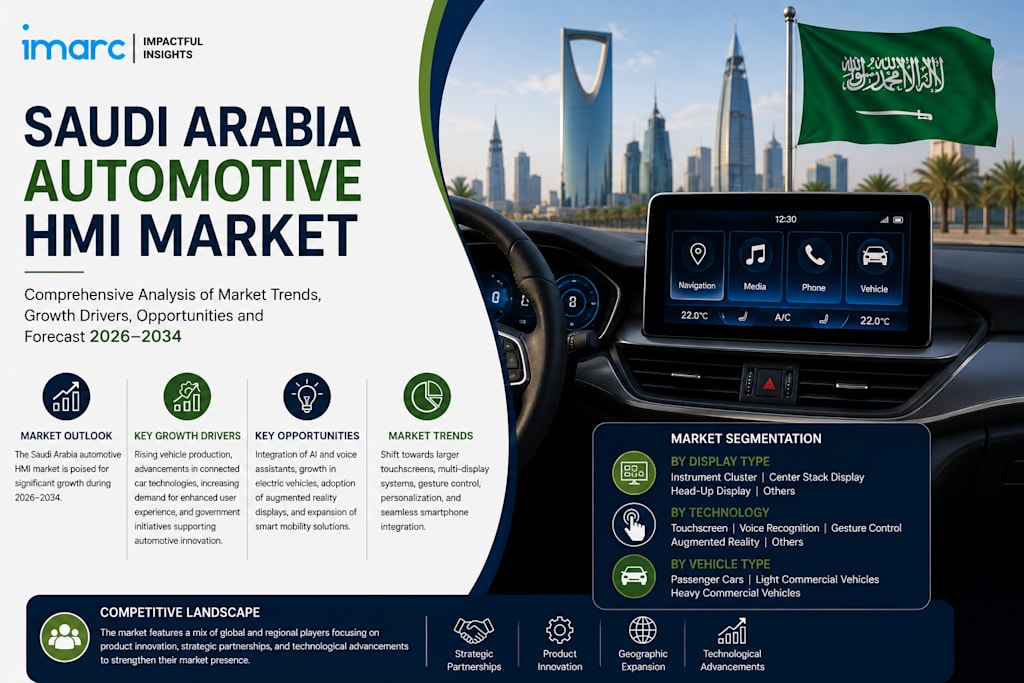
The way drivers interact with their vehicles has changed dramatically over the past decade and Saudi Arabia is right at the heart of that shift. Touchscreens, digital clusters, voice controls, and augmented reality head-up displays are no longer premium differentiators. They’re becoming standard expectations, even in mass-market models. As Vision 2030 accelerates automotive sector growth and international brands deepen their presence in the Kingdom, the demand for sophisticated in-vehicle interfaces is climbing fast. According to IMARC Group’s latest data, the Saudi Arabia automotive HMI market size was valued at USD 237.1 Million in 2025. Looking forward, IMARC Group estimates the market to reach USD 484.1 Million by 2034, exhibiting a CAGR of 8.26% from 2026-2034. Instrument clusters lead product demand at 38%, standard access type holds 63%, visual interface dominates technology at 50%, passenger cars account for 68% by vehicle type, and the Northern and Central Region tops regional demand at 30% all in 2025.
What’s particularly interesting about this market is how much of the growth is being pulled from multiple directions at once. Rising vehicle ownership, a growing young population with high technology expectations, the expansion of female driving, and an influx of international brands all point in the same direction. Saudi Arabia’s best-selling cars the Hyundai Accent at 19,081 units and the Kia Pegas at 15,528 units show that even affordable, high-volume models are now expected to come with connected touchscreen interfaces as standard. That’s the kind of baseline shift that sustains long-term market demand.
Saudi Arabia Automotive HMI Market Growth Drivers:
- Accelerating Digital Transformation in the Automotive Sector
Saudi Arabia’s automotive industry isn’t just growing it’s going through a genuine technology shift. Manufacturers are deploying computing platforms capable of running AI applications, supporting over-the-air updates, and handling multiple interface layers simultaneously. Kia’s launch of Kia Connect in Saudi Arabia, offering over 50 connected features including remote control, digital key, geo-fence alerts, and live map updates, is a clear sign of where the whole segment is heading. Each new model that enters the market raises the digital bar for competitors, driving sustained investment in HMI innovation across the board.
- Rising Consumer Expectations for Connected In-Vehicle Experiences
Saudi consumers are among the most digitally connected in the region, and they bring those expectations straight into the showroom. With smartphone penetration high and digital services deeply embedded in daily life, buyers want their car’s interface to feel like an extension of their phone not a separate, clunky system. Seamless navigation, entertainment, communication, and vehicle management through a single intuitive interface has become a purchase decision factor, not just a feature. Automakers who can’t match that experience are increasingly losing ground to those who can.
- Government Support for Automotive Industry Development
Vision 2030 isn’t just a branding exercise it’s creating real structural change in how the Kingdom’s automotive market operates. The Ministry of Investment, NIDC, Stellantis, and Petromin signed an MoU to explore full vehicle manufacturing inside Saudi Arabia, covering both passenger and commercial models across Stellantis’ brand range. When vehicles are assembled locally, the procurement of HMI components and technology integration happens locally too. Smart city development, road network expansion, and electric vehicle infrastructure further amplify demand for advanced human-machine interface systems throughout the ecosystem.
Saudi Arabia Automotive HMI Market Trends:
- Integration of Voice-Activated Control Systems
Voice control has moved from a novelty to a genuine usability priority, particularly as drivers want to keep their hands on the wheel across the Kingdom’s expanding road networks. Genesis took this seriously with its Connected Services platform launch in Saudi Arabia, which includes enhanced Arabic voice navigation and real-time system updates. The Arabic-language capability matters it signals that global brands are investing in genuine localization, not just translated menus. As voice recognition accuracy improves and natural language processing becomes more contextually aware, this will become one of the most-used features in everyday driving.
- Expansion of Augmented Reality Head-Up Displays
AR head-up displays are making real inroads in the Saudi market, and the launches tell the story well. Volkswagen introduced the third-generation Tiguan in Saudi Arabia featuring a 15-inch head-up display with AR navigation and an advanced digital cockpit, integrating live driving data directly into the driver’s line of sight. The appeal is clear: you get navigation guidance, hazard alerts, and speed information without ever looking away from the road. As more brands bring AR-equipped models to the Kingdom, consumer familiarity and demand will only accelerate adoption across vehicle segments.
- Growing Emphasis on Personalized User Experiences
Personalization is quickly becoming the differentiator that separates premium HMI experiences from generic ones. BMW Group KSA implemented AI-driven personalization tools designed to tailor digital customer engagement and in-vehicle settings for Saudi drivers, adjusting features based on individual user data and preferences. These systems go well beyond saved seat positions they adapt display layouts, climate preferences, music suggestions, and navigation habits based on who is driving. As AI processing capability in vehicles improves, the expectation that a car “knows” its driver will shift from luxury promise to mainstream reality.
Recent News and Developments in Saudi Arabia Automotive HMI Market
- November 2025: Saudi Arabia’s Ministry of Investment, NIDC, Stellantis, and Petromin Corporation signed an MoU to explore establishing a full vehicle manufacturing facility in the Kingdom. The proposed facility would produce passenger and commercial vehicles across Stellantis’ American and European brand range, creating direct downstream demand for locally integrated HMI systems and digital cockpit components.
- October 2025: Kia launched Kia Connect in Saudi Arabia, delivering over 50 connected car features including remote vehicle control, a digital key function, geo-fence alerts, and over-the-air map updates. The platform signals the expanding role of cloud-connected HMI services in the Saudi market and sets a new benchmark for what consumers expect from in-vehicle connectivity across the brand’s local lineup.
- February 2025: JETOUR unveiled its T1 urban light off-road SUV at a Riyadh launch event, featuring an advanced touchscreen HMI system, a 2.0T+8AT powertrain, intelligent four-wheel drive, and seven selectable driving modes. The launch marked JETOUR’s formal entry into the Saudi market and reflects the broader trend of Chinese automotive brands entering the Kingdom with fully featured digital cockpit setups as standard.
Note: If you require specific details, data, or insights that are not currently included in the scope of this report, we are happy to accommodate your request. As part of our customization service, we will gather and provide the additional information you need, tailored to your specific requirements. Please let us know your exact needs, and we will ensure the report is updated accordingly to meet your expectations.
About the Creator
Faisal Al-Harbi
Market research professional based in Saudi Arabia (KSA), focused on industry trends, market growth, and economic insights.
Writing data-driven articles on Saudi markets, business outlook, and Vision 2030–driven sectors.
Enjoyed the story? Support the Creator.
Subscribe for free to receive all their stories in your feed.
Comments
There are no comments for this story
Be the first to respond and start the conversation.