
Saudi Arabia Animal Feed Market Gains Momentum with Livestock Expansion
How rising demand for livestock and poultry products, increasing focus on animal nutrition and productivity, and growing investments in modern farming practices are driving innovation in nutrient-rich feed formulations, sustainable ingredients, and feed efficiency technologies across the Saudi Arabia Animal Feed Market.
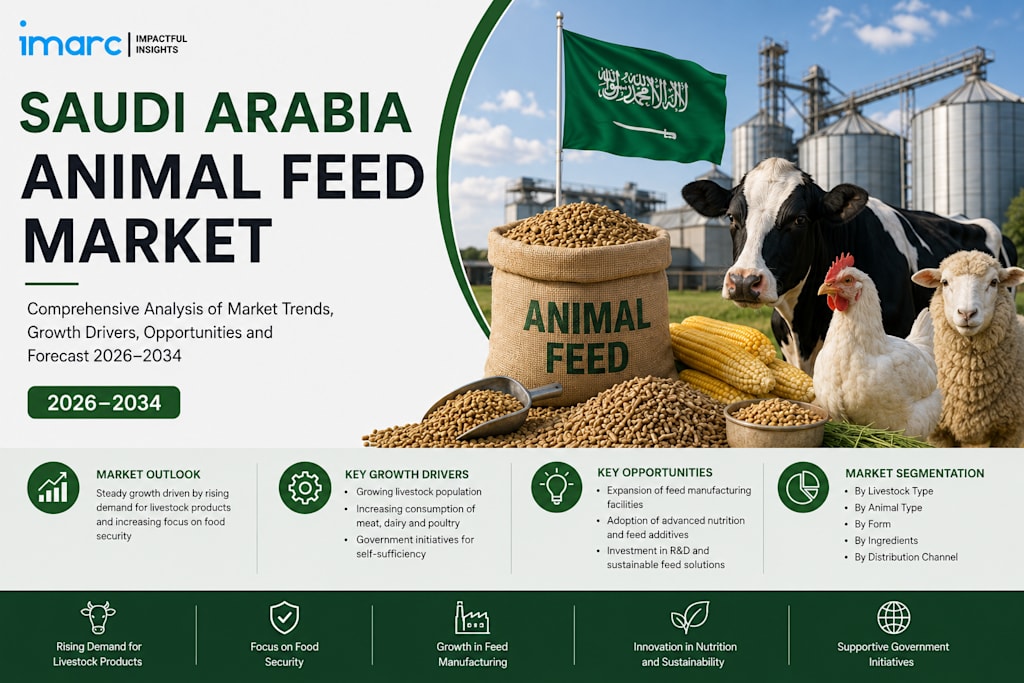
Saudi Arabia’s animal feed market sits at the intersection of two powerful forces: a government that is spending seriously to achieve food security, and a population that is eating more protein than ever before. With domestic poultry production already surpassing 900,000 metric tons and local dairy output reaching 109% of consumption requirements, the livestock sector is expanding fast and feed demand is following. According to IMARC Group’s latest data, The Saudi Arabia animal feed market size was valued at USD 6.86 Billion in 2025. Looking forward, IMARC Group expects the market to reach USD 10.80 Billion by 2034, exhibiting a growth rate (CAGR) of 5.11% during 2026-2034.
The market’s structure reflects a sector in active modernization. Pellets lead by form with a 53.12% share, favored for their superior feed efficiency, reduced wastage, and ease of handling across Saudi Arabia’s extreme climate conditions. Poultry dominates by animal type at 44.24%, underpinned by government self-sufficiency targets and rapidly growing per capita chicken consumption now at 24.3 kilograms. Cereals command the largest ingredient share at 45.45%, with corn and barley forming the backbone of most feed formulations. The Northern and Central Region holds a 40% market share, anchored by Riyadh’s concentration of integrated feed manufacturing and livestock operations. The market spans four forms (pellets, crumbles, mash, others), three primary animal categories (ruminants, poultry, aquaculture), five ingredient groups (cereals, oilseed meal, molasses, fish oil and fish meal, additives), and four geographic regions.
Saudi Arabia Animal Feed Market Growth Drivers:
Rising Meat and Dairy Consumption Fueling Feed Volume Growth
Saudi protein consumption is growing measurably. Poultry meat intake has climbed from 23.7 kilograms per capita to 24.3 kilograms, while beef and veal reached 4.2 kilograms per capita both reflecting a population that is wealthier, more urban, and eating more animal protein than before. The egg sector is producing at 116% of domestic consumption requirements, while dairy output covers 109% of demand. Each of these figures represents a feed consumption equation. As production volumes grow across poultry, dairy, and ruminant operations, the aggregate demand for high-quality compound feed particularly pelleted formulations rises in direct proportion, creating sustained, structural market pull.
Government Agricultural Investment Creating a Structured Demand Foundation
Saudi Arabia’s government is not passively watching the livestock sector grow it’s actively engineering it. The Agricultural Development Fund allocated USD 1.9 billion in 2024 to improve livestock and feedstock production infrastructure. In 2025, the Ministry of Environment, Water and Agriculture finalized 29 poultry sector agreements worth SAR 5 billion, incorporating advanced technologies across production, manufacturing, and marketing. These are not one-off disbursements they are systematic investments in capacity, quality, and supply chain resilience. For feed manufacturers, this government-backed demand base provides a predictable procurement pipeline that de-risks expansion decisions and incentivizes capital allocation into modern feed mill infrastructure.
Poultry Self-Sufficiency Targets Accelerating Vertical Integration
The government’s push toward 80% poultry self-sufficiency has catalyzed a wave of vertically integrated investment across hatcheries, feed mills, and processing plants. Tanmiah Food Company exemplifies this launching a new poultry processing plant in Al Majmaa and a dedicated feed mill in Dahna, adding to an existing network that spans the full production chain. Almarai’s May 2024 signing of five agreements with global poultry companies worth over SAR 500 million signals similar conviction from the private sector. With the Saudi Arabia poultry market projected to reach USD 26.6 billion, and integrated operators controlling their own feed supply, captive feed demand is becoming an increasingly significant and reliable component of market volume.
Saudi Arabia Animal Feed Market Trends:
Aquaculture Expansion Opening a Fast-Growing Specialized Feed Segment
Fish farming in Saudi Arabia is scaling rapidly, with government targets set at 500,000 tons of aquaculture production. Coastal regions are seeing investment in modern fish farming infrastructure equipped with advanced water management and biosecurity systems. This expansion is generating demand for species-specific aquafeed formulations products that require meaningfully different nutrition profiles from traditional ruminant or poultry feeds. Thailand’s November 2025 landmark export of 20,000 tons of pelletized cassava to Dammam port, specifically for the Saudi animal feed sector, captures this momentum well new ingredient sources and new international supplier relationships are forming around a sector with genuine scale ambitions.
Advanced Feed Technology and Nutritional Additives Raising Quality Standards
Feed formulation in Saudi Arabia is getting measurably more sophisticated. Manufacturers are moving beyond basic cereal-and-protein blends toward precision formulations incorporating enzymes, probiotics, amino acids, and feed acidifiers that enhance digestibility and animal health outcomes. Digital monitoring systems are being integrated into feeding programs, letting farmers optimize consumption patterns and reduce waste in real time. Tanmiah Food Company’s achievement of the highest-grade international food safety certification for its poultry facility in 2024 reflects how seriously quality benchmarks are being taken. ANDRITZ’s contract to supply a 90 TPH feed mill to Alwadi Poultry Farms in Riyadh with dual poultry and ruminant production lines is further evidence of significant capital being deployed into state-of-the-art manufacturing infrastructure.
Alternative Feed Ingredients Reducing Import Dependency and Water Pressure
Saudi Arabia’s arid climate and scarce arable land make reducing feed ingredient import dependency both an economic and strategic necessity. Vision 2030’s push for circular agriculture is driving research into locally available alternatives date palm by-products, algae, and food waste streams as viable feed inputs that reduce pressure on water-intensive grain imports. Producers are also adopting precision nutrition approaches that calibrate feed specifications tightly to animal requirements, cutting over-feeding and waste. Government subsidy programs on imported feed grains have historically helped manage cost volatility, but the direction of travel is clearly toward building more domestic ingredient resilience and reducing the market’s exposure to global commodity price swings and shipping route disruptions.
Recent News and Developments in Saudi Arabia Animal Feed Market
November 2025: Thailand achieved a historic milestone by exporting its first-ever shipment of pelletized cassava to Saudi Arabia 20,000 tons of Hard Pellets arriving at Dammam port. The shipment followed a business delegation visit to the region in May 2025 and marks Thailand’s formal entry into the Middle Eastern animal feed sector. For Saudi feed manufacturers, it signals new ingredient sourcing options entering the market and broader diversification of the Kingdom’s feed ingredient supply base.
April 2025: ANDRITZ secured a contract from Alwadi Poultry Farms Company in Riyadh to deliver a high-capacity, comprehensive feed mill designed for both poultry and ruminant production. The facility, expected to commence operations in the first half of 2026, will operate at 90 tons per hour total capacity split across two poultry feed lines (60 TPH) and one ruminant feed line (30 TPH) making it one of the most capable multi-species feed manufacturing sites in the Kingdom.
2025: The Ministry of Environment, Water and Agriculture (MEWA) finalized 29 agreements in the poultry sector with combined investments reaching SAR 5 billion. The initiative is designed to enhance national supply chains and advance the poultry sector by incorporating modern technologies across production, manufacturing, and marketing. The scale of the commitment underscores the government’s resolve to drive poultry toward self-sufficiency while upgrading feed-related infrastructure across the value chain.
Note: If you require specific details, data, or insights that are not currently included in the scope of this report, we are happy to accommodate your request. As part of our customization service, we will gather and provide the additional information you need, tailored to your specific requirements. Please let us know your exact needs, and we will ensure the report is updated accordingly to meet your expectations.
About the Creator
Shubham Sharma
Market research enthusiast sharing insights on global industries, emerging trends, growth opportunities, and data-driven analysis across diverse markets.
Enjoyed the story? Support the Creator.
Subscribe for free to receive all their stories in your feed.
Comments
There are no comments for this story
Be the first to respond and start the conversation.