
Saudi Arabia Air Conditioning Market: Smart Cooling, Energy Efficiency & Mega Infrastructure Growth
How rising temperatures, energy-efficient cooling technologies, and smart climate control systems are reshaping demand, innovation, and long-term growth across the Saudi Arabia Air Conditioning Market, with increasing emphasis on sustainability, indoor air quality, and cost optimization.

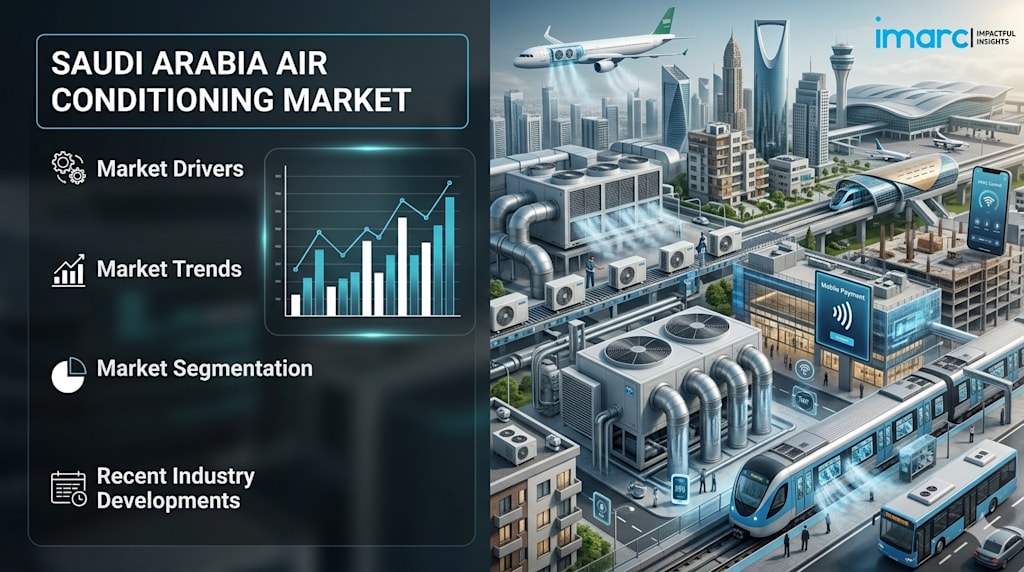
Saudi Arabia Air Conditioning Market Size, Share, Trends and Forecast by
The Saudi Arabia air conditioning market size reached USD 2.7 Billion in 2025. Looking forward, IMARC Group expects the market to reach USD 5.2 Billion by 2034, exhibiting a growth rate (CAGR) of 7.30% during 2026-2034. The market has grown due to policy-led energy efficiency programs, extreme heat conditions, and rising demand from construction and urban expansion. Local production initiatives and consumer upgrade incentives have further supported sustainable product adoption. This has positively impacted the Saudi Arabia air conditioning market share, strengthening domestic competitiveness and long-term market growth.
Air conditioning in Saudi Arabia is not optional, it is infrastructure. With summer temperatures regularly topping 50 degrees Celsius and AC systems accounting for nearly 70% of residential electricity consumption, the market is one of the most structurally resilient in the region. Demand spans residential towers, mega-project hospitality venues, healthcare facilities, and shopping malls. Energy efficiency has become the defining battleground, driven by government mandates, smarter consumer choices, and a construction boom that is adding hundreds of thousands of new buildings across the Kingdom. Major product segments include room and unitary air conditioners, chillers, VRF systems, and coolers, covering residential, commercial, healthcare, and hospitality applications.
Saudi Arabia Air Conditioning Market Growth Drivers:
- Extreme Climate and Non-Negotiable Cooling Demand
Saudi Arabia's climate does most of the selling for this market. Summer temperatures exceed 50 degrees Celsius in parts of the country, and air conditioning accounts for roughly 52% of total national electricity production consumed. That is not a seasonal spike, it is baseline demand that runs for months. This explains why AC penetration is near-universal in urban housing and why replacement cycles are shortening as residents upgrade to inverter-driven and energy-rated units. With over 555,000 new residential units and 275,000 hotel rooms planned under Vision 2030 by 2030, that baseline demand keeps growing every year.
- Vision 2030 Construction Boom Creating Massive HVAC Demand
The construction pipeline tied to Vision 2030 is enormous, and every new building needs cooling systems. Giga-projects like NEOM, Qiddiya, and the Red Sea Project together represent hundreds of billions in construction spending, all requiring purpose-built HVAC installations. The hospitality sector alone is adding 23,000 hotel rooms in Makkah to serve 25 million annual visitors. Infrastructure investment in healthcare, education, and retail is adding further demand. Johnson Controls Arabia responded by launching the Kingdom's first AHRI-certified chiller production line at King Abdullah Economic City in May 2025, right in step with this construction wave.
- Government Energy Efficiency Programs Accelerating Upgrades
Government policy is actively pulling the market forward, not just supporting it. The Saudi Energy Efficiency Center expanded its Estbdal initiative nationwide in September 2024, offering SR 1,000 discounts plus free delivery and installation to push households from old window units to efficient models. Over 350 showrooms and 50 retailers joined the rollout, backed by the National Industrial Development and Logistics Program. In February 2025, SEEC announced a further SR 2 billion expansion to cover commercial HVAC upgrades, bringing 500 retailers on board. When the government subsidizes both the product and the installation, upgrade cycles accelerate quickly.
Saudi Arabia Air Conditioning Market Trends:
- Smart and AI-Powered Systems Becoming the New Standard
Over 40% of new AC installations in Saudi Arabia now include smart technology, from self-learning thermostats to Wi-Fi-enabled remote controls. AI-driven systems analyze occupancy patterns and weather data to cut energy consumption by 20 to 35% compared to conventional units. The National Energy Efficiency Program has committed USD 1.8 billion to accelerate AI-based air conditioning adoption. In Riyadh, HVAC systems are being integrated into centralized building control platforms, and Samsung and Gree both report 35% growth in connected AC sales. Giga-projects like Qiddiya are specifying AI-driven cooling from the design stage, not retrofitting it afterward.
- Local Manufacturing Push Reducing Import Dependency
Saudi Arabia is building domestic HVAC manufacturing capacity rather than staying a pure import market. Basic Electronics Company's Al Asasyah factory in Dammam, a joint venture with Gree, commenced full-scale production of 500,000 smart VRF units annually in March 2025 following a USD 300 million R&D and training investment. The 70,000-square-meter facility includes AI-driven production lines and testing labs. In February 2025, Ceer signed a partnership with Zamil Central Air Conditioners to localize HVAC components for electric vehicles. These moves support Vision 2030's localization targets and build export capacity toward GCC markets by 2026.
- VRF Systems and Energy-Rated Products Taking Market Share
VRF systems are outgrowing other product categories because they solve two problems at once: flexible zone control and meaningful energy savings. They allow simultaneous heating and cooling across different zones, which makes them practical for large commercial and hospitality buildings. Sales of energy-efficient AC units have surged over 40% in just two years. Daikin now offers models using up to 60% less energy than conventional alternatives, and the April 2025 Saudi Green Building Council mandate requires smart AC systems with IoT sensors in all new buildings over 5,000 square meters. That regulation alone will drive sustained demand for premium, efficient products.
Recent News and Developments in Saudi Arabia Air Conditioning Market
• June 2025: The Grand Mosque in Makkah unveiled the world's largest cooling system, built to serve over one million Hajj pilgrims during peak summer heat. The installation underlines Saudi Arabia's commitment to world-class HVAC infrastructure in support of its target of 25 million annual religious tourists.
• May 2025: Johnson Controls Arabia launched the Kingdom's first AHRI-certified air-cooled chiller performance testing laboratory at the YORK Manufacturing Complex in King Abdullah Economic City, Jeddah, alongside its inaugural 600-ton chiller production line, establishing Saudi Arabia as a regional HVAC innovation hub.
• April 2025: The Saudi Green Building Council introduced mandatory energy efficiency standards for all new construction projects exceeding 5,000 square meters, requiring smart AC systems with IoT sensors and predictive maintenance capabilities across NEOM, Red Sea Project, and Qiddiya developments.
• March 2025: Basic Electronics Company's Al Asasyah Advanced Industry factory in Dammam started full-scale production of 500,000 smart VRF air conditioning units annually, backed by a USD 300 million investment in R&D facilities and training centers, with GCC export plans set for 2026.
• February 2025: Ceer signed a partnership with Zamil Central Air Conditioners Co. Ltd. at the PIF Public Sector Forum to localize HVAC components for electric vehicles, supporting domestic manufacturing growth and aligning with Saudi Arabia's broader industrial and energy efficiency goals.
Note: If you require specific details, data, or insights that are not currently included in the scope of this report, we are happy to accommodate your request. As part of our customization service, we will gather and provide the additional information you need, tailored to your specific requirements. Please let us know your exact needs, and we will ensure the report is updated accordingly to meet your expectations.
About the Creator
Faisal Al-Harbi
Market research professional based in Saudi Arabia (KSA), focused on industry trends, market growth, and economic insights.
Writing data-driven articles on Saudi markets, business outlook, and Vision 2030–driven sectors.
Enjoyed the story? Support the Creator.
Subscribe for free to receive all their stories in your feed.
Comments
There are no comments for this story
Be the first to respond and start the conversation.