
Saudi Arabia Agriculture Market Witnesses Strong Growth Through Innovation
How government initiatives to enhance food security under Vision 2030, increasing adoption of precision farming technologies, and growing investments in sustainable irrigation and greenhouse cultivation are driving productivity, innovation, and long-term growth across the Saudi Arabia Agriculture Market.
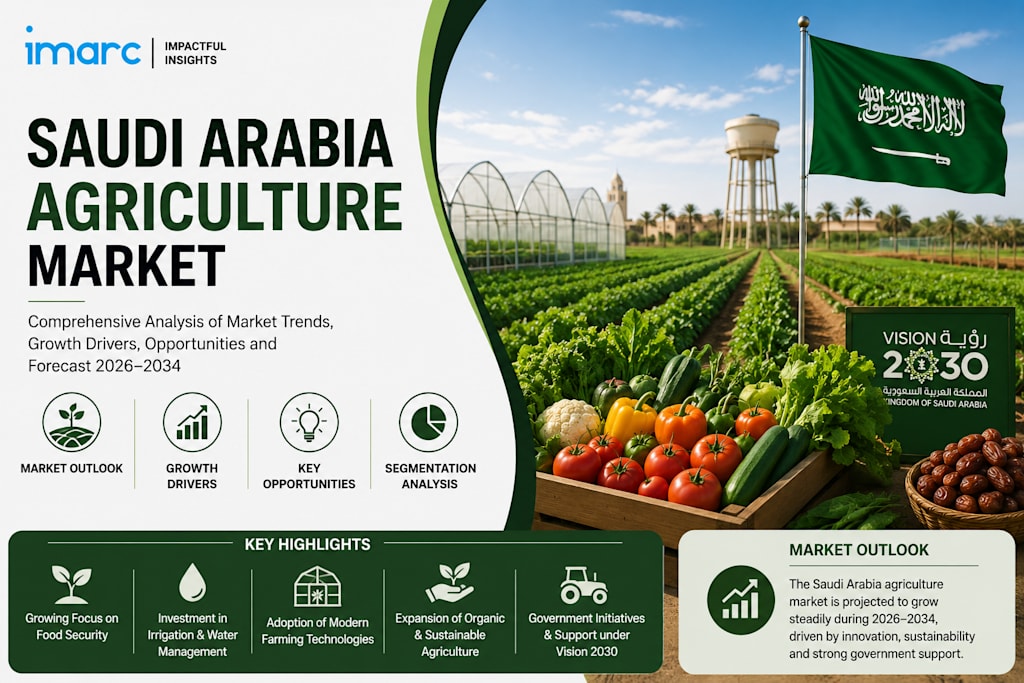
Saudi Arabia's push for agricultural self-sufficiency, driven by Vision 2030, growing domestic food demand, and rapid adoption of precision farming and agritech, is fueling robust expansion across the kingdom's agriculture sector. According to IMARC Group's latest data, The Saudi Arabia agriculture market size reached USD 136.9 Billion in 2025. Looking forward, IMARC Group expects the market to reach USD 212.6 Billion by 2034, exhibiting a CAGR of 5.02% from 2026-2034.
Saudi Arabia's agriculture sector is undergoing a remarkable transformation moving from a resource-constrained, import-heavy model to a technology-driven, food-secure ecosystem. The kingdom produces around 837,000 metric tons of dates annually and has recently made headlines by exporting tomatoes to Europe for the first time, grown using advanced vertical farming and greenhouse technology. Segments including food crops/cereals, fruits, vegetables, and oilseeds and pulses are all seeing momentum, backed by government subsidies, international partnerships, and private investment. The Saudi Agricultural Development Fund (ADF) continues to extend financing to both domestic and foreign agricultural businesses, while public-private partnerships are transforming large-scale farming, food processing, and supply chain infrastructure.
Saudi Arabia Agriculture Market Growth Drivers:
- Rising Demand for Food Security
With over 35 million residents and a heavy reliance on food imports, Saudi Arabia treats food security as a national priority. The government is actively funding projects to boost self-sufficiency in wheat, dates, poultry, and dairy. Strategic stockpiles are being built to buffer against global supply disruptions, while research centers like Estidamah are testing drought-resistant crops such as quinoa, moringa, and millet. These efforts are reducing import dependence while building long-term agricultural resilience for the kingdom.
- Agri-Investments and Private Sector Entry
Private capital and foreign investment are flowing into Saudi agriculture at an accelerating pace, backed by Vision 2030's economic diversification agenda. Public-private partnerships are funding large-scale farming schemes, food processing plants, and cold-chain infrastructure. In a clear signal of market confidence, Saudi agritech startup Arable closed a USD 2.55 million seed round to scale its hydroponic farming systems across arid regions with 90% of funding sourced from international investors. The Saudi Agricultural Development Fund offers low-interest loans to further attract agribusiness players domestically and globally.
- Growing Consumer Awareness of Sustainable and Organic Products
Saudi consumers are increasingly choosing organic, pesticide-free, and locally grown food, driven by rising health awareness and environmental consciousness. Supermarkets are expanding their organic product lines and e-commerce platforms are making sustainable food more accessible across the country. The government supports organic certification programs and provides financial incentives to farmers adopting clean farming practices. Social media campaigns are amplifying the message nudging more producers to shift toward eco-friendly methods and cleaner supply chains to match evolving buyer expectations.
Saudi Arabia Agriculture Market Trends:
- Policy Measures and Support from Government
Saudi Arabia's Ministry of Environment, Water and Agriculture (MEWA) is rolling out a wide range of programs covering subsidized seeds, fertilizers, and advanced irrigation systems. Vision 2030 has made agriculture a pillar of economic diversification, with the National Research Centre Estidamah running active trials on over 10 promising crops. Saudi Arabia and the Netherlands recently finalized investment agreements worth over SR428 million (USD 114 million) to advance agricultural technology transfer and localization a strong sign that policy is matching ambition with real capital commitment.
- Embracing Advanced Agricultural Technologies
From drone-assisted crop monitoring to AI-driven soil sensors, precision agriculture is reshaping how Saudi farmers work. Vertical farms, aquaponics, and hydroponic setups are gaining traction as reliable alternatives to traditional open-field cultivation in the harsh climate. Controlled-environment agriculture is moving from pilot to scale evidenced by Nole Agriculture's 85,000 m² polycarbonate greenhouse under construction in Hail region. Partnerships with international agritech firms and government grants for startups are keeping innovation pipelines active and accelerating deployment of next-generation farming systems.
- Water Management and Irrigation Systems Development
Water scarcity is arguably the biggest constraint on Saudi agriculture, and the kingdom is investing heavily to manage it intelligently. Drip and sprinkler irrigation systems are being deployed at scale, while desalination capacity and treated wastewater reuse programs are expanding alternative water supplies. At the Saudi Water Forum, local and global experts convened to address dam water efficiency, desalination innovation, and integrated water services signaling a coordinated national approach. AI and remote sensing tools are also being used to optimize irrigation scheduling and reduce groundwater overextraction across key farming zones.
Recent News and Developments in Saudi Arabia Agriculture Market
- October 2025: Nole Agriculture began construction of an 85,000 m² polycarbonate greenhouse in the Khotta region of Hail, northern Saudi Arabia, with initial planting scheduled for early 2026. The facility is being developed in partnership with agritech firms Priva and Stolze, signaling continued private sector confidence in controlled-environment agriculture in the region.
- September 2025: Tanmiah Food Company inaugurated two new facilities in central Saudi Arabia an advanced poultry processing plant in Al Majmaa and a modern feed mill in Dahna in the presence of Minister Eng. Abdulrahman AlFadley. The expansion strengthens Tanmiah's vertically integrated food production network and supports the kingdom's food security and job creation goals.
- June 2025: Saudi Arabia and the Netherlands finalized several bilateral agreements and MoUs worth over SR428 million (USD 114 million) to promote the development and localization of modern technologies across environmental, water, and agricultural sectors, reinforcing the kingdom's commitment to international agri-cooperation.
Note: If you require specific details, data, or insights that are not currently included in the scope of this report, we are happy to accommodate your request. As part of our customization service, we will gather and provide the additional information you need, tailored to your specific requirements. Please let us know your exact needs, and we will ensure the report is updated accordingly to meet your expectations.
About the Creator
Shubham Sharma
Market research enthusiast sharing insights on global industries, emerging trends, growth opportunities, and data-driven analysis across diverse markets.
Enjoyed the story? Support the Creator.
Subscribe for free to receive all their stories in your feed.
Comments
There are no comments for this story
Be the first to respond and start the conversation.