
Saudi Arabia Agriculture Market: Food Security Initiatives, Smart Farming & Growth Outlook
How increasing focus on food security, government support under Vision 2030, and adoption of advanced farming technologies are driving productivity, sustainability, and market expansion in the Saudi Arabia agriculture market
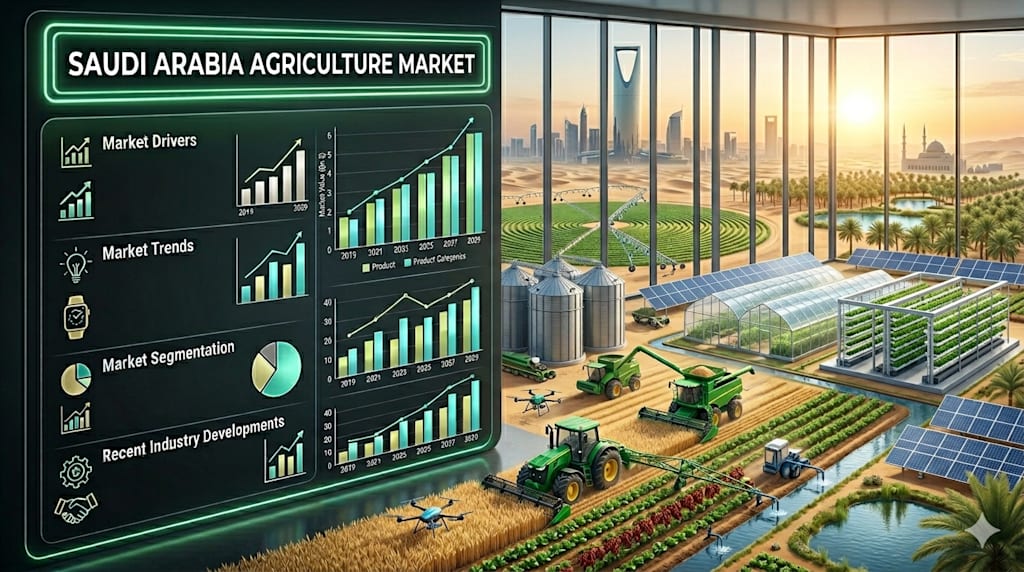
Saudi Arabia is quietly pulling off one of the most ambitious agricultural transformations in the world, and the numbers reflect it. Rising food security priorities, heavy government investment under Vision 2030, and rapid adoption of precision farming technologies are pushing the sector forward at a remarkable pace. According to IMARC Group's latest data, The Saudi Arabia agriculture market size reached USD 136.9 Billion in 2025. Looking forward, IMARC Group expects the market to reach USD 212.6 Billion by 2034, exhibiting a CAGR of 5.02% from 2026-2034.
Saudi Arabia's agriculture sector is undergoing a structural shift unlike anything seen in the region before. What was once heavily reliant on imports and rain-fed cropping is now evolving into a technology-driven, government-backed engine for food self-sufficiency. Vegetables lead the crop mix with 38% of market share, supported by controlled-environment facilities that produce tomatoes, cucumbers, and peppers year-round despite harsh conditions. Dates, poultry, dairy, and aquaculture are also scaling fast, with Saudi Arabia already achieving egg self-sufficiency and targeting a 500% increase in fish production.
Saudi Arabia Agriculture Market Growth Drivers:
Rising Demand for Food Security
• Saudi Arabia imports roughly 85% of its food needs, making domestic production a national priority. The government has set aggressive self-sufficiency targets for wheat, dairy, poultry, and dates, backed by strategic reserve centers to buffer against global supply shocks. The Agricultural Development Fund offers up to 75% financing for greenhouse projects and provides tax holidays of up to 10 years for qualifying agritech investments. In July 2024, Saudi Arabia added five new investment opportunities specifically to fortify food security, including a coffee city project targeting over 150,000 trees and the Al-Ennab Village project focused on fruit and palm cultivation.
Agri-Investments and Private Sector Entry
• Capital is flowing into Saudi agriculture at a scale that would have been hard to imagine a decade ago. In May 2025, the Saudi-Chinese Forum signed 57 agreements worth USD 3.7 billion covering water recycling, agri-tech, and a smart food security city. In April 2025, Brasil Foods committed USD 160 million to a Jeddah poultry plant targeting 40,000 metric tons of annual capacity. Hilton Foods and NADEC formed a joint venture in March 2025 to expand value-added protein offerings. Meanwhile, PIF-backed entities like Green Dunes and Pure Harvest are deploying hydroponic and vertical farming systems that use up to 95% less water than traditional methods.
Growing Consumer Awareness of Sustainable and Organic Produce
• Saudi consumers are increasingly seeking organic, chemical-free, and locally grown food, driven by rising health consciousness and higher disposable incomes. The Kingdom is already the largest natural and organic foods market in the Middle East, valued at USD 54.2 million, with projected growth of 17.4% through 2026. In November 2023, twelve farms in Tabuk completely switched to organic methods using natural fertilizers. The government is reinforcing this shift through subsidies, educational campaigns, and the Ministry of Environment, Water, and Agriculture's SR 4 billion greenhouse expansion plan, which is set to add 430,000 tons of annual agricultural output.
Saudi Arabia Agriculture Market Trends:
Government Policy Measures and Vision 2030 Support
• Vision 2030 is the backbone of Saudi agricultural development, with the government committing over SAR 20 billion annually to modernize the farming sector. The Ministry of Environment, Water, and Agriculture (MEWA) is actively promoting greenhouse farming, hydroponics, and precision cultivation practices. In 2024, the National Research and Development Centre for Sustainable Agriculture (Estidamah) launched research on more than 10 promising crops including quinoa, moringa, stevia, and safflower, targeting self-sufficiency in economically significant produce. These policy-led initiatives are drawing both domestic entrepreneurs and international agribusiness partners into a sector that was previously underinvested.
Embracing Advanced Agricultural Technologies
• Precision agriculture is moving from concept to standard practice across Saudi farms. GPS-guided tractors and autonomous spraying equipment are cutting operational costs by 25-30%, while AI-based crop monitoring catches disease and nutrient stress early. In February 2025, Saudi Arabia completed its largest indoor vertical farming facility in Riyadh, a 20,000-square-meter operation by VFCo, Mowreq Specialized Agriculture, and YesHealth Group, featuring fully automated AI monitoring. The Agricultural Development Fund also launched SAR 2.5 billion in equipment-support programs in August 2025, specifically designed to bring these technologies to smaller farming operations. IMARC Group projects the Saudi Arabia agritech market to reach USD 628.66 million by 2033.
Water Management and Irrigation Systems Development
• With Saudi Arabia's freshwater supply under persistent pressure, smart water management has become a core pillar of agricultural strategy. Drip and sprinkler irrigation systems are widely deployed, and AI-based platforms now use remote sensing to monitor soil moisture and automate water distribution. In 2024, the Saudi Water Forum brought together local and international specialists to advance desalination innovation and integrated water service delivery. Meanwhile, PIF-backed ventures like Green Dunes are proving that vertical farms can operate on 95% less water than conventional fields, offering a replicable model for desert-region agriculture that preserves groundwater for future generations.
Recent News and Developments in Saudi Arabia Agriculture Market
• May 2025: Saudi Arabia and China signed 57 bilateral agreements worth USD 3.7 billion at the Saudi-Chinese Forum, covering water recycling, agri-tech infrastructure, and the development of a dedicated smart food security city, reinforcing China's position as Saudi Arabia's largest trading partner with 18% of total foreign trade.
• April 2025: Brasil Foods S.A. (BRF) committed USD 160 million to build a poultry processing plant in Jeddah in partnership with Halal Products Development Company, targeting an annual capacity of 40,000 metric tons and expected to begin operations in mid-2026 with potential for regional export.
• March 2025: Hilton Foods and NADEC (National Agricultural Development Company) formed a strategic joint venture to expand value-added protein offerings, enhancing the Kingdom's food processing capabilities and strengthening supply chain integration across multiple agricultural sectors.
Note: If you require specific details, data, or insights that are not currently included in the scope of this report, we are happy to accommodate your request. As part of our customization service, we will gather and provide the additional information you need, tailored to your specific requirements. Please let us know your exact needs, and we will ensure the report is updated accordingly to meet your expectations.
About the Creator
Shubham Sharma
Market research enthusiast sharing insights on global industries, emerging trends, growth opportunities, and data-driven analysis across diverse markets.
Enjoyed the story? Support the Creator.
Subscribe for free to receive all their stories in your feed.
Comments
There are no comments for this story
Be the first to respond and start the conversation.