
Saudi Arabia 3D Printing Market: Additive Manufacturing Innovation, Industrial Adoption & Growth Outlook
How increasing adoption of advanced manufacturing technologies, strong government support for industrial diversification under Vision 2030, and growing demand for rapid prototyping, customized production, and lightweight components are driving innovation and investment across the Saudi Arabia 3D Printing Market.

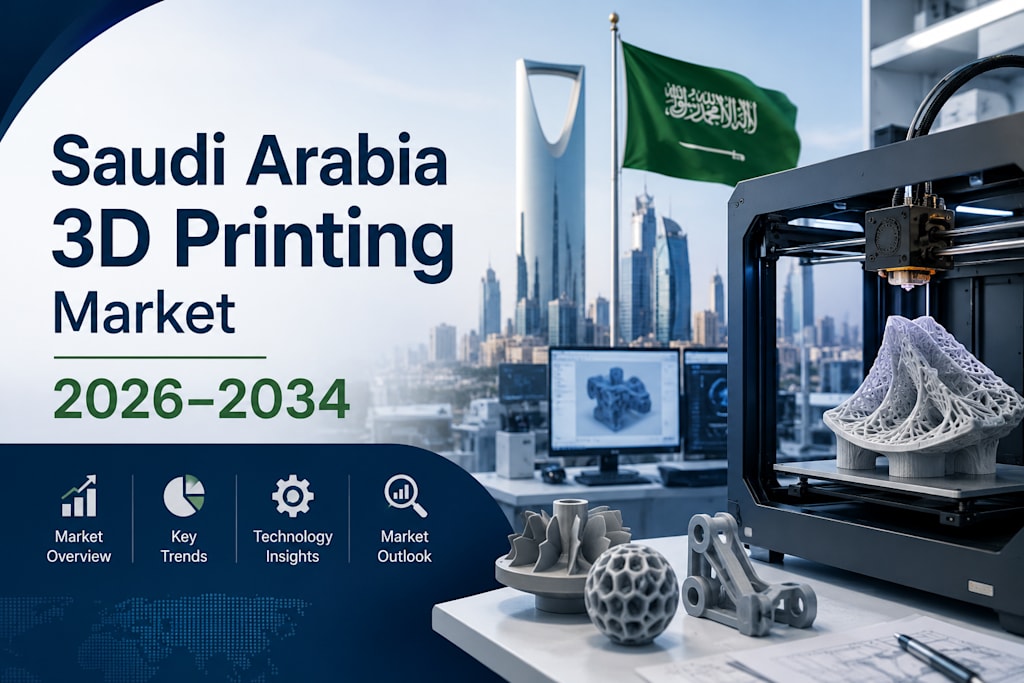
The growing partnerships and collaborations between local and international companies, rising supportive policies and investment from the governing body, and increasing utilization in the healthcare sector are driving demand for 3D printing in Saudi Arabia, supported by Vision 2030 industrial diversification and expanding applications across aerospace, construction, and medical devices. According to IMARC Group's latest data, the Saudi Arabia 3D printing market size was valued at USD 321.6 Million in 2025. Looking forward, IMARC Group estimates the market to reach USD 1,725.5 Million by 2034, exhibiting a CAGR of 20.52% from 2026-2034.
Saudi Arabia's 3D printing market is fast becoming one of the most closely watched segments of the Kingdom's industrial transformation. Additive manufacturing, which builds objects layer by layer from a digital design, is no longer confined to prototyping labs. It's now showing up in aerospace component production, hospital diagnostic equipment, and even full-scale construction projects. With Vision 2030 pushing the country toward economic diversification and technological self-sufficiency, 3D printing has earned a spot as one of the technologies the Kingdom is actively betting on, backed by real partnerships, real investment, and real infrastructure on the ground.
Saudi Arabia 3D Printing Market Growth Drivers:
• Sustainability and Environmental Benefits
Manufacturers are turning to 3D printing as a way to cut waste, lower energy use, and shrink carbon footprints compared with conventional production methods. Unlike traditional manufacturing, which often discards large amounts of raw material, 3D printing uses only what's needed for each part, and leftover material can frequently be recycled for future production runs. With sustainability climbing the priority list for both corporate strategy and government policy in Saudi Arabia, additive manufacturing is increasingly viewed as a practical tool that aligns directly with the Kingdom's broader environmental commitments and resource efficiency goals.
• Government Initiatives and Strategic Investments
Saudi authorities are actively pushing the adoption of 3D printing across healthcare and manufacturing through targeted programs, financial incentives, and partnerships with global technology experts. The Saudi Food and Drug Authority, for instance, has backed initiatives to build diagnostic lab equipment and expand 3D printing capabilities inside hospitals, aiming to cut costs for healthcare institutions while strengthening domestic industry. These investments are helping position the Kingdom as a genuine technology hub, encouraging local skill development and creating room for more competitive, innovative solutions across multiple sectors of the economy.
• Growing Awareness and Industry Adoption
As more companies recognize what 3D printing can actually do, adoption is spreading fast across automotive, healthcare, aerospace, and construction. These industries are leaning on the technology to produce prototypes, replacement parts, and customized products without the expense of molds or lengthy tooling setups. That translates into shorter production cycles and lower operating costs, letting businesses respond faster to shifting market demand. A growing pool of skilled professionals is reinforcing this trend, making additive manufacturing a foundational piece of Saudi Arabia's industrial future rather than a passing experiment.
Saudi Arabia 3D Printing Market Trends:
• Strategic Partnerships and Global Collaborations
Saudi Arabia's growing integration into the global economy is fueling a wave of partnerships between local firms and international technology suppliers. These alliances give domestic companies direct access to advanced printing techniques and specialized expertise, helping them sharpen production efficiency and stay competitive internationally. Beyond technology transfer, these collaborations are encouraging the build-out of modern manufacturing facilities and supporting infrastructure needed to scale additive manufacturing nationwide. The government is actively supporting this momentum through targeted policies, incentives, and financing designed to attract global players while strengthening local technical capabilities.
• Enhancement of Production Efficiency Through Advanced Technology
Businesses adopting advanced 3D printers are seeing real gains in operational efficiency and cost control. The technology allows companies to build digital inventories, producing spare parts on demand instead of holding large physical stockpiles. This cuts lead times and reduces waste tied to traditional molding or tooling methods. A notable example: Saudi Arabia's National Additive Manufacturing & Innovation company acquired advanced printers from 3D Systems to localize energy supply chains for the Saudi Electricity Company, building a digital parts inventory that trimmed both costs and dependency on imported components.
• Demand in Construction and Architecture
3D printing is reshaping how buildings get designed and constructed, enabling intricate architectural forms with better accuracy, reduced labor costs, and faster build schedules. Printing components on-site cuts transportation and logistics overhead, while material waste drops sharply compared with conventional construction. Saudi Arabia made global headlines by completing the world's first 3D-printed mosque in Jeddah, a 5,600 square meter structure blending traditional design with cutting-edge printing technology. As demand grows for distinctive, eco-friendly buildings, additive construction is becoming a genuine option for both private developers and public infrastructure projects.
Recent News and Developments in Saudi Arabia 3D Printing Market
• September 2025: Saudi Arabia's National Additive Manufacturing and Innovation Company (NAMI) partnered with Lockheed Martin to produce 3D-printed aerospace parts locally. The project aims to support Saudi Arabia's Vision 2030 by advancing defense and manufacturing capabilities.
• September 2025: Alfaisal University in Riyadh acquired a LUYTEN 3D construction printer to advance innovation in architecture and sustainability. The printer will help students and researchers explore sustainable construction methods, particularly for low-carbon materials, aligning with Saudi Arabia's Vision 2030 goals for smart construction and urban development.
• July 2025: Saudi Arabia's Pavilion at Expo 2025 Osaka announced a special event to showcase KAUST's groundbreaking 3D printing research for coral restoration, highlighting how the technology is being used to accelerate reef recovery and support marine biodiversity.
Note: If you require specific details, data, or insights that are not currently included in the scope of this report, we are happy to accommodate your request. As part of our customization service, we will gather and provide the additional information you need, tailored to your specific requirements. Please let us know your exact needs, and we will ensure the report is updated accordingly to meet your expectations.
About the Creator
Shubham Sharma
Market research enthusiast sharing insights on global industries, emerging trends, growth opportunities, and data-driven analysis across diverse markets.
Enjoyed the story? Support the Creator.
Subscribe for free to receive all their stories in your feed.
Comments
There are no comments for this story
Be the first to respond and start the conversation.