
Rubidium Market Trends: Atomic Clock Innovations, Telecom Growth & Industry Forecast to 2034
How increasing adoption in atomic clocks, telecommunications infrastructure, and aerospace technologies is driving long-term expansion in the rubidium market

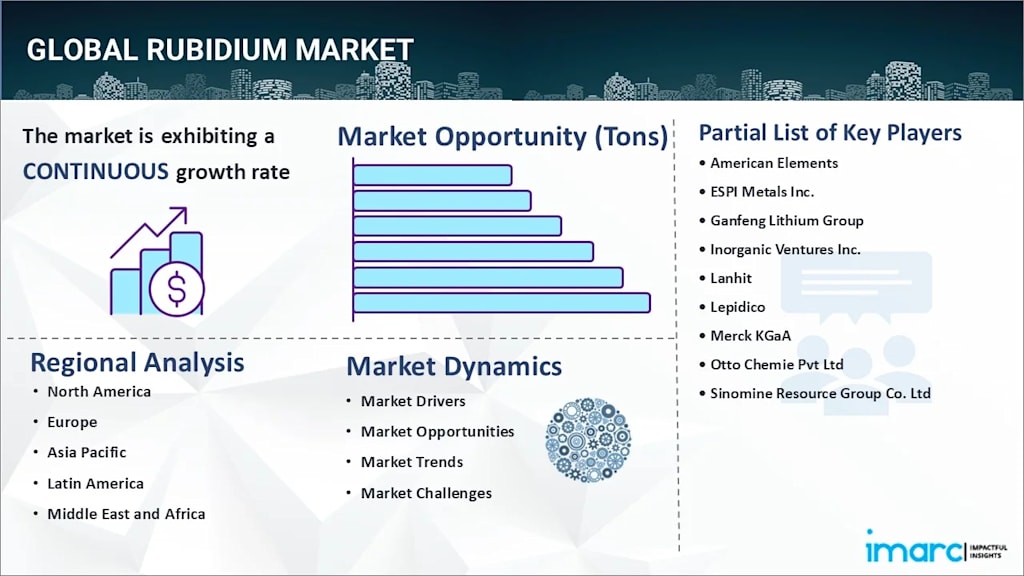
The global rubidium market is experiencing a transformative shift, evolving from a niche specialty chemical into a strategically vital material for next-generation telecommunications and quantum technologies. Driven by its indispensable role in high-precision atomic clocks and fiber-optic stabilization, the industry is witnessing significant investment in co-product recovery from lithium and cesium mining. According to IMARC Group’s latest data, the global rubidium market size was valued at 3.10 Kilo Tons in 2025. Looking forward, IMARC Group estimates the market to reach 4.06 Kilo Tons by 2034, exhibiting a growth rate of 3.02% during 2026-2034.
Rubidium has emerged as a cornerstone of the modern digital infrastructure, facilitating nanosecond-level synchronization required for global 5G rollouts and satellite navigation. Its unique ability to enhance the refractive index in specialty glass makes it essential for the long-distance durability of fiber-optic cables. As the world moves toward quantum-mechanics-based computing, the demand for high-purity rubidium salts and metal is accelerating, pushing the market beyond traditional chemical applications. Major industrial segments include specialty glass manufacturing, biomedical research particularly in myocardial perfusion imaging and frequency-standard oscillators for defense and aerospace sectors.
Rubidium Market Growth Drivers:
- Expansion of 5G and Satellite Infrastructure
The global rollout of 5G networks relies heavily on rubidium atomic clocks to ensure precise timing and synchronization across decentralized base stations. Unlike traditional oscillators, rubidium-based systems offer the stability needed to prevent signal interference in high-density urban environments. With global 5G subscriptions expected to surpass several billion by 2027, the demand for these timing modules is surging. These clocks are also critical for GNSS (Global Navigation Satellite Systems) infrastructure, where they serve as vital backups to ensure continuous positioning data even when primary signals face disruption or jamming.
- Growth in Biomedical and Medical Imaging Applications
Rubidium-82 isotopes are increasingly vital in the healthcare sector, particularly for Positron Emission Tomography (PET) scans used to evaluate heart health and coronary artery disease. Because rubidium behaves similarly to potassium in biological systems, it is rapidly absorbed by active cardiac tissues, allowing for high-speed imaging with minimal patient exposure. The rising prevalence of cardiovascular conditions worldwide is pushing diagnostic facilities to adopt rubidium-based tracers for faster throughput. Research into neurological applications and mood stabilization treatments further expands the metal's footprint, as laboratories utilize rubidium chloride for advanced brain imaging studies.
- Rising Demand for Specialty Glass and Fiber Optics
In the telecommunications sector, rubidium carbonate is a critical additive used to produce specialty glass with reduced electrical conductivity and enhanced durability. This material is essential for fiber-optic preforms, where it stabilizes the glass and controls the refractive index, ensuring that data signals travel long distances without significant loss. As subsea cable projects and terrestrial broadband expansions accelerate to meet global data traffic needs, the reliance on rubidium-doped glass increases. Beyond optics, these specialty glasses are utilized in night-vision devices and lidar systems for autonomous vehicles, where optical clarity and stability are non-negotiable.
Rubidium Market Trends:
- Strategic Shift Toward Co-Product Recovery Innovations
Since rubidium is rarely mined as a primary mineral, industry leaders are focusing on improving extraction yields from lepidolite and pollucite during lithium and cesium refining. Innovations in acid-leaching and roasting processes allow refiners to capture rubidium without the need for standalone capital expenditure. For instance, recent lithium projects in Canada and Australia have integrated rubidium recovery circuits to capitalize on the high value of rubidium carbonate, which can trade at over USD 1,000 per kilogram. This trend is creating a more resilient supply chain by diversifying production away from historically concentrated geographic regions.
- Integration in Quantum Computing and Cold-Atom Research
The race for quantum supremacy is positioning rubidium as a primary candidate for "qubit" development. Scientists use ultracold rubidium atoms in vacuum chambers to create highly stable environments for quantum calculations. This academic and commercial research is moving from theoretical stages to pilot-scale developments, increasing the consumption of high-purity rubidium metal. Government-backed quantum initiatives in North America and Europe are providing significant funding for these technologies, viewing rubidium as a "critical mineral" necessary for national security and future computing architectures, which is fundamentally changing the market's long-term demand profile.
- Miniaturization of Atomic Clocks for Defense and Aerospace
There is a growing trend toward the development of Chip-Scale Atomic Clocks (CSAC) that utilize rubidium to provide high-precision timing in a compact form factor. These miniaturized devices are being integrated into defense drones, missile guidance systems, and underwater sensors where traditional GPS signals cannot reach. By reducing the power consumption and size of rubidium clocks, manufacturers are making them viable for portable electronics and tactical military gear. Recent defense contracts have highlighted the need for autonomous "timing-holdover" capabilities, ensuring that critical systems remain synchronized even in GPS-denied environments during complex operations.
Recent News and Developments in Rubidium Market
- April 2026: Panther Minerals Inc. successfully finalized the acquisition of the Rubidium Ridge pegmatite project in Ontario, Canada. This move is designed to fast-track exploration in a high-prospectivity district to secure a domestic supply of rubidium for the North American electronics industry.
- January 2026: Sinomine Resource Group expanded its processing capacity at the Tanco mine to optimize the recovery of rubidium salts. This expansion responds to the tightening global supply and the increasing reliance on pollucite-based minerals for high-purity industrial applications.
- February 2026: A leading aerospace consortium initiated a collaborative project to integrate rubidium-based frequency standards into the next generation of low-earth orbit (LEO) satellite constellations, aiming to improve global synchronization for autonomous maritime navigation.
Note: If you require specific details, data, or insights that are not currently included in the scope of this report, we are happy to accommodate your request. As part of our customization service, we will gather and provide the additional information you need, tailored to your specific requirements. Please let us know your exact needs, and we will ensure the report is updated accordingly to meet your expectations.
About the Creator
Andrew Sullivan
Hello, I’m Andrew Sullivan. I have over 9+ years of experience as a market research specialist.
Enjoyed the story? Support the Creator.
Subscribe for free to receive all their stories in your feed.
Comments
There are no comments for this story
Be the first to respond and start the conversation.