
Robotic Welding Market Is Headed for $29.9B — Here's Why
Skilled welder shortages and AI-adaptive robots are pushing a $9.7B industry into its fastest growth decade.
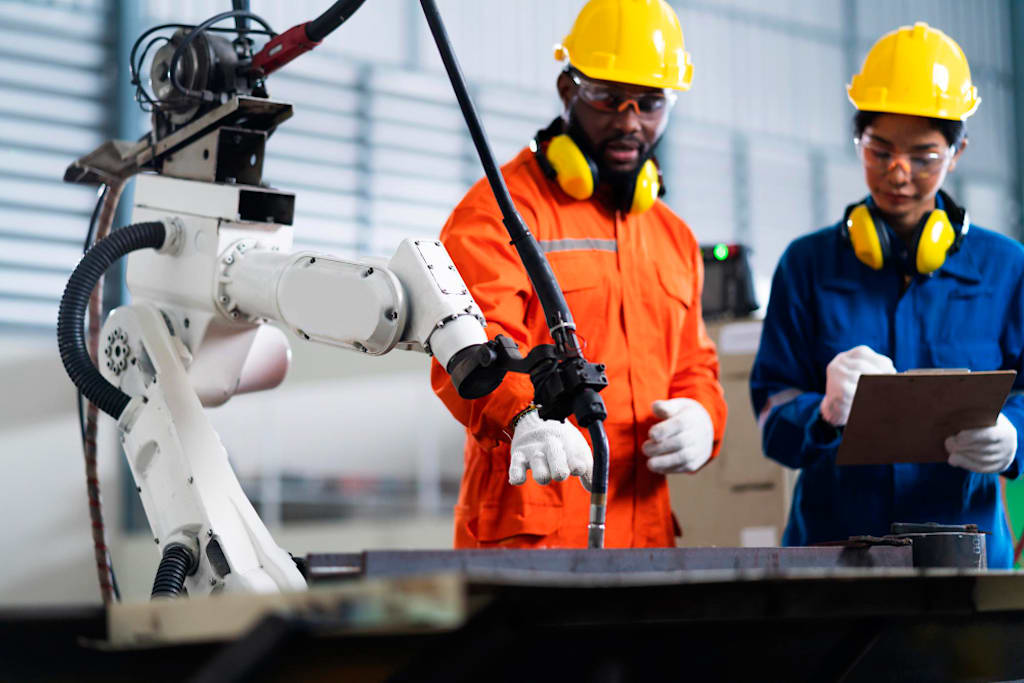
The Welder Who Never Clocks Out
Walk through any modern automotive plant and the scene is the same: orange robotic arms swinging in choreographed arcs, throwing showers of sparks against steel in near-total silence from a human standpoint. No breaks, no fatigue, no variance between the ten-thousandth weld and the first. The Robotic Welding Market size reflects exactly how far this shift has gone — valued at $9.7 billion in 2025, it is forecast to reach $29.9 billion by 2035, growing at a compound annual rate of 11.9%. The industry is no longer automating at the margins. It is replacing entire categories of manual labor at the core of global manufacturing.
Detailed figures on robot types, regional deployment, and end-use industry breakdowns are available in this robotic welding industry research overview.
Where the Numbers Come From
The automotive sector accounts for nearly half of all robotic welding deployments — 48.7% by industry share. A single vehicle body requires thousands of individual welds, and that number is rising as electric vehicle platforms introduce more aluminum-intensive structures and battery enclosures. Aluminum is lighter but trickier to join than conventional steel; robotic systems maintain the precise parameters the process demands at a volume and consistency that human welders cannot match across a production shift, let alone a continuous operation.
Asia Pacific commands the largest regional share at 47.8%, a position anchored almost entirely by China's concentration of automotive OEMs, electronics manufacturers, and shipbuilders. Japan and South Korea add manufacturing depth through their own robotics ecosystems and export-driven heavy industry. State-backed industrial policies accelerate the timeline — China's Manufacturing 2025 initiative and Germany's Industry 4.0 framework both channel capital directly toward factory automation infrastructure, compressing what might otherwise be decade-long adoption curves.
A Labor Crisis the Market Did Not Create
There are not enough certified welders. That sentence alone explains a significant portion of the demand driving this sector. In North America, Europe, and parts of Asia, skilled welder wages have risen steadily while training pipelines fail to replace those exiting the workforce. A robotic welding cell that runs overnight without supervision — producing output equivalent to multiple manual shifts — generates a return on investment within two to three years for most mid-size fabricators. The math has become difficult to ignore.
The efficiency gap is real. Robotic systems in fabrication environments achieve arc-on time approaching 90–100%, compared to roughly 30% for a manual welder who must reposition, rest, and inspect between passes. For manufacturers paying premium wages to a shrinking skilled workforce, that gap translates directly into cost pressure.
AI Enters the Weld Cell
The more consequential shift may be what is happening inside the robots themselves. Path Robotics, a U.S. company focused on autonomous welding systems, launched its Obsidian AI model in September 2025 — trained on tens of millions of welded inches and designed to adapt weld parameters in real time without requiring reprogramming for each new component. The company surpassed $100 million in bookings for autonomous robotic welding systems, signaling that demand has moved well past pilot programs and into full procurement cycles.
This is the development that expands Robotic Welding Market growth beyond the automotive assembly lines where the technology first took hold. High-mix, low-volume job shops — the fabricators handling diverse parts across short production runs — historically could not justify automation because every new part required dedicated programming. AI-adaptive systems remove that barrier. A University of North Dakota doctoral dissertation published in 2025 found that cobotic welding in high-mix environments reduced cycle time by 39% compared to manual processes. Weld strength improved too, with cobotic joints testing 13.5% to 37% stronger than their manually produced equivalents.
The Constraint That Persists
None of this expansion is without friction. A complete robotic welding cell — robot arm, power source, fixturing, safety infrastructure, programming software — carries upfront costs that remain prohibitive for smaller fabricators. Integration into existing facilities adds months to payback calculations. Maintenance represents its own hidden cost: research published in Frontiers in Robotics and AI found that maintenance-related issues accounted for 79% of total downtime in robotic welding machines at one automotive supplier, with financial losses over a three-year period reaching the equivalent of millions of dollars. Technology adoption rarely travels in a straight line.
The Next Decade
The convergence of AI-guided programming, collaborative robot designs that eliminate the need for safety enclosures, and government industrial policies funneling capital into smart factory infrastructure points toward an industry in the early stages of a structural expansion rather than a cyclical uptick. When a technology simultaneously addresses a labor shortage, a quality compliance requirement, and an energy efficiency mandate — cobotic welding reduced energy consumption by 41–71% in certain applications compared to manual processes — the adoption argument stops being a question of if and starts being a question of how fast existing manufacturing capacity can absorb it.
About the Creator
Mark K. Belton
I’m Mark K. Belton, 26 years old, currently working as a Digital Marketing Intern. I have a strong interest in digital marketing and have been developing my skills in SEO, social media marketing, content creation, and online campaign
Enjoyed the story? Support the Creator.
Subscribe for free to receive all their stories in your feed.
Comments
There are no comments for this story
Be the first to respond and start the conversation.